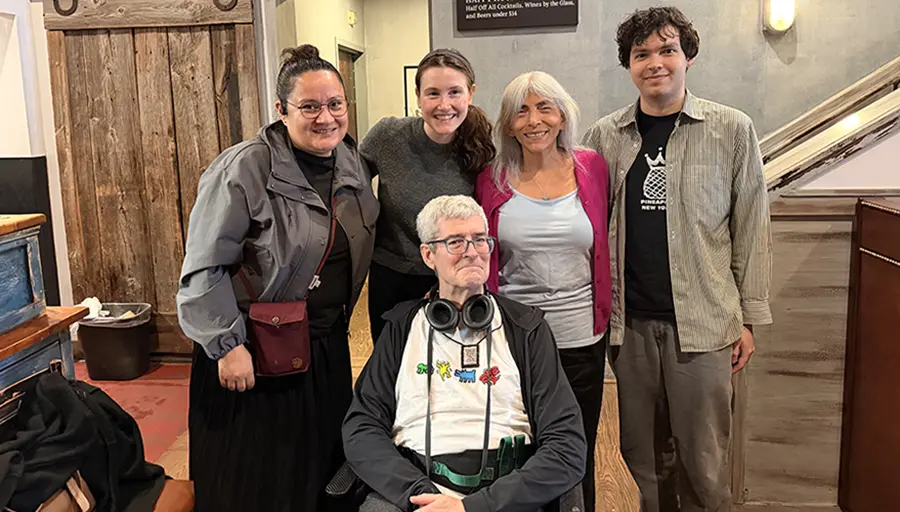














Jack Humburg, Pamela Williamson, and Barry A. Whaley from the Southeast ADA Center
Many people have questions about using medical marijuana (cannabis) and the Americans with Disabilities Act (ADA), a federal law. Marijuana use is legal in many states, and sometimes it is prescribed for medical use. With ongoing changes in drug laws at the state and federal level, people with disabilities who use medical marijuana may have questions about how this affects their rights and what their legal protections are in work, housing, and health care access. The Southeast ADA Center, part of the ADA National Network, has been studying these issues, especially as they relate to the ADA.
Products & Services

Background
In 1970, the Controlled Substances Act defined marijuana as a Schedule I substance, with “no currently accepted medical use and a high potential for abuse,” and therefore illegal under federal law. However, over the last 20 years, 38 states have adopted their own medical marijuana laws in response to patient advocacy, emerging research, and public opinion.
In December 2025, President Donald Trump directed U.S. Attorney General Pam Bondi to expedite the reclassification of marijuana under the Controlled Substance Act of 1970. On April 23, 2026, Acting U.S. Attorney General Todd Blanche officially signed the order reclassifying certain categories of marijuana from Schedule I to Schedule III (defined as substances “with a moderate to low potential for physical and psychological dependence”). Specifically, the reclassified categories were products approved by the U.S. Food and Drug Administration (FDA) and state-licensed medical marijuana production and distribution. Other forms of marijuana remain on Schedule I.
While the change in classification signals a shift in federal policy and acknowledges marijuana’s accepted medical use and lower potential for abuse, marijuana remains illegal under federal law in key aspects. It does not automatically change employment protections, interpretation of the ADA, or U.S. Department of Housing and Urban Development (HUD) housing restrictions. Executive action cannot amend statutory law. Only an act by Congress can do that.
Medical marijuana policy in the United States reflects a fragmented legal landscape shaped by competing state and federal authorities, not health science. Although medical marijuana has been legalized by most states across the country, the federal government still classifies it as a controlled substance. This has created a dilemma for those who rely on the employment protections provided by the ADA and housing under HUD. Federal law overrides state law, limiting the right to disability accommodations and housing protections for medical marijuana users, despite growing scientific evidence of marijuana’s therapeutic value.
The conflict extends beyond criminal enforcement and directly affects civil rights protections, employment practices, housing eligibility, and access to federally funded programs. People who use medical marijuana lawfully may still face adverse employment actions, denial of housing, and access to federally funded programs.
Products & Services


The ADA, Employment, and Marijuana Use
The first section of the ADA, known as Title I, prohibits discrimination against qualified individuals with disabilities and requires employers to provide reasonable accommodations, unless it would cause the employer undue hardship. However, the ADA explicitly excludes individuals who currently engage in the illegal use of drugs. Because marijuana remains illegal under federal law, the courts have consistently held that medical marijuana falls within that exclusion. As a result, employers do not have to accommodate employees under the ADA who are lawfully registered under a state medical marijuana program.
Evan’s Story
Evan applied for a job as a peer specialist helping people who are transitioning from jail or prison to settle back into the community by assisting with finding a job and getting health care. During Evan’s interview, they disclosed that they used medical marijuana for a disability and a drug test would be positive for THC, the psychoactive compound in marijuana. The company extended the job offer and gave them a start date. The day that Evan was supposed to start work, they were told that the job offer was withdrawn because of their current medical marijuana use.
The ADA states that a person who is currently using drugs illegally is not considered a qualified individual with a disability and therefore is not protected by the ADA. In addition, testing for illegal use of drugs is not considered a medical examination, so the ADA does not restrict when an employer can test for the use of illegal drugs.
However, a question arises when state law allows for the use of medical marijuana. Under the ADA (42 U.S.C. § 12111(6)(A) (Americans with Disabilities Act of 1990, Title I, § 101(6)(A)), “the term illegal use of drugs means the use of drugs, the possession or distribution of which is unlawful under the Controlled Substances Act (21 U.S.C. 812).” However, this definition does not apply to someone who is taking a controlled substance legally, for example, under a doctor’s supervision or as otherwise permitted by federal law.
While medical marijuana can be legally prescribed under most state laws, its use is still illegal under the federal Controlled Substances Act. Although the use of medical marijuana is legal under state law, and is prescribed by a medical provider, its use is not protected under the ADA. However, the underlying disability that the person is taking the medical marijuana for may still qualify a person for employment protections under Title I of the ADA.
While the ADA does not protect medical marijuana itself, it does protect individuals with underlying disabilities like depression, glaucoma, chronic pain, and anxiety. For example, an employee with severe chronic pain, who uses medical marijuana outside of work, may still be entitled to schedule modifications or remote work, if it does not pose an undue hardship to the employer. Employers cite workplace safety as a concern when evaluating accommodation requests involving medical marijuana for positions like commercial driving, operating heavy equipment and emergency services.
Products & Services


State Laws
Some states provide broader disability protections than federal laws like the ADA. New York treats certified medical marijuana patients as having a disability under state law and requires employers to consider reasonable accommodations. Arizona similarly restricts adverse employment action based solely on a positive drug test when there is no evidence of impairment at work.
By contrast, Florida law allows employers to enforce drug-free workplace polices without accommodation for medical marijuana use. Federal contractors and safety-sensitive employers remain subject to strict federal requirements, including the U.S. Department of Transportation regulations and the Drug-Free Workplace Act, for positions like drivers, railroad engineers, pilots, and public transit operators.
U.S. Department of Housing and Urban Development
HUD prohibits all marijuana use, medical or otherwise, in federally funded housing. Under the Quality Housing and Work Responsibility Act of 1998, Public Housing Agencies must deny admission to applicants who use controlled substances that are illegal under federal law. They state there is no discretion, and only a change in federal law would allow them to lease to medical marijuana users.
These restrictions disproportionally affect low-income individuals, seniors, and people with disabilities, who are significantly more likely to rely on HUD-assisted housing programs and who may also use medical marijuana for symptom management. This creates substantial inequity and public health concerns.
Federal Enforcement Policy
Federal enforcement policy has largely been shaped by prosecutorial discretion. The 2013 Cole Memorandum, issued by U.S. Deputy Attorney General James Cole, instructed federal prosecutors to deprioritize enforcement against state-compliant marijuana activity. The U.S. Department of Justice (DOJ) rescinded the policy in 2018 by Jeff Sessions during the first Trump administration, but its enforcement has remained limited and prosecutions remain uncommon.
The DOJ, under President Biden, formally initiated a change to the Controlled Substances Act that would reschedule marijuana from a Schedule I to Schedule III. That action reflected an increased federal recognition of marijuana’s therapeutic potential, and eased restrictions on research, prescribing and regulatory oversight. With certain categories of marijuana (FDA approved products and state-licensed medical marijuana) being reclassified to Schedule III in April 2026, while other forms of marijuana remain on Schedule I, the approach the DOJ will use going forward is still unknown.
Products & Services


Summary
While the change signals a shift in federal policy and acknowledges marijuana’s accepted medical use and lower potential for abuse, marijuana remains illegal under federal law in key aspects. It does not automatically change employment protections, ADA interpretation, or HUD housing restrictions. Only an act by Congress can make those changes.
The conflict between state legalization and federal prohibition creates uncertainty for individuals, employers, and housing providers. Comprehensive reform will require congressional action to formally reschedule marijuana, regulatory updates, and clear federal guidance for employers and housing providers to restore equity and provide protections for medical marijuana users under the ADA.
Do You Have an ADA Question?
Contact your regional ADA Center by calling us at 800 • 949 • 4232 or send us a message at www.adata.org/contact-us.