













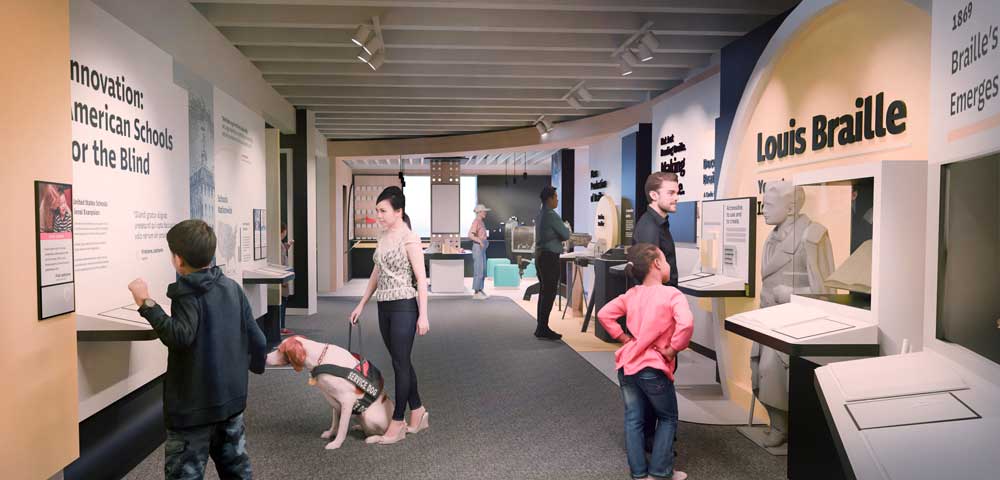
The American Printing House for the Blind (APH) is preparing to open the doors to The Dot Experience, a facility spanning approximately 28,000 to 30,000 square feet designed to be the world’s most inclusive museum. Located at the APH headquarters in Louisville, Kentucky, the initiative marks a significant expansion of the organization’s mission, which has served the educational needs of blind and low-vision children since 1885. Jo Haas, the Chief Operating Officer of APH, and Cynthia Torp, the CEO of the design and build firm Solid Light, Inc., are spearheading the project to create a public space that serves as a catalyst for conversations regarding disability, barriers and human-centric storytelling.
Origin and Inclusive Philosophy
The project originated from a convergence of physical plant needs and a conversation with the American Foundation for the Blind regarding the stewardship of the Helen Keller Archives. This led to an envisioned model of inclusivity that avoids “othering” visitors. Haas noted that the team started to imagine what the world’s most inclusive museum might look like while upholding a company mantra to “welcome everyone”.
Haas described the fundamental questions that drove the project’s inception: “You know, if we took that idea of making the world a better place for everyone and creating a welcoming museum environment in the spirit of the company, our company sort of mantra of welcome everyone… What would that model museum of inclusivity look like? What would it feel like and how would it work?”. Rather than treating accessibility as a secondary feature, the facility is designed from floor to ceiling with the goal of fostering independent, autonomous experiences.
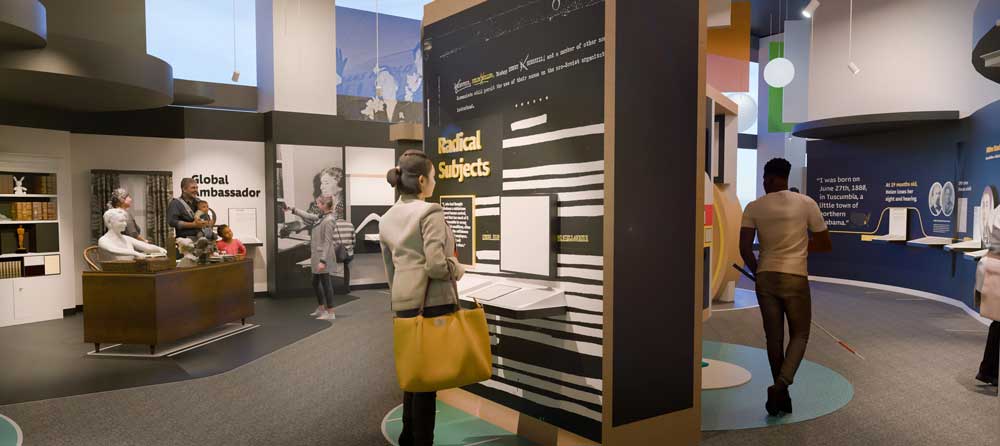
Torp emphasized the rigorous nature of the design process, stating that for far too long, public venues have just done the minimum. “We have also challenged ourselves the whole time to test all our assumptions,” Torp said. The design team utilized an inclusive prototyping group to ensure the museum’s solutions, including tactile experiences, soundscapes and multisensory exhibits, to communicate effectively to the broadest possible audience. Torp explained that the goal is to provide a “really great example to the world of how to change people’s perspectives about blindness and empower individual action toward a world that welcomes everyone”.
Products & Services

Exploring the Galleries
The Dot Experience is organized into three primary galleries that explore human identity, history and technological progress. The first gallery, titled “Who We Are,” focuses on “individual stories and celebrating individuals who are blind or low vision and their achievements in the world”. Narratives are delivered through anchor media pods designed for physical comfort, light levels and acoustic clarity.
Haas explained that these stories provide a “full, well-rounded 360° view of individuals,” noting that “we’re not shying away from talking about struggles, which we know exist, biases, barriers, all of those things”. The selection process for these narratives was highly intentional. “So, the thing that we’ve attempted to do in the selection of these first-person stories was identify people of all kinds of cross-sections,” Haas said, noting they looked beyond gender to include diverse jobs, ages and various ways individuals came to their blindness. Featured individuals include Chris Downey, whose story is featured in a media pod regarding living and working. “Chris Downey is an architect. He went into surgery for a brain tumor as an adult and woke up with no sight,” Haas said.
The second gallery houses the Helen Keller Archives, which includes her personal correspondence, scrapbooks and travel artifacts. To ensure these items are accessible, the museum uses tactile replicas mounted in the same orientation as the original objects. Haas described the use of “materiality swatches” developed by the prototyping team to offer the “real material” of an object, such as a wooden walking stick with inlaid mother of pearl, ensuring visitors understand the textures without information overload.
The third gallery, known as the “Breakthrough Gallery,” focuses on innovations that ensure everyone can live equitably. This area features hands-on experience with educational tools APH provides to students across the country. It includes collaborations with the LEGO Foundation for building with Braille Legos and a Microsoft gaming area for inclusive gaming experiences. Visitors can also explore tactile packaging innovations, such as shampoo bottles developed by Procter & Gamble.
Designing for Every Body and Mind
While the museum has a specific focus on blindness and low vision, its commitment to inclusivity encompasses a vast range of human diversity, including neurodiversity and mobility. Haas noted that the design team considered a variety of body types, including individuals of larger or shorter stature. For those with mobility issues, the museum provides a higher standard of access than traditional requirements. “If you’re in a wheelchair often, it’s called accessible even if you have to come up to it from the side. And in our case, we have ensured equal front access to everything,” Haas said.
The facility also addresses neurodiversity by managing cognitive load through intentional design. This includes the provision of a quiet room and careful attention to light levels, sound and the minimization of sound bleed. Haas explained that even Braille served as a “limiter” to prevent overwhelming visitors with too much text, helping to manage cognitive load for all guests.
This inclusive philosophy extends to the retail space, where the team is working to create “the world’s most inclusive retail experience”. This involves reimagining how items are priced, labeled and organized. Haas noted that the goal is to ensure “everybody knows where everything is and everybody can get access to it,” preventing the frustration of searching through unorganized inventory.
Products & Services


Authentic Engagement vs. Fear-Based Simulation
A core philosophy of the museum is the rejection of “blindness simulations” or blindfolds, which Haas noted can inadvertently introduce fear. Haas explained, “we’ve very intentionally not done that because most of the individuals who we have talked to about that very question really don’t want to introduce any more fear into the concept of being blind”. She elaborated that for many sighted individuals, blindness is one of the disabilities they fear most, and the museum seeks to avoid reinforcing that perspective.
Instead, the museum fosters understanding through direct engagement with tools and environments. Visitors can explore a cane navigation interactive to “understand how someone who is blind may be using their sense of touch, their sense of sound,” touch a piano played by Stevie Wonder and use various magnifier technologies. By experiencing the world as these individuals do—focusing on commonalities and specific ways of interpreting the environment—the museum aims to create a sense of common humanity.
Multiple Layers of Accessibility
To achieve this level of autonomy, the museum relies on a series of overlapping accessibility systems that ensure information is never limited to a single sense. For example, every object that must remain behind glass is accompanied by a tactile replica, meaning nothing is off-limits to the sense of touch. Orientation areas allow visitors to familiarize themselves with the specialized flooring used for navigation and the universal keypad system that operates every multimedia piece throughout the galleries.
Furthering this multisensory approach, every written word in the building includes a Braille companion, and all text is available through text-to-speech technology. Visual elements are not overlooked; every image and artifact is paired with a visual description. Haas emphasized that the ultimate goal is to “welcome everyone into the space in a way that doesn’t force someone to rely on somebody else to interpret their experience, but where they can have their own autonomous, independent experience”.
A Vision for the Future
The Dot Experience is scheduled to open on October 30, 2026. It joins a roster of prominent Louisville attractions and is expected to draw regional, national and international tourists. Beyond serving as a destination, the project aims to provide a blueprint for other institutions to follow. Haas reflected on the personal impact of the project, noting, “I can tell you today that I truly did not think about inclusion and access in anywhere close to as comprehensive a way as I do now”.
Products & Services
By combining inclusive multimedia systems with intentional community consultation, APH and Solid Light hope to spark a sea change in how public spaces accommodate and celebrate the diversity of the human experience. Haas noted that many visitors, after learning about the project, realize “I never really thought about that,” highlighting the museum’s role in challenging unconscious biases. Torp concluded that this has been “by far the most impactful project that I’ve worked on with my team,” and the team remains dedicated to creating future visitor experiences that “work very hard to accomplish this idea of welcoming everyone”.