






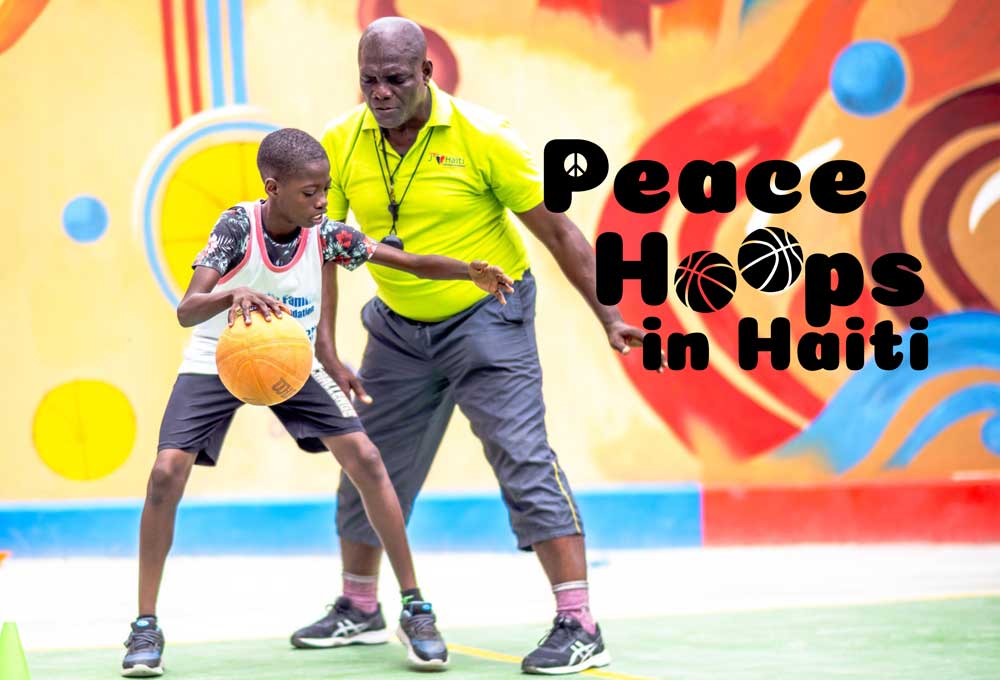
It’s a typical Saturday in the Panye Lapè (Creole for “Peace Hoops”) youth basketball program. Preteen and teen-aged boys and girls line up for a drill that involves dribbling around orange cones and shooting layups under the watchful eye of their coach. It’s a normal scene occurring on playgrounds throughout the world, except this is Haiti, a country suffering through horrific gang violence since the assassination of its President in July of 2021.
The program is run by Fondation J’Aime Haïti (I Love Haiti Foundation), a Haitian non-profit whose executive director, Gérald Oriol, Jr. has been featured five times in ABILITY Magazine for his work as Haiti’s twice-appointed Secretary of State for the Integration of Persons with Disabilities. Oriol, who has spinal muscular atrophy, left office a year before the assassination of President Jovenel Moise, an event that created a political vacuum in the Caribbean island nation of twelve million and allowed a coalition of gangs known as Viv Ansam to take control of an estimated 90% of the capital city, Port-au-Prince. Roughly 1.4 million Haitians are displaced, and thousands have died due to gang violence. A handful of communities in and around Pétion-Ville have armed themselves and set up roadblocks and check points, to create a ‘safe zone’ within the capital’s metropolitan area.
Gang violence has had a major impact on the Peace Hoops program, which operates in Canot, Bourdon, and Cité Meriken, three disadvantaged neighborhoods within the safe zone but near gang-controlled territories. Gunfire is a common occurrence during weekend practices. According to Edrice Dely, site manager for Cité Meriken, “people in the community have observed bullet impacts on a wall near the court and in other areas of the neighborhood. There was even an incident in which a child was struck by a stray bullet while inside her home, which deeply affected everyone.”
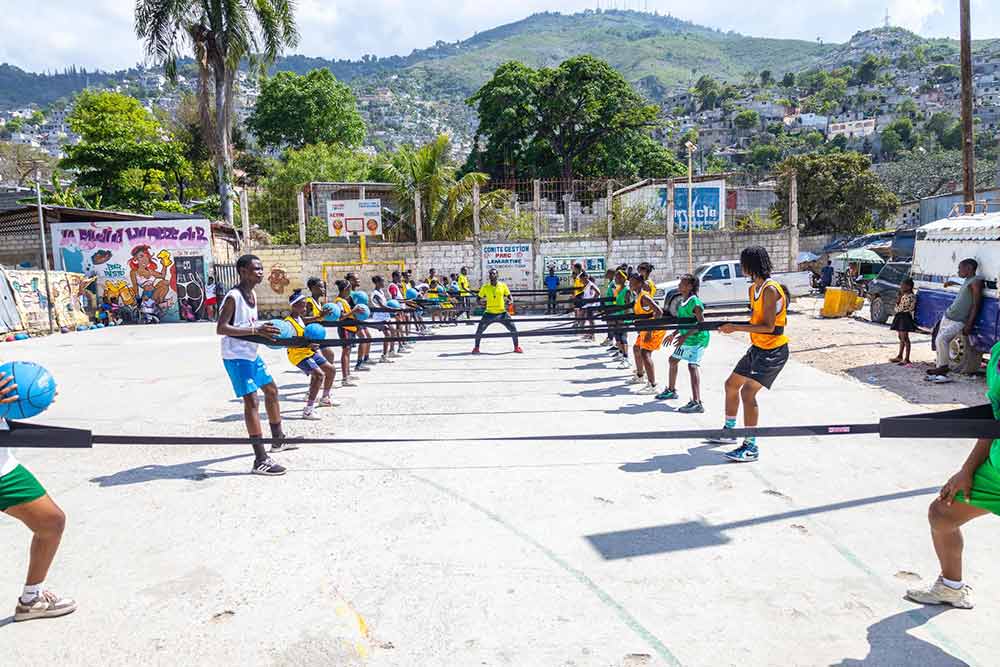
Hubert Dorléan is one of three coaches in the Peace Hoops program. He has been coaching basketball in Haiti for 32 years. When asked about the gang violence, Coach Hubert says, “this situation has destabilized everything in the country, and it affects the children, as well. They are afraid and do not live well.” Hubert’s coaching philosophy is that his players—whether in private high schools or Peace Hoops—”must be strong, be fighters, and be very competitive.”
“When the gangs start shooting, the children lose focus,” Coach Kency Milien adds. Kency grew up in Bristou, a disadvantaged neighborhood in Pétion-Ville. He discovered his love for basketball at a young age when some kids set up a hoop near his home. He spent hours playing barefoot on the Bristou court. Kency went on to play high school basketball at Collège InterFamilia and for the Ballers Club before reaching the pinnacle of the sport in Haiti, playing point guard for the national team in 2011 and 2012. In addition to coaching at Saint-Louis Gonzague, a private high school in Delmas, Kency coaches for Peace Hoops because, he says, “it is a program that fights against juvenile delinquency and shows there is talent in these neighborhoods, too.”
With Panye Lapè, Oriol is playing the long game on Haiti’s future, helping to build the country’s next generation of leaders. Basketball is the perfect tool for that undertaking. Success requires teamwork and discipline. There are rules to be understood and followed and consequences for failing to do so. Basketball is also an escape, just as it has been for many inner-city youths in the United States who grew up surrounded by gang violence. The court is a place to leave the chaos behind, a chance to be a normal kid for a couple of hours each day.
Eight people currently run the Peace Hoops program: Oriol and his personal assistant, Jacky Désir, three site managers—one at each location—and three coaches who rotate between sites. The site managers are respected members of their communities who recruit and supervise players, manage program logistics, and monitor attendance. They also follow up with parents if there is an issue with one of their players like bad behavior on the court, arriving late for practice, or failing to maintain good grades in school, a requirement of the program.
Products & Services


The Canot court sits atop a hill with good road access and newly constructed bathroom facilities—features that will make it the primary site for Panye Lapè tournaments. Canot site manager, Joacyn Marseille focused his recruiting efforts on children who were interested in basketball but often lacked the means to even buy sneakers or attend school. Joacyn talks proudly of Micheline (fictitious name), a fourteen-year-old girl he recruited for the program who came from a broken family and spent more time in the streets than in school. Micheline performed so well on the court during tryouts that Panye Lapè helped re-enroll her in school and volunteers provided her with school supplies and sneakers. Today, Micheline is a serious student and one of the most advanced players on the girls U15 team.
The Bourdon Peace Hoops site is located in a ravine so deep that Oriol has to be carried on a stretcher, down steep stairs and across a small bridge, before arriving courtside to watch practices. Since the introduction of Panye Lapè, Bourdon site manager Fritz Osner Saint Paul has noticed “the basketball court has become a space for recreation for the entire community, and the level of delinquency has decreased because of sports activities.”
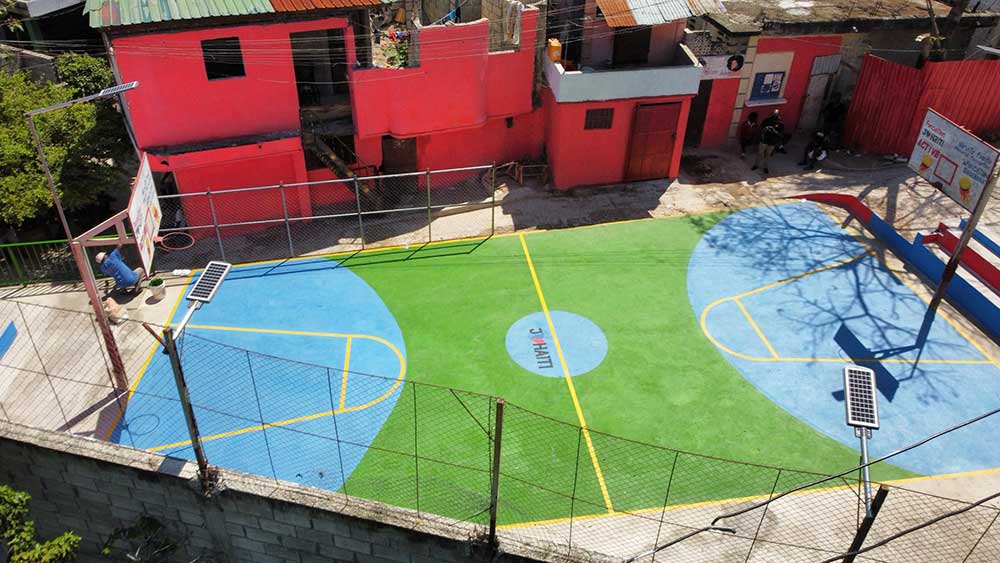
Site manager, Edrice Dely reports similar outcomes in Cité Meriken where a path for motorcycles and foot traffic borders their smaller, yet colorful court. He says, “the court has become a gathering place for the wider community, while girls training alongside boys has increased their confidence. The program has also created small economic opportunities for local street vendors, particularly during training sessions and special events.” One of the greatest moments for Dely was when the Cité Meriken girls team won the Panye Lapè championship, which energized the entire neighborhood. “That day was a great source of pride for me,” Dely recalled. “The children were singing, “This cup is going to Mr. Edrice’s house,” and even today, I am still very happy about it.”
Panye Lapè started in 2006 as a collaboration between Fondation J’Aime Haïti and Voilà, Haiti’s largest telecommunications provider and private employer before being acquired by a competitor in 2012. The Voilà Foundation provided funding for the installation of basketball hoops and the hosting of tournaments between communities, to promote peace while growing the game throughout the country. As Haiti spiraled into chaos, Oriol decided to revive and reorient the program in 2023, by focusing on youth. The story comes full circle through Panye Lapè’s current primary sponsor, the Horwitz Family Memorial Foundation, which is led by Brad Horwitz, a founding partner of Voilà.
In the 1990s, Horwitz and his business partners installed telecom infrastructure and delivered wireless services to Haiti and other less developed countries in the Caribbean, Africa and the former Soviet Union—markets their competitors did not believe could be profitable due to low GDPs and high poverty rates. Horwitz and his partners recognized the untapped human potential in the countries where their networks existed and formed foundations to encourage further human and economic development. At about this time, Brad and his father started their own foundation, initially to memorialize Brad’s sister Diane, who died from an accidental overdose, then other deceased family members, including Brad’s brother Wayne Mark, who was developmentally disabled and joined Special Olympics in 1969, the year the movement began in California with the inaugural Western Regional games at the Los Angeles Memorial Coliseum. The foundation maintains a global focus and supports initiatives that advance education, food security, and the empowerment of girls—common goals of the Peace Hoops program.
Products & Services


By 2023, many international NGOs and donors had already pulled up stakes or reduced funding in Haiti due to escalating gang violence and insecurity. That’s when Oriol reached out to the one person he thought might be willing to invest in Peace Hoops, despite these difficult conditions. Brad Horwitz calls Oriol an inspiration for his work in “the most inaccessible environment imaginable” and praises his friend for “making a dollar work harder than any person I’ve seen.” Horwitz admits that Haiti has occupied a “disproportionate amount of grey matter” over the years because of the country’s tremendous needs and potential. Ultimately, Brad invests in people and with Oriol, he says, “you could not find a more dedicated or impressive guy.”
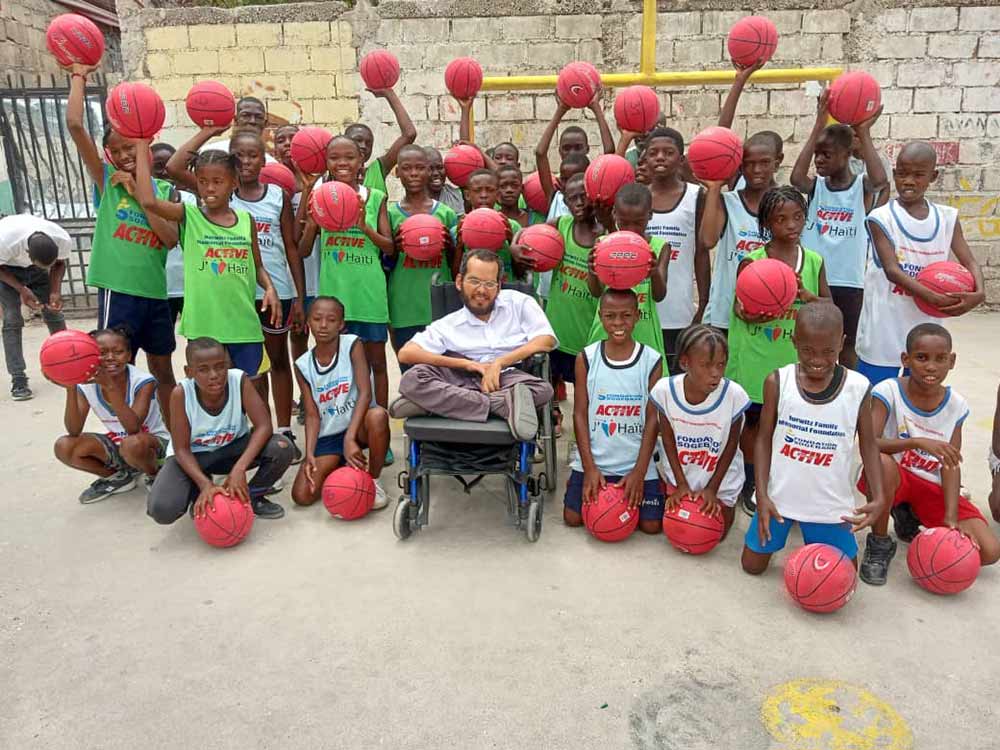
With a primary sponsor secured, Oriol enlisted other partners like the Caribbean Bottling Company and Fondation Sogebank, to provide drinks for the kids and funding for in-house tournaments. Another fruitful collaboration was established with the International Organization for Migration (IOM), a UN agency that works to ensure the humanitarian treatment of displaced persons throughout the world. IOM had already funded multiple projects with J’Aime Haïti to support persons with disabilities displaced by gang violence when Oriol pitched the basketball training program as a way to further help persons with disabilities traumatized by their displacement, as well as children affected by the violence. IOM agreed and, in 2025, supported the temporary expansion of the program to 275 participants, including 60 players with disabilities who received training sessions, nutritional aid and, in some cases, psychological support. IOM also funded the rehabilitation of all three courts and the addition of bathroom facilities at the Canot site. Specialized basketball wheelchairs were acquired with IOM funding, to facilitate trainees with limited mobility. Although the IOM-funded program ended in November of 2025, one player with an intellectual disability was able to transition into the ongoing program and several other players with disabilities, who are top contenders for the national wheelchair basketball team led by the National Paralympic Committee of Haiti, were able to train regularly, providing a much-needed boost as they prepare for major competitions.
Haiti’s struggles are not only at home. In the United States, the Trump administration included Haiti in its travel ban and attempted to end, on February 3, 2026, Temporary Protected Status (TPS) for approximately three hundred and fifty thousand Haitians living in the US, many of whom received TPS after the deadly 2010 earthquake. A US District judge intervened at the eleventh hour and issued a stay. The Trump Administration has vowed to appeal that decision to the US Supreme Court but for now, those Haitians living in the US through TPS have been allowed to remain in the country, pending further judicial review.
Back in Haiti, the nine-member Transitional Presidential Council that ran the country for more than two years reached the end of its mandate on February 7th and disbanded, having failed to restore order and hold elections. The country is now being led by US-backed Prime Minister Alix Didier Fils-Aimé. The UN has announced plans to deploy a 5,500 strong anti-gang force to Haiti by the summer, although it is unclear which countries would provide those military and police forces. The international community is also calling for elections later in 2026, which seems like a daunting task given that gangs still control much of the capital and other parts of the country.
Despite the ongoing challenges at home and abroad, Peace Hoops continues to impress. On January 4th, 2026, Oriol accepted the Honneur et Mérite (Honor and Merit) award from ONASH (National Observatory of Haitian Sport) “for his support of persons with disabilities and his remarkable contribution to the preservation of peace in certain neighborhoods through his sports program, Panye Lapè.” The award was presented by ONASH President Edwing Charles, a former Minister of Youth, Sports, and Civic Action in Haiti, marking a meaningful acknowledgment of the program’s impact.
Products & Services


Another notable highlight for the program occurred on January 25th of this year, when Kency coached the boys and girls U15 teams against a formidable rival, the Power Vikings, a strong club from Pétion-Ville. In their previous matchup, the Power Vikings defeated J’Aime Haïti in the Back To School semifinals and Kency used that defeat to motivate his players. When the final whistle blew on the boys’ game, J’Aime Haïti had prevailed 29-27—a victory that surprised many, but not the Peace Hoops coaches and players. Kency was equally impressed with the performance of his U15 girls’ team that went head-to-head with the Power Vikings U23 women’s team because the club did not have a female junior team. Despite significant age and size differences, the Peace Hoops girls only lost by a point, which felt like a victory to their coach.
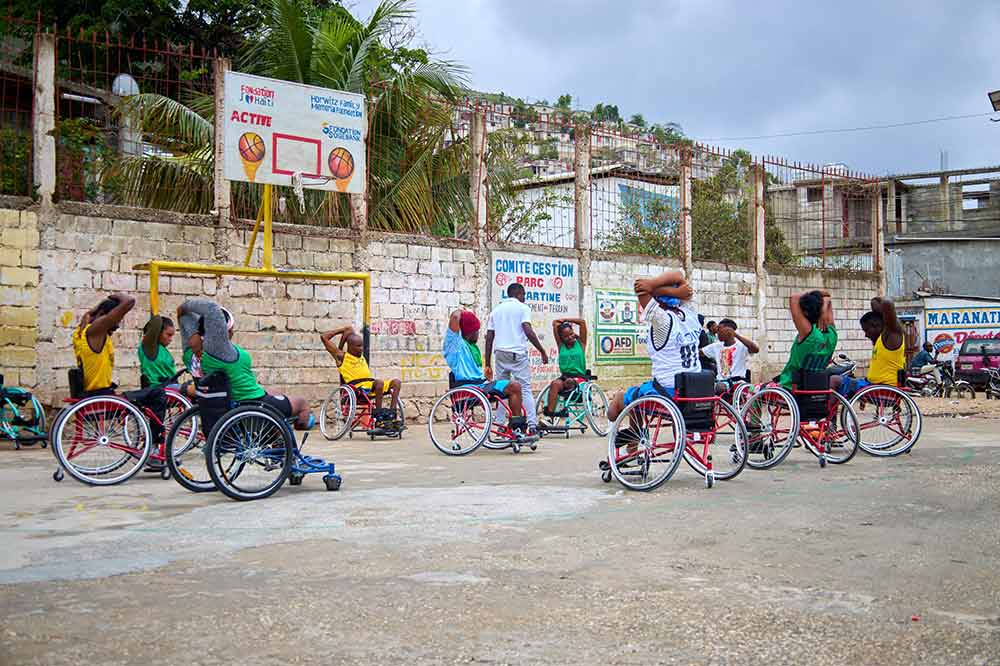
Oriol and his team are united in their vision for Panye Lapè—to expand the program to other neighborhoods like Desermithe, a disadvantaged community in Pétion-Ville, which recently signed on to become the program’s fourth training site. The long-term goal for Peace Hoops is to establish a basketball academy in the capital where top players from sites throughout the country could train and play at the highest level. The hope is that the program will eventually produce players who compete on the national team and in international leagues, representing the country and Panye Lapè proudly.
The J’Aime Haïti Facebook page is updated regularly with videos and photos of the Peace Hoops kids practicing and competing. For those who have followed this remarkable story throughout the worst of the gang violence, the children’s progress is stunning. But it is not only the Peace Hoops players who are moving forward. “We, too, are moving forward with them,” Coach Guertot Leroy says of the coaches and communities in the program. Oriol agrees. He also knows sport has the power to unite his country. When the Haitian men’s soccer team qualified for the World Cup on November 18th, 2025—a date already significant as the anniversary of the Battle of Vertières, the decisive victory that led to Haiti’s independence—thousands of people poured into the streets of the capital to celebrate, despite the insecurity. Oriol believes Peace Hoops offers Haiti a pathway forward by providing youth with an alternative to joining gangs and the skills to build a better future for their country. As Coach Kency often reminds his players, “the team that makes fewer errors and believes in defense will be happy when the final whistle blows.”
by James English
Products & Services
James English served as a pro bono advisor to Gérald Oriol, Jr. during his two appointments as Haiti’s Secretary of State with the disability portfolio. He has published numerous articles and a children’s book about disability in Haiti.
The US-based nonprofit led by Brad Horwitz is the program’s primary financial sponsor. Horwitz was a part-owner of the telecom company Voilà, which funded an earlier version of Panye Lapè, as well as a program providing income generating activities for persons with disabilities.
The Caribbean Bottling Company provides drinks for the Peace Hoops kids who often struggle with food insecurity. The bottling company is located in a red zone, and gang violence sometimes impacts their ability to deliver drinks.
The non-profit arm of Haiti’s second largest bank, Fondation Sogebank provides small grants to support in-house basketball tournaments for the boys and girls in the Peace Hoops program.
The IOM funded the rehabilitation of all three courts in the Panye Lapè program and supported the temporary expansion of the program to 275 participants, including 60 players with disabilities.
Follow Panye Lapè (Peace Hoops):
Peace Hoops on Facebook
Peace Hoops on Instagram