













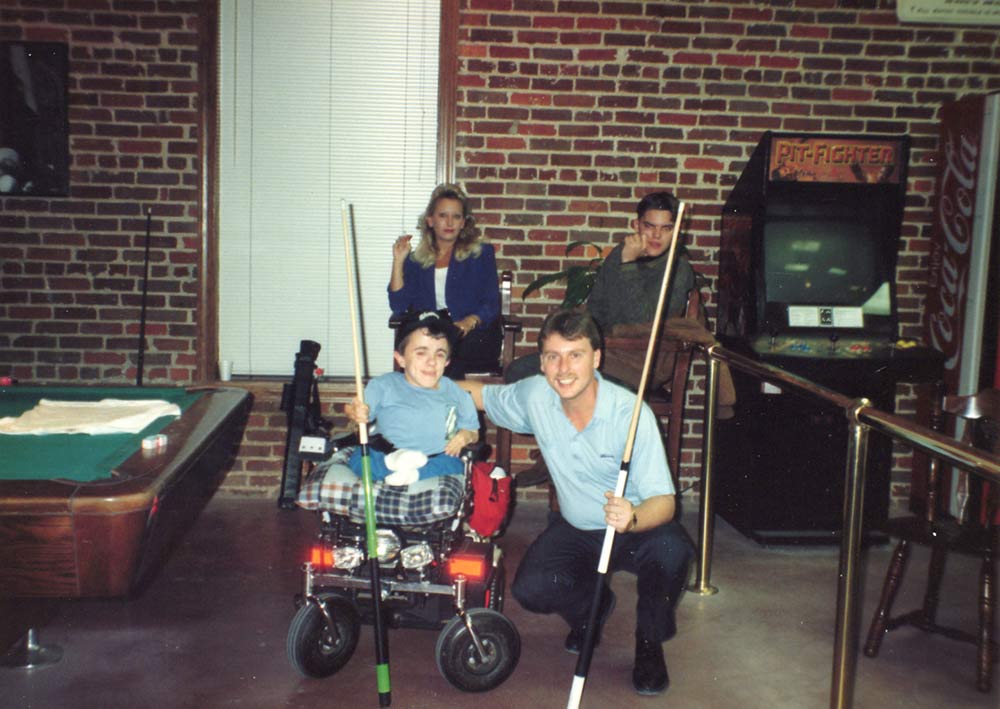
The morning routine of a champion often begins in the quiet hours before the world wakes up. For Chad “Shorty” McDaniel, the day starts long before the sun rises, much to the playful chagrin of his wife of nearly twenty-three years. Moving through his home, McDaniel relies on a seamless blend of tailored accessibility and lifelong adaptability. A specialized power lift carefully lowers him from the height of his bed to the floor, where his day truly begins.
“I scoot into my office at the other end of the house and make my coffee, one coffee a day, that is the size,” McDaniel said, holding up a remarkably large cup that fuels his early hours. His home environment is meticulously designed for his needs, featuring an office set entirely at floor level. “Chad friendly, but not very child friendly, as we like to say,” he joked. “The dog can easily get into things as well, especially the garbage. I pretty much live a normal life.”
Products & Services


This normal life belongs to a retired Department of Defense (DoD) contractor of twenty-seven years, a fiercely competitive billiards champion, and the star of the biographical documentary 96 Pounds of Dynamite. McDaniel was born with osteogenesis imperfecta (OI) type 3, a congenital collagen disorder characterized by weakened bones, diminutive stature and the distinct blue sclera of the eyes. For McDaniel, the reality of his body has never been a barrier to his ambitions; it has simply been the framework within which he operates. Now. two years into a comfortable retirement, his mornings are unhurried. “I wait around until my wife gets up and then after she’s had her coffee, join her and get up in my chair and we watch TV and just enjoy each other’s company now that I’m retired,” McDaniel said.
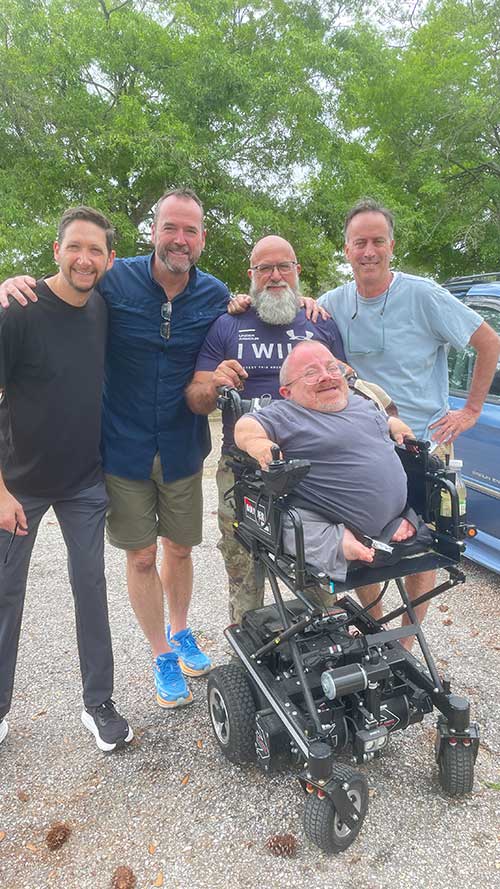
Yet, beneath this tranquil domestic surface lies the mind of a meticulous tactician. When McDaniel positions himself at the edge of a billiards table, the quiet retiree transforms into a formidable competitor. Through a mastery of geometry, a custom-engineered adaptive bridge and an unbreakable spirit. Raised in the rural South, long before the Americans with Disabilities Act, McDaniel has spent decades proving that true power on the felt—and in life—comes not from physical size, but from undeniable, explosive talent.
Growing up in rural Mississippi in the 1970s presented a unique landscape for a child navigating a physical disability. The world was not yet thinking about accessibility and the federal law for including students with disabilities was only passed in 1975—Education for All Handicapped Children Act, renamed Individuals with Disabilities Education Act (IDEA) in 1990. For his first two years of schooling, the local district placed him in a classroom for children with intellectual disabilities, fundamentally misunderstanding the nature of his condition.
“Then finally, they wised up and said, ‘He’s not mentally handicapped, he’s just physically handicapped,'” McDaniel said. “They put me in a regular classroom, starting with the second grade. Should have gone in the third grade, but they held me back a year.”
This pivotal shift in his education was largely driven by his mother, a fierce advocate who refused to let systemic ignorance dictate her son’s future. She demanded that he be allowed to pursue a standard education and experience childhood on his own terms. “She just really fought for me to do everything that I wanted to do and to have as normal of an education and a childhood as I could have,” McDaniel recalled.
The physical environment of his hometown offered its own set of hurdles, having no curb cuts or ramps. McDaniel noted that the infrastructure simply reflected the era. “I don’t blame the town for that or anything,” he said. “That was just the 1970s. There wasn’t a big push. There wasn’t that many physically disabled kids in that town.”
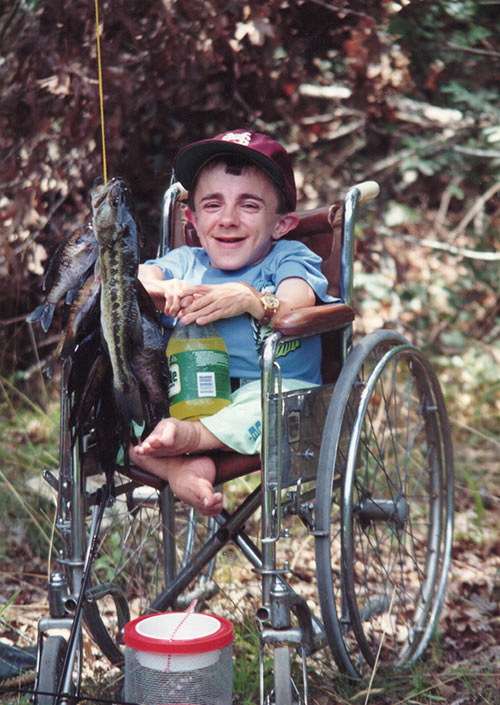
Despite the fragility of his bones in his earliest years, his body naturally began to strengthen as he approached adolescence. “I would break bones a lot when I was younger, but by the time I was 10 to 12 years old, my bones started to harden up a lot more,” McDaniel explained. His mobility was never in question. “I’ve always scooted on my bottom since I was about two, ever since I can remember it. So, I’ve always been real mobile.” This intrinsic drive propelled him academically, ultimately leading him to graduate third in his high school class of 127 students.
Products & Services


McDaniel’s entry into the world of billiards was a serendipitous alignment of location and curiosity. At age eleven, his family relocated to a house near the city park’s waterworks building, which hosted a summer program for local youth. Inside, a bumper pool table caught his eye. Remembering his father’s avid love for the game, young McDaniel decided to test his own potential.
“I tried to take up bumper pool. I said, ‘Oh, maybe I can figure out a way for me to participate in this,'” McDaniel said. “And it turns out I was pretty good at it. It’s a lot of geometry and physics. And that stuff interests me as long as there’s numbers involved—don’t put a bunch of letters, I get confused.”
After two years of dominating the bumper pool table, a new teen nightclub called Rainbows opened its doors. It was there that McDaniel encountered his first standard bar box—a three-and-a-half by seven-foot table. He transitioned to 8-Ball, and a lifelong passion was ignited.
The Craft
McDaniel approaches pool with a focus on geometry and physics rather than flashy techniques. While trick shots might draw a crowd, he views them as mostly setup rather than a true measure of a player’s fundamental skill. “I like to watch them; I think they’re kind of cool,” he admitted. “Now, I don’t want to slight it, but they’re not a good display of the ability to play pool. They’re a lot of set up. How the balls are set up is just as important as stroking the ball and making it. I don’t put a lot of merit on that. I’m like, ‘Eh, okay.'”
Instead, McDaniel reserves his real admiration for snooker, the brutally precise British form of billiards played on a massive six-by-twelve-foot table with smaller balls and notoriously unforgiving pockets. “It’s a lot more skilled involved in it,” he noted. “I’ve just been a really big fan of snooker since I was a teenager. We had a snooker table in the pool room, and I really got into it. I learned if I played snooker and then I went and played on a regular pool table, it made it so much easier because it really develops your game along the way.”
Products & Services


Because snooker tables are rare, McDaniel hones his skills on Super 8s, expansive eight-and-a-half-foot tables. Practicing on these larger surfaces gives him a distinct advantage when he travels to Las Vegas to compete on standard seven-foot tables. “I’d rather play on the harder table and then go back down to the easier than try to go the other way,” he explained.
Central to McDaniel’s elite performance is his custom adaptive bridge, an apparatus that allows him to execute flawless strokes despite his shorter reach. The origin of this device is a testament to his father’s ingenuity. When McDaniel was thirteen and transitioning to bar tables, his father fashioned the first prototype out of pipe collars, a straightened metal coat hanger and black electrical tape. “He gave it to me one weekend and said ‘Here, try this out.’ And sure enough, I learned how to play with that,” McDaniel said.
Over the decades, the bridge has evolved into a highly refined piece of sporting equipment. Today, his bridges are constructed from three-quarter-inch metal conduit with ten-penny nails meticulously welded on, fabricated by close friends. McDaniel personally maintains the device, ensuring the cue glides with zero friction. “I polish the inside of it with a Dremel and sand it,” he said. “And I get it pretty smooth, but other than that, no, it’s all just how light I move the cue through it and I don’t fight with it. I let the cue do the work. I don’t try to do the work.”
This light touch requires immense dedication to master. McDaniel frequently carries a spare bridge to lend to other disabled players who express interest, though he noted with a knowing smile that they almost always return it. “They cannot get the hang of it because it really does take a special light touch and dedication and just getting used to it. And it’s difficult,” he said.
His dedication has yielded an impressive competitive resume. His first major taste of victory occurred in 1996 during college in Mississippi, at the Southern Billiards “Spring Fever” tournament. Competing in the junior division, he went entirely undefeated. “I was hitting the ball really well at that point in my life, and I won a trophy that I still got that’s taller than me,” he recalled.
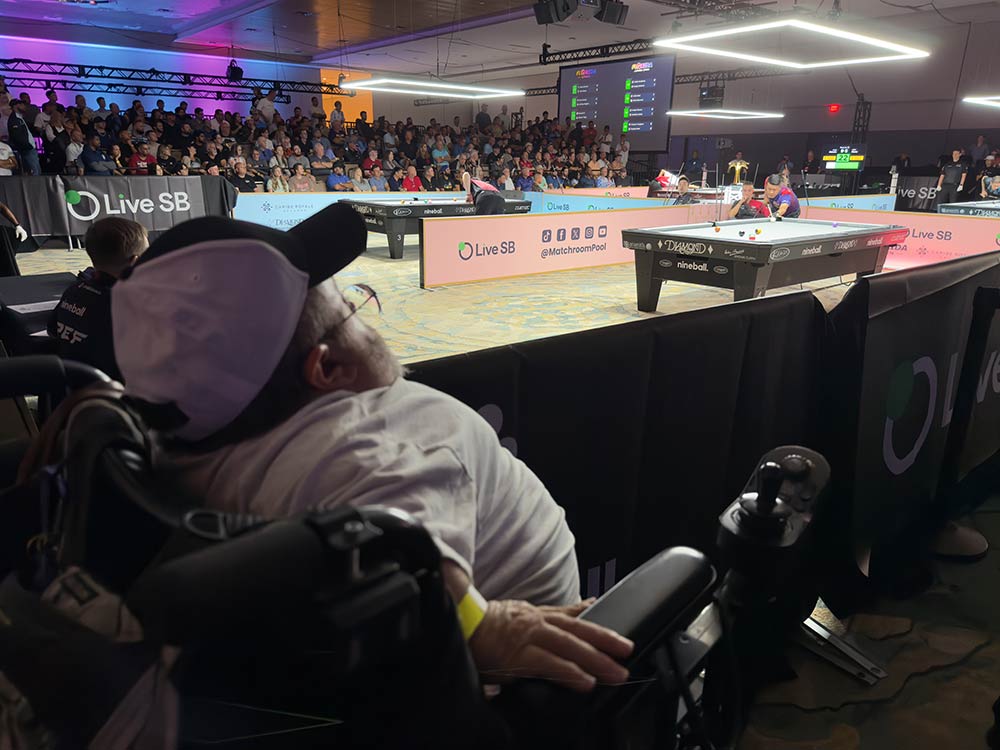
Since joining the American Poolplayers Association (APA) in 2004, McDaniel has been a formidable force. He has contributed to four team 9-Ball championships, secured three regional titles, and advanced to the highly competitive national boards in Las Vegas multiple times. The amateur competitive circuit is an intense grind of single-elimination tournaments and regional brackets, demanding near-constant play. “The way the APA works is you play every week, and you’re usually off only four or five weekends a year altogether. So, you’re playing all the time, it feels like,” he said.
McDaniel focuses his energy primarily on 9-Ball and is openly not a fan of 8-Ball.. “I’m not really that good at 8-Ball, I have a weak break and I hate the game of 8-Ball,” he laughed. “It’s a mental thing more than anything, but 9-Ball is my better game.”
McDaniel’s journey through the world of competitive billiards has not been without interpersonal friction. The billiards community, like any other, can harbor ignorance and hostility toward those who require accommodations. Early in his APA career, McDaniel faced a frustrating incident regarding his specialized equipment. Because of his stature and the limited elevation provided by his chair, he utilized a jump break cue—a stick designed to be broken down into a shorter length, not to perform illegal jump shots, but simply to navigate the physical geometry of shooting over obstructing balls.
During a league match, an opposing coach aggressively accused McDaniel of committing a foul for altering his cue. “My opponent’s coach charged me with a foul and got really nasty about it. And it was a big to-do,” McDaniel recalled. The conflict escalated, fueled by the opposing coach’s intoxication and aggressiveness.
Seeking clarification, McDaniel directly contacted the APA for a ruling. He asked whether the rule banned the physical jump cue itself or the act of performing a jump shot. The league confirmed that the cue itself was technically prohibited, despite McDaniel’s valid use case. They suggested he have his local league operator write a special provision, but McDaniel, recognizing the emotional toll of bureaucratic battles, opted for a practical solution instead.


“I didn’t go down that road,” he stated. “I said, ‘You know what? It’s just not worth fighting. I’ll deal with it as it comes up.'” He eventually acquired a different style of bridge that allowed him to shoot over balls without breaking down his cue, cleanly solving the physical problem.
Yet, the emotional sting of the incident lingered, largely because of the lack of solidarity from his own team. “I got hostile about it, not because of what he did so much as my own coach didn’t stand up for me like I thought he should,” McDaniel reflected. “As my old boss used to say, ‘Pick your battles.’ And that was just a battle I wasn’t willing to pick.”
McDaniel is acutely aware of how society often monoliths the disabled community, failing to recognize the vast spectrum of personalities, capabilities, and flaws that exist within it. He champions the idea that individuals with disabilities are, first and foremost, complex human beings.
“I’m a member of a group with OI, and even within that, there’s so many different flavors of it,” McDaniel explained, highlighting the diversity of severity and personality even within a specific diagnosis. “It’s like ‘Oh, my God! Heaven forbid we have a different personality than someone else.’ And pardon my French, but you can be an asshole, too, you know what I mean? It’s just that people don’t get that. They don’t see that often enough. You could say, ‘Well, everybody with brown eyes has got this.’ Well, no, you can’t do that. People need to look beyond that.”
It was McDaniel’s undisputable skill at the table that eventually caught the eye of the filmmaking world. During an October 2023 regional tournament in Orlando, Florida, McDaniel was in a state of absolute flow, defeating six consecutive opponents. Watching from the audience was a man who, by sheer coincidence, shared a mutual acquaintance with McDaniel from his time as a DoD contractor.

A Facebook message soon followed, proposing a modest project. “We got to talking and he says, ‘Yeah, yeah, we’re going to do a 15, 20-minute film. Nothing major,'” McDaniel recalled. The filmmaker visited McDaniel’s home to conduct a preliminary interview, diving into the rich history of his childhood, his battles for education, his professional career, and his life on the felt.
The scope of the project exploded almost immediately. “Next thing I know, he’s like, ‘Okay, we’re making a movie, an hour and 20 minutes long. We got this full production crew coming in. You’re going to Mississippi to see your family,'” McDaniel said. “It became a lot more of a big process. I’m happy it did. I’m very proud of it. I’m very proud of the message it relays to people. I think it’s important for people to have hope and to have somebody to look at—although I’m not perfect—but I really enjoyed making it. I feel that it represents me pretty darn well.”
The resulting documentary, 96 Pounds of Dynamite, captures the full tapestry of McDaniel’s existence. It’s a portrait of a man who refused to be sidelined. As he navigates the promotional circuit for the film, including highly anticipated and tightly under-wraps travel to new locations within the United States, McDaniel remains steadfast in his core philosophy. He has no use for feel-good clichés; his message is a fierce claim to self determination. “Your disability cannot limit you in life,” McDaniel stated firmly. “You are the only person that can limit you. I worked as a Department of Defense contractor for over 27 years. I played pool. I’ve gotten married. I’ll be married 23 years this July. I have a home. I have a real nice van. I’ve achieved everything I’m going to achieve in my life.”
McDaniel’s life is a testament to the power of forward momentum. Guided by the early echoes of his mother’s relentless advocacy, he has built a legacy defined by professional success, enduring love, and undeniable competitive dominance. “My mother would tell me, ‘Don’t let your disability stop you. Don’t let anything stop you,'” he recalled. “I overcame a lot… just not only disability setbacks, but discrimination setbacks and things like that. I just don’t dwell on them. I just plow through it.”
And as for the future? Whether he eventually achieves his goal of traveling to the UK to test his mettle on a regulation snooker table or simply continues to dominate the 9-Ball brackets in his retirement, Chad McDaniel is entirely in control of the break.
“96 pounds of dynamite, you know what I mean?” he said with a wry, knowing smile. “I’m going to blow up some time or another.”
TRAILER: 96 Pounds of Dynamite