









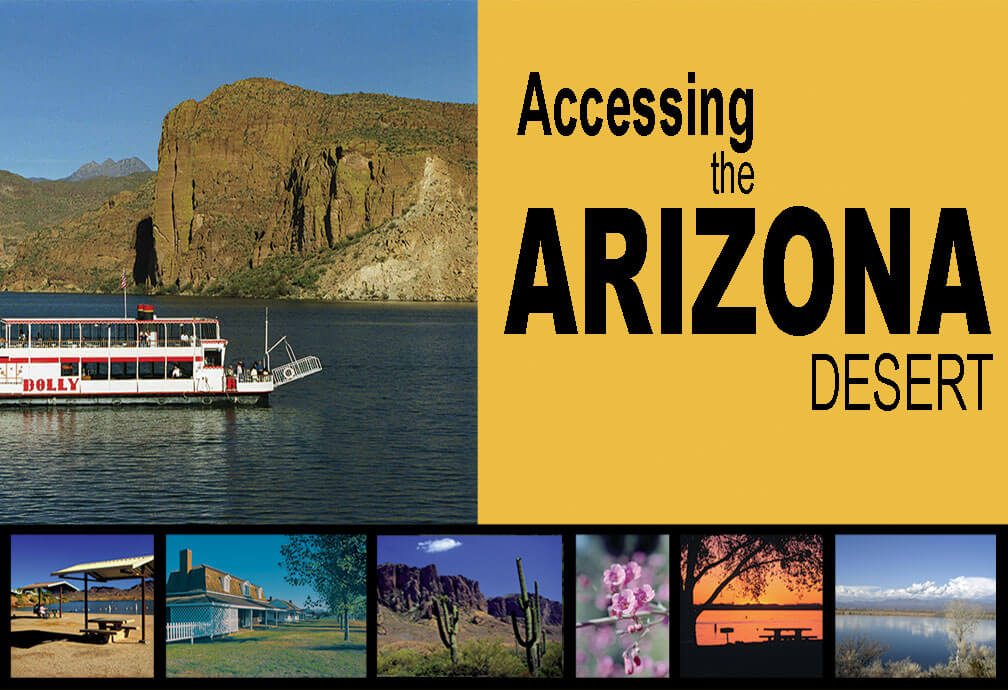
The Arizona desert is a beautiful part of our country. Its unique characteristics make it a great place to explore, and there is no shortage of natural wonders to enjoy. It’s beautiful, yet not entirely accessible. All too often even able-bodied travelers find the harsh environment strenuous and even hazardous. Prior to my spinal injury, I spent a great deal of time exploring the Arizona desert, and so I decided that after eighteen years, I would find some new way to explore it again.
Arizona is part of the Sonora Desert. It encompasses parts of northern Mexico, southern California and the lower portion of Arizona. I spent four days this winter exploring four different locations in the state, and each trip was entirely different.
The city of Tempe makes a great central location for anyone coming to visit the state. Located right next to Phoenix and only minutes from the Sky Harbor Airport, Tempe is new, clean, lively and most of all, very accessible. Their new tourist slogan is “In the middle of it all,” and from what I’ve seen, that’s pretty accurate.
There are two places in Tempe worth noting. Mill Avenue is a Tempe landmark; the pedestrian-friendly half mile corridor has over fifty shops and sixty-five restaurants, coffee shops, and taverns. Located next to Arizona State University, Mill Avenue has a lively night life and loves to host a celebration. Lots of fun in the sun, a nearby university, excellent accessibility and casual atmosphere make it a great place to explore.
At the north end of Mill Avenue is the Tempe Town Lake. What once was a dry river bed is now a 220-acre lake, contained by rubber dams at both ends. What makes the man-made lake and surrounding park great is the amount of accessibility it offers.
Products & Services


Voyages Unbound is a non-profit organization that offers people with disabilities a chance to go sailing in their two Martin 16 sailboats they keep at the lake. I spent a great afternoon on the high seas with the director, Jack Oppenhuizen, and his crew. There aren’t too many places where, in the middle of winter, you can have lunch on the patio then stroll down to the lake and spend the afternoon sailing in just a shirt and shorts. Looking across the lake, I could see Papago Park, the first of my four destinations.
The Desert Botanical Garden
The Desert Botanical Garden is located in the rocky buttes of Papago Park near the borders of Phoenix, Scottsdale and Tempe. Papago Park is the perfect place to get a first dose of Arizona’s great outdoors.
The 50 acre garden hosts one of the world’s finest collections of desert plants and attracts more than 250,000 visitors each year. It is home to 139 rare, threatened and endangered plant species from around the world.
Calling this a garden is somewhat of a misnomer. This is actually a desert tour and a great place to get some exercise. If you use a chair, make sure your brakes are tuned. There are a few black-diamond paths ahead, and if you are in a manual chair, a good pair of gloves will come in handy. If needed, the garden does have electric chairs and scooters for rent.
I visited the Desert Botanical Garden on a Sunday morning. A blues band was playing in the outdoor auditorium and everyone was enjoying a fine sunny day. The Garden has a central path that is perhaps a quarter mile long. Branching out from the main path are five additional paths of similar length. Each takes you through a different type of desert landscape. The paths snake, wind and wrap around the side of a mountain, up and down knolls, through creek beds and across open desert. The width of the paths vary from 6 feet to 10 feet and are well designed and groomed. Even the gravel paths are well packed and fun to travel.
Throughout the Garden there are information stands, interactive demonstrations and various items for kids to enjoy. I found that most everything was accessible, including a telescope that looks across the valley. In the courtyards they were selling drinks, food, desert plants and arts and crafts.
I spent about three hours at the Garden only ended up traveling two of the paths because I got sidetracked chatting with people and enjoying the music. Even if you aren’t into gardens, flora or desert inhabitants, the Desert Botanical Garden is a great escape.
Canyon Lake
Ninety minutes east of Tempe is Canyon Lake. The lake is home to the Dolly Steamboat, a vintage steamer that offers a tour of the lake and its surrounding desert.
For me, however, the fun started before we arrived at the lake. Highway 87, locally known as the Apache Trail, begins where the city ends. If you have access to a sporty convertible, this is what it’s all about. The two-lane highway is non-stop turns, cut backs, swoops, hills, winds, twists, bends and cliff-hanging curves. It’s been eighteen years since I traded in my four on the floor for a set of hand-controls, but coming out of some of these banked curves I could almost feel my left foot stabbing the clutch while grabbing a lower gear and pouring on the gas with my right. This is an exhilarating drive for anyone, and if you drive with hand controls, you will really be testing your ability to steer with one hand and brake with the other.
Aside from the driving, the view is absolutely amazing. Imagine a roller coaster going through an art gallery and you have the Apache Trail. Each knoll you top, and every corner you round, brings a new perspective to what a few million years of wind and water can do to the side of a canyon wall.
The Dolly Steamboat sits docked aside the marina. She’s not actually a steamboat but she looks similar to one. I appreciated being able to roll straight from the parking lot to the ship’s deck without any obstacles. She holds upwards of 160 passengers, and makes one trip everyday around noon. She also makes a sunset dinner run that does require reservations.
Dolly has two levels. The lower deck is completely accessible, with both indoor and outdoor seating. There is plenty of room to maneuver and it’s easy to travel stem to stern in a chair. To reach the upper floor, however, you must ascend one flight of steps. She’s an old boat and not too surprisingly, didn’t come factory-equipped with an accessible head (Navy lingo for bathroom). Given it’s only a 90-minute ride, I wasn’t overly concerned, but it’s worth knowing before casting off.
Canyon Lake is appropriately named. The lake is surrounded by huge rock cliffs, inviting coves and quite a few species of birds swooping about. Captain Tom also doubles as our tour guide and offers a casual dose of native history while mixing in a few sailing tunes to set the mood. On our return, we spotted a herd of Desert Big Horn sheep grazing, leaping and hurdling their way across sheer cliffs to munch on grass, a very rare sight indeed.
Sure enough, we reached the port ninety minutes later, whereupon I was easily able to roll off the boat and on to the dock. I spent the evening at the Lakeside Restaurant and Cantina, and in addition to an accessible bathroom, the place also has a great patio area overlooking the lake. The food is good and fairly priced.
Products & Services


The cruise does sell drinks and snacks at a reasonable price. However, next time, I’d pack a lunch and eat at the Boulder Creek Recreation Site because the park has a very accessible pier and excellent picnic grounds.
In all, it was a full, but not rushed, day-trip. The Dolly Steamboat was well worth the price of admission and has the capacity to host a whole group of people who use chairs.
The Verde Canyon Railroad
The Verde Canyon Railroad began as a mining railroad, and now it hauls tourists through the high desert region. Located two hours north of Tempe/Phoenix in the little mining town of Clarkdale, the trains follow the Verde River for 20 miles before returning.
The train dates back to the industrial boom of the early 1900’s. In its heyday the railroad moved ore from the mines of Jerome to the smelters in Clarkdale and then north to the main Santa Fe line. Because the canyon is very remote, it’s ecology exists virtually undisturbed.
On the drive over, we pass through some beautiful country and scenery. Heading north out of Phoenix, we immediately began to climb through the mountains. In the next ninety minutes we ascend from an elevation of 1500 feet to over 5000 feet.
Upon arrival, the train depot was easy to locate. Similarly, the parking lot and path leading up to the loading area were easy to navigate, and there is a nice outdoor plaza where passengers wait to board. It is just as accessible onboard in both the coach and first-class cars. The lift to board the train is located on the side of an open car. Three engineers spot you as the lift takes you smoothly up to the deck. The open cars are for sitting outside and offer excellent accessibility. You could easily fit a whole herd of wheelchairs out here.
Boarding either passenger car from the open car is a bit like boarding a commercial airline. To enter it requires that you go through a short gang-way and a narrow doorway. The solution they have come up with is to transfer a rider into their narrow aisle chair to get you into the cabin. Once inside, you have three choices. One is to stay in their aisle chair (assuming no one else needs it), another is to transfer into the coach seats, and a third (which I chose) is to snap off one back wheel and bring your chair inside for another transfer.
If you use a power chair, you need to think this one out. If the weather is great, you’d be plenty happy sitting outside, but if you’ll be going inside you may want to bring along a manual chair. I’d suggest spending half the trip inside and the remainder on the deck car. The open cars offer a spectacular view of the canyons, and it’s great to be outside where you can go from side to side with ease. The cars also have awnings when shade is needed.
The first-class cars have very nice sofa seating, although you might find yourself straining to take in all the sights. We watched one person get so comfy he slept half the trip. The coach cars have bench seating that for some might not offer enough balance or leg room. If, for whatever reason, you can’t transfer out of your power wheelchair, and the weather is not good, this may not be a good trip for you to consider.
I would highly recommend that anyone who absolutely must stay in their wheelchair to visit the accessible bathrooms located in the plaza before departure. Once on board you will see that each of the cabin cars has a single bathroom located to one end. The toilet itself is accessible and I take them at their word that they are compliant with the Americans with Disabilities Act, but using it while the train is moving can prove to be a daunting task. Furthermore, I didn’t see a way to access the sink in the car I rode.
The trip is four hours long. As we settled in, our guide enlightened us with some historical facts about the town, the train and the terrain we’d be covering.
The one problem with sitting outside is that the views down into the canyon and of the river are slightly obscured because of the car’s 4 feet high steel mesh railing designed to keep kids and litter from going overboard. Sitting inside, the windows make it possible to see virtually everything below. Given that the train goes up and back down the same track, I found that the change in locations broke up the redundancy.
Along the way we saw ancient Indian dwellings, relics from 100 years worth of mining, canyon after canyon of amazing cliffs and the Verde River below. About half way, the tracks take us aside a large gorge. It is here that an estimated twenty bald eagles have their summer homes. Perkinsville is an abandoned railroad stop and the half way point of the tour. There are four old wooden buildings and a water tank. As the engines used a sidetrack to recouple at the rear of the cars, we moved out to the open car for our ride home. Once we return to the station, getting off the train is a cinch. The crew was already congregating at the lift as I arrived.
Kartchner Caverns
Southern Arizona offers a whole different perspective of the desert. Here the mountains protrude from the desert like islands. I had heard a rumor than Arizona’s newest state park near the city of Benson was fully accessible, so I chose it as my final destination.
Kartchner Caverns is considered a living cave. Water still drips from above and calcium carbonate formations, such as stalagmites, are still growing. This amounts to thousands of years worth of natural art hanging from the ceiling, sprouting from the floor and covering the walls of the cave. There is no evidence that any man explored the cave until the 1970’s. As one guide put it, man walked on the moon before he set foot inside this cave.
Anybody who goes to Kartchner Caverns will be inspired by the experience, it is like nothing else out there. It is also completely accessible.
Even the story behind the Kartchner Caverns is fascinating. The caverns were discovered by two amateur cave explorers in the early 1970’s, who kept it a secret for over ten years. The state eventually purchased the cave and the surrounding land and turned it into a state park. It took five years to make the cave inhabitable, and in 1999 the park was opened to the public.
The park service has taken many steps to restrict the elements from being contaminated and the cave from being damaged. Such restrictions will mostly affect people who have difficulty walking. No canes, crutches or strollers are allowed. They do have good manual chairs available for loan to anyone and virtually the entire path has hand rails on one or both sides. Benches for sitting appear every so often. Power wheelchairs and service dogs are allowed but they ask you make sure your power chair is not leaking anything. Probably good to check your service dog too. Those who are hard of hearing can get a written copy of the guide’s presentation. No cameras, food or drinks are permitted.
Before you tour the cave, you pass through the Discovery Center to get your tickets. The center itself is a really nice place to explore. Outdoors there are numerous gardens and approximately five miles of desert trails. One loop is accessible.
Indoors, the Discovery Center is completely accessible. Automatic doors greet you in the front and rear. There is an auditorium which features a short documentary about the cavern that runs every hour. Numerous exhibits explain everything about the cave, the construction of the park, the geology and the anthropology. Since you cannot touch anything in the cave, the exhibits are designed to be touched by kids big and little. The center has vending machines and there are no restaurants near by, so bringing a picnic lunch is advised.
In order to get up to the mouth of the cave, everyone must board a tram that hauls you up the mountain about a quarter mile. There are no bathrooms in the cave so everyone should board the tram well prepared. Each electric tram has one cart where wheelchair-users can load and remain in their chairs. The loading ramp is steep but the driver saw us coming and volunteered to assist. The ride is maybe 3 to 5 minutes long and is quite scenic.
Products & Services
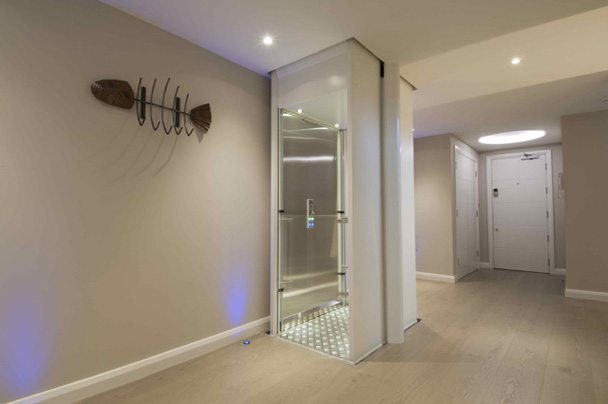

At the entrance to the cave is a vault-like door. The lighting is very obscure and humidifiers create a fog that’s designed to maintain the constant 99 percent humidity level inside. The walkways are at a slight grade so the moisture on the hand rims affects braking. At the end of the tunnel is another door which the last person passing through pulls shut. As your eyes adjust, our presence activates a series of dim lights on the path.
Describing what is to be seen in the cave is difficult. Even photos don’t offer much compared to the amazing feeling you get while in the cave. And while nature has formed something grand in this cave, those who designed and built the park have respectfully added to it’s grandeur. Subtle lighting casts colors and shadows that highlight it all brilliantly. Given that you are deep in a mountain with some rather ominous rocks around you, the gravity of it all could make one cautious if not apprehensive, yet the tour is very peaceful and relaxing. Man has complimented nature in here.
The path is about four feet wide in most places. In certain sections it gets slightly narrower as you squeeze between rock formations. Perhaps 50 percent of the path is virtually flat. The remainder consists of inclines and slopes that vary from slight to moderately steep so wheelers may require a push on occasion. Along the path there are plenty of flat landings to stop on and view the amazing formations.
After we surfaced from the tunnel, the tram was ready to take us back to Kartchner Cavern’s Discovery Center. While heading back, there is an incredible view of the Drangoon Mountains in the distance with Mexico just off to the East. Roundtrip, the tour takes ninety minutes.
All four trips are worth the price of admission. For overall beauty, I’d have to say the drive and boat ride at Canyon Lake and the ride on the Verde Canyon Railroad offer the most spectacular views of Arizona’s desert. If you’d like to spend a lazy day in Tempe, be sure to include a half day at Desert Botanical Garden. My favorite trip, however, is the one with the biggest wow-factor—the Kartchner Caverns. It’s simply hard to believe something so unique (and accessible) exists in the Arizona desert.
by Loren Worthington