






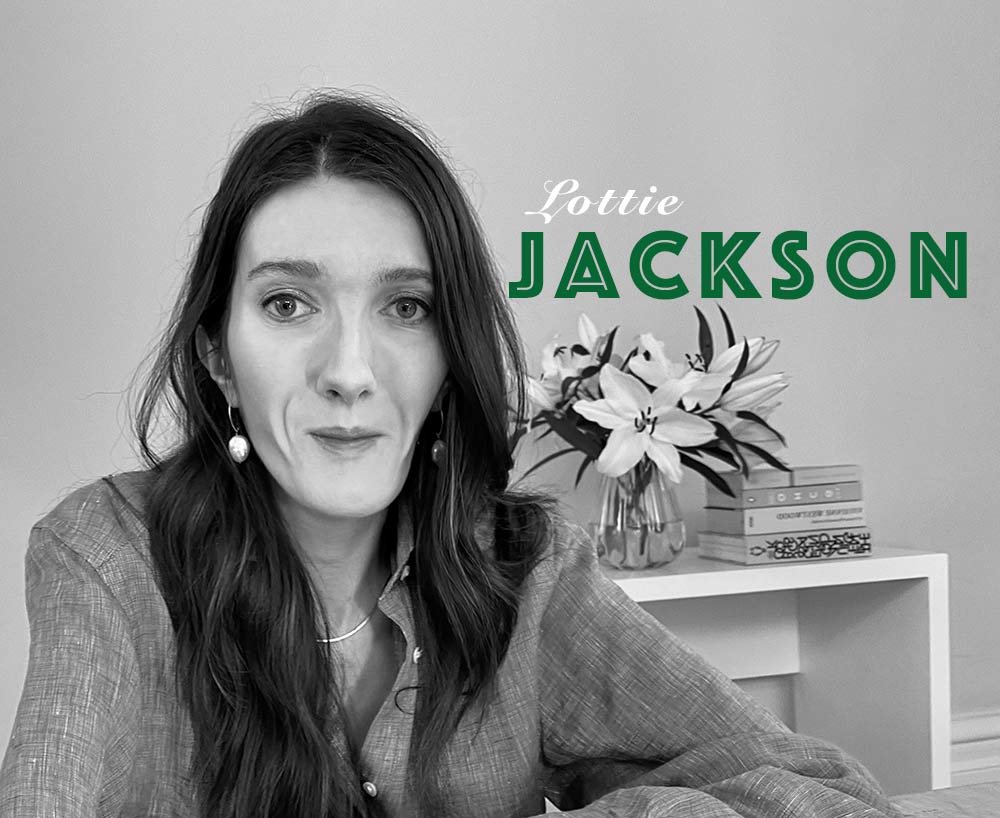
Since 2017, Lottie Jackson has been a freelance writer for publications like British Vogue, Elle and The Guardian, writing about fashion, disability and beauty standards. Mid-pandemic, Jackson set out to write a memoir, See Me Rolling. An unflinching narrative about navigating life with a disability and the joys and frustrations that accompany striving for being seen as who you are in a world that wants to see you as “less than”.
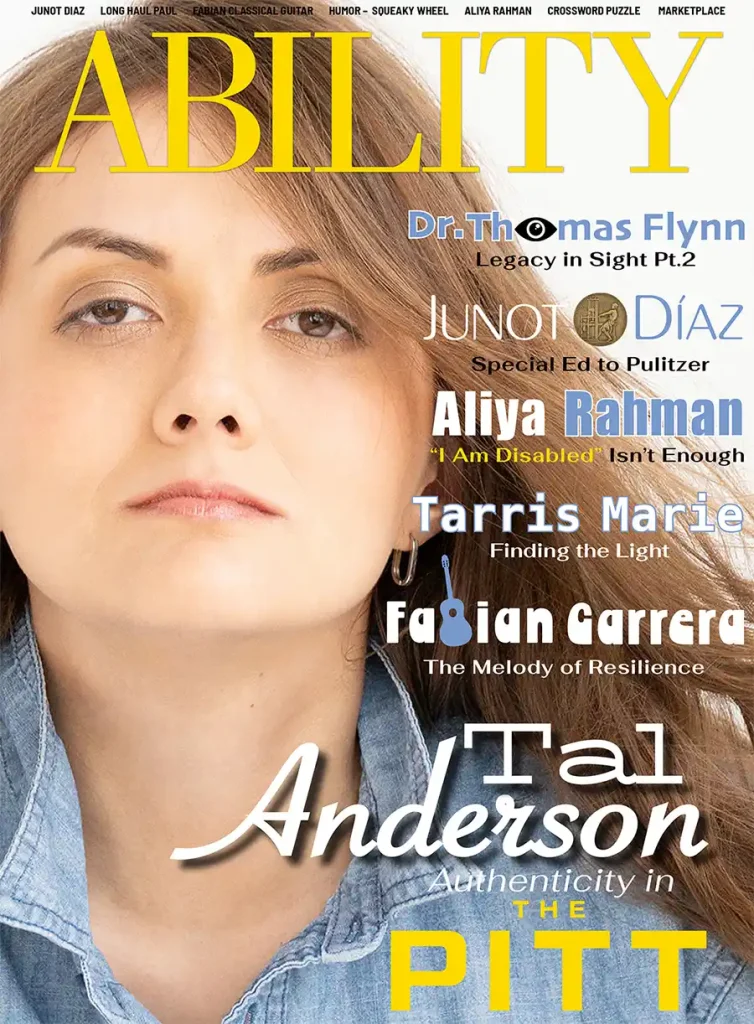
In a thoughtful discussion, ABILITY Magazine’s Jennifer Woodall spoke with Jackson about embracing personal changes in ability, confronting societal stigmas surrounding disability and exploring fashion as a powerful means of self-expression and empowerment.
Jennifer Woodall: Can you talk a little bit about your background and how you became a writer?
Lottie Jackson: Of course. I’m from Bristol (in the UK). Since birth, I’ve had a generalized muscle-weakness disability, a rare condition that affects my physical strength. For a long time, this condition didn’t pose many constraints on my day-to-day life. But as I was approaching adulthood, I faced several years of intermittent, severe illness (such as serious pneumonia) which entailed long spells in intensive care. This significantly impacted my mobility and stamina. Getting around, for example, has become more challenging. It has also affected the physical strength of my voice, so it is hard to speak at length. Since graduating from university in 2017, I’ve worked as a freelance journalist for magazines and newspapers (British Vogue, Elle, The Guardian, The Sunday Times, Telegraph, CNN). Most of my articles have focused on disability, fashion and beauty standards, analyzing why the fashion industry has routinely excluded people with disabilities. It was only during the pandemic, fearing that journalism opportunities would soon dry up, that I turned my hand to writing a memoir. Writing a book is not something I had considered a possibility before. And, admittedly, it was a huge learning curve! I first got the idea while listening to a podcast which mentioned a competition for Penguin’s WriteNow scheme for new writers. Winners would secure a place on Penguin’s mentoring program, working with an editor to develop their book for publication. So, in the space of a year, what began as a thousand words for my application eventually led to a book deal, and then gradually evolved into my published book, See Me Rolling.
See Me Rolling evolved a lot throughout the writing process. Not only was I learning about the history of disability and all these incredible activists, but I was also learning more and more about myself. Ultimately, my book was a springboard for self-discovery, a chance to make sense of what I have gained from my disability. These moments of self-realization were emotionally draining, but I feel as if the investment paid off, as I have gained a lot of confidence from the experience, as both a writer and a person.
Woodall: When a person experiences a change in ability, there is often a grieving period that happens where they may be hyper focused on the loss of their previous “norm”. Do you have any advice for someone who is in this transitional period?
Jackson: This transitional period is one of the hardest things you can go through. As much as I think it’s a personal journey that will look different for each person, I do believe there are several pieces of advice that can benefit everyone. Firstly, it’s important to understand the role that society plays on your mindset and the feeling of loss. Coming to terms with your new physical reality is a hundred times harder when you buy into the myth that “able-bodied-ness” is an essential component of a life well lived. It’s something we are told by the media, our culture, and it’s pummeled into us every time we open Instagram, for instance. But, as I explain throughout my book, this simply isn’t true.
I want to remind others that our physical body is only one part of our experience in the world. There is action and adventure to be found far beyond the constraints of our body. Your everyday experience may look different from the average person, but it doesn’t make it any less valid or full of possibility. Finding a new passion can be a great motivator. It’s a way of reconnecting with your inner self and imagining a new future. This could be through making art, studying a new subject or helping others—anything that gives you a reason for being. When the world suddenly feels a lot smaller and more restrictive, it takes courage to imagine something bigger for yourself, but I think it will save you. The same can be said for friends and family. I’m grateful to have had the support of my social circle, especially my sister, to get me through hard times. Lean on them because they’ll remind you of who you are and take you out of your own head.
From a practical standpoint, I think it helps to be creative and proactive about making your day-to-day experience easier. Learn how to tackle accessibility issues before they arise because this will lessen the frustration. It will avoid those constant battles that remind you of your new physical limitations and chip away at you. Lastly, I would say don’t ignore it. You need to look at these frustrations straight in the face and recognize that even if you think you’re alone, you’re not. Historically, society hasn’t been built for disability, so it’s not presented as a viable reality. But I hope that my speaking out about these issues and sharing real experiences, disability will no longer be seen as an unnavigable or fringe issue. At its core, See Me Rolling is a book about hope, possibilities and what can be achieved when we expand our ideas about what constitutes a ‘normal’ body. I hope it will help lots of people.
Products & Services


Woodall: Despite disability being such an intertwined facet of human existence, there is still heavy stigma around it. Can you share some of your experiences with stigma and unconscious bias and the steps society, as a whole, can take to help reduce it?
Jackson: Exactly, there’s still so much stigma that surrounds disability. In part, I think it’s because modern life has made us fearful of anything “abnormal”. Society is a place where everything must be uniform, where people must slot into tick box categories. It’s impossible to exist outside of the boundaries, or those tick boxes. Inevitably, this creates a challenge for disabled bodies which may escape categorization or defy our need for what’s familiar and identifiable.
I experience this stigma when using my mobility scooter. If I’m able to go somewhere accessible without a long walking distance, I can go without a mobility scooter and almost exist like someone “normal”. I sense my body is unstigmatized and I’m part of the collective. However, if I’m driving down the street by mobility scooter, this is a signpost of my abnormality. It forces me to be segregated from others. I am painfully visible. While society views any mobility aid as evidence of weakness and frailty. ironically, I’m far more able with it, than without it.
These outdated misconceptions and stigmas can distract people from the reality of who I am. Much of this stigma is down to the fact that disability is not seen as an everyday part of life. For example, there aren’t enough disabled people in positions of authority or in the workplace. So, I think the first step to reducing stigma is integration. This means creating an accessible world where disabled people are an integral, welcome part of society. It will require more employment schemes to increase disability representation in the workplace; more visibility of disabled people on screen and in the media; more education about both visible and invisible disabilities; more accessible buildings and transport systems and more advocacy for disabled people’s rights in politics. To name a few!
But on a more individual level, I think we all need to start having honest and open conversations about disability. One of the biggest barriers facing disabled people is the awkwardness about how to talk about disability. A recent survey, for example, found that 45 per cent of the British public do not even feel comfortable saying the word “disabled”. If we can remove the anxiety and misconceptions that surround people with disabilities, I think this could go some way to creating a more equal future. After all, inequalities will only breed in silence.
Woodall: In your book you mention a study that talks about how a significant portion of people, particularly in the 18-34 age range, avoid communicating with someone they perceive to be disabled because they are concerned about saying something wrong or they weren’t sure how to communicate. Can you touch on this subject a bit?
Jackson: When non-disabled readers have talked about my book, this was the statistic that left them the most shocked and appalled. I found this encouraging, as it shows a real willingness and desire to change the pattern of how disabled people are treated. Often, the avoidance of disabled people is not anything conscious or purposely unkind. It’s just down to a lack of confidence and knowledge. When people come across someone with a visible disability, they see it as the easier option just not to engage or make that first move. Perhaps they are scared to cause offence, or are afraid they should be talking to the disabled person in a specific way. Do they ask about someone’s disability or is it offensive to even mention it?
Because of all this uncertainty, people may avoid eye-contact and shut down any conversation starters. Obviously, this is very upsetting for someone with a disability. It feels dehumanizing and does little to stop the cycle of marginalization. As the statistic showed, this hesitation is more common among millennial and Gen-Z. Perhaps, it’s because face-to-face interaction can be more daunting for generations who grew up with social media and online communication. Younger generations could also be more concerned with how they are perceived by others and want to avoid embarrassing or cringe situations at any cost.
I think as we mature, we become more self-assured and confident about how to navigate unfamiliar social interactions. In terms of improving this statistic, we need more positive interaction between disabled and non-disabled people from the earliest age. New generations must understand that disability is a natural part of life. This could start in schools if classrooms promote a safe environment where disabled and non-disabled children can learn about the things that unite them. For people of my age, millennial and Gen-Z, I think it’s a very personal journey that involves educating ourselves about disability. Teaching ourselves that disability is a complex, nuanced thing that should not be feared. Reading books like See Me Rolling is a good starting point, and also watching tv programs with positive and authentic narratives about disability like Netflix’s Sex Education.
Woodall: In your book, you talk about applying for college and some of the pushback you experienced with a career counselor, mentioning how “a study published by the British Journal of Sociology found that disabled adolescents are 15 per cent more likely to have low expectations about going to university compared to able-bodied pupils of similar socioeconomic backgrounds.” Can you expand on this topic and what may be contributing to that statistic?
Jackson: It’s a very complex issue which has so many possible causes, but it’s worth investigating. Firstly, I believe people with disabilities need more support throughout the school system. When you’re grappling with health conditions or facing periods of time away from the classroom, due to hospitalization, it’s hard to visualize your future and talk about career aspirations. I think schools struggle to cater to these students who, understandably, can’t keep up with strict timelines and examinations. More disability awareness and flexibility from teaching staff is paramount if we are going to improve the situation.
Also, the world of university and academia aren’t always seen as inclusive or accessible to people with disabilities. The challenge of living away from home for the first time and being more independent feels impossible. The study you mentioned, published by the British Journal of Sociology, actually found that the prospects of young disabled people may be curtailed by the fears of their parents or guardians who are concerned that university campuses are an unsafe environment for a young adult with a disability.
But, from a more general perspective, I think there’s a lot of misunderstanding about what disabled people can achieve in life. Too often we presume that somebody’s physical stamina is a reflection of their mental capability and intelligence. As a result, disabled people are frequently talked down to and infantilized. It takes courage to push against these assumptions and assert your intellect in a society that continually underestimates you. Everybody should have the right to a university education, and the support to get there. I don’t think anyone should be underestimated.
Woodall: I really enjoyed reading the essay “Fashion-able” from your book. Can you talk about your views on fashion and disability?
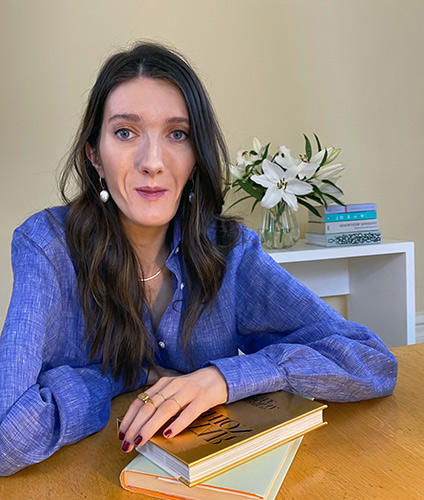
Jackson: Thank you so much, it’s great to hear you enjoyed Fashion-able. I really loved writing it, I think coming from a fashion journalism background, where I’ve mostly written articles with deadlines and word counts, it was interesting to go much deeper into the subject and research things more freely in an essay format. From a personal perspective, I’ve always adored fashion. I think if I had to pinpoint why, I’d say it’s because personal style is all about self-expression. Our clothes are a visual signifier of who we are or, sometimes, who we aspire to be.
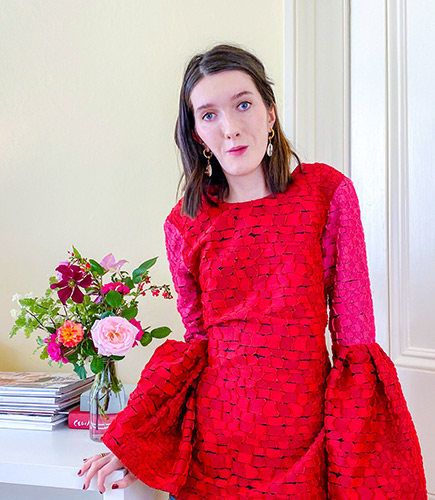
Clothes exist beyond language, and in that sense, they cut through all the stigma and prejudicial baggage that follows disabled people like a dark shadow. Through clothing, it’s possible to shake off negative stereotypes about how someone with a disability should look or behave. So, for example, when I did a magazine internship, the clothes I wore were a fun way to express my interest in the fashion world and make a first impression that wasn’t just about my disability. On the first day of my internship, my pussy-bow blouse and leather pants gave me courage to enter the editorial meeting by mobility scooter. Or even starting at university, where despite nerves about whether I’d even be able to navigate Oxford’s old buildings, a colorful fair-isle knit gave me a sense of comfort and belonging.
Or, going back further, my earliest recollection of my personal style was around age 7, an outfit I wore for my sister’s birthday party. I threw aside the twin-set my mum had laid out and went for a garish pajama top, Dalmatian-print leggings, stuck-on earrings and patent Mary Janes—an outfit I thought was the height of sophistication. Let’s just say it was hard to separate me from the clown booked for post-lunch entertainment! But, to me, it was a way to express my individuality and character.
From the outside, fashion might seem trivial. But so many people fail to see how it empowers people with disabilities like me. Historically, fashion has been non-diverse and unwelcoming to anyone who doesn’t fit the mold. But, in recent years, I’ve watched fashion open itself up and embrace diverse models. When it comes to disability, very disappointingly, it’s another story: able-bodied-ness remains a necessary feature of what’s desirable and on trend. Despite a few notable examples—such as Gucci beauty’s casting of Ellie Goldstein, a model with Down’s syndrome—disabled people are near invisible in fashion, unrepresented on the catwalks, in magazines and on the shop floor where there are very few disability-friendly clothing options. A study found that, here in the UK, only 4% of TV adverts have featured disabled people, although almost a fifth of the UK population is disabled. When it comes to fashion week, the lack of disabled models is so stark that inclusivity reports don’t even feature a disability category.
In my book, I go back and investigate the possible reasons for this erasure. For example, I think it may have roots in the Ugly Laws (1867–1974) when disabled people were unjustly segregated and prohibited from public view. This anxiety around disability is so deep-rooted, it’s part of our social conditioning. Right now, urgent change is needed. I believe the fashion industry has a unique opportunity to change our view of disability by presenting disabled bodies as both beautiful and integral. If we want to live in a diverse world where disabled people no longer face shame and stigma, fashion must redefine what constitutes a “desirable” body.
And there are reasons to be hopeful. I think the rise in adaptive fashion is a positive move towards a more disability inclusive fashion industry. For context, when off-the-rack garments aren’t designed for disabled bodies, they may be unwearable for those with disabilities, like limb difference, multiple sclerosis or autism. Adaptivewear is clothing purposely created for people with disabilities and chronic conditions. It includes features like discreet elasticated waistbands that are pinch-free when seated, adjustable hems to accommodate prosthesis and magnetic fastenings for independent dressing. From the design process, to the models and the end customers, adaptivewear is a world where inclusion cannot be an afterthought.