






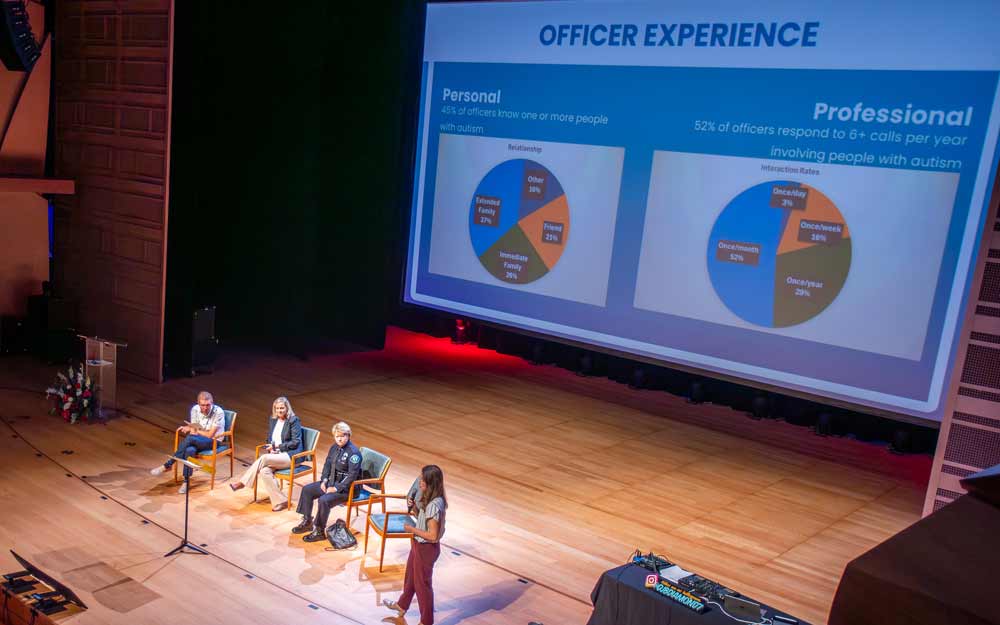
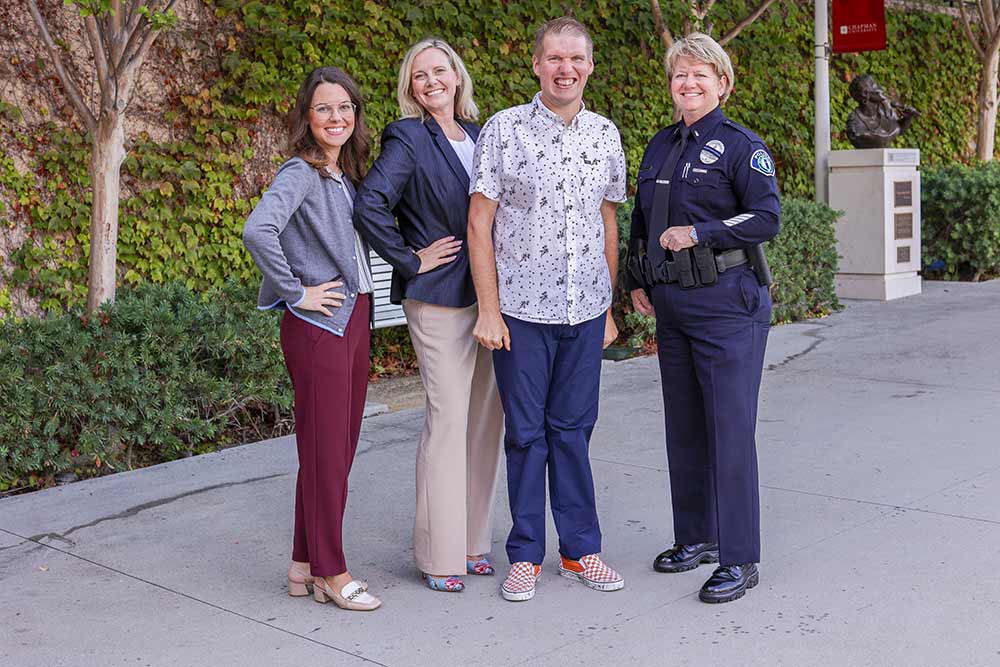
Many law enforcement officers (LEO’s) lack the training and resources needed to effectively engage with individuals on the autism spectrum during everyday public encounters—from routine traffic stops to high-stress, critical incidents. This often results in harmful outcomes and escalations that increase the risk of injury for both the individual with autism and the responding officer. To close this gap, a small group of researchers created Autism Awareness Training for Law Enforcement Officers. The program makes a lasting impression by bringing officers face-to-face with a multi-disciplinary team, including researchers from the Thompson Autism Center at CHOC /Chapman University, a fellow officer, and, most importantly, individuals with autism. Elissa Kaustinen and Kaylie Holke from Thompson, and Lieutenant Cathy Scherer of the Irvine Special Operations Division, recently sat down with ABILITY Magazine’s Chet Cooper and Diana Pastora Carson, M.Ed., to discuss the program’s development, its real-world impact, challenges in law enforcement and some of the surprising positive outcomes they’ve seen along the way.
Chet Cooper: How did this program come about? Did you create the program and then pitch it to the police department?
Elissa Kaustinen: In a sense, yes. But Cathy was also a part of the development. In development, we were really looking at what the need was and then seeing if there was a police department who was on board in assisting with the development. Kaylie and I did a lot of it, along with John, Spencer and Amy, but also Cathy had a lot of input on it. So, I think the development was really multidisciplinary and really having that officer’s lens to it. So, I think Cathy was very crucial in the development. She was just an integral piece of the whole entire thing, and we needed her to present as well.
Cooper: Can you give me the history of the program?
Kaustinen: I would say around maybe three and a half years ago, we were talking with our main donors, the Thompson family, about the need for law enforcement training, the need for officers to be trained on how to interact with individuals with disabilities. I think there were different stories in the news, and so it prompted a lot of conversation. There was another police department who worked in the past with us for an April Autism Awareness. We tried to start conversations with them. I don’t recall how exactly I got connected with Cathy, but someone said that Irvine may be interested. They do a lot for the community and are very supportive. Cathy was very willing and graciously met with me and jumped on board.
Cooper: Kaylie, you were part of that development?
Kaylie Holke: Previously, I was a speech pathologist, so I have a lot of experience working with individuals with autism from birth all the way up to young adulthood. Elissa, do you want to give a little bit about your background?
Kaustinen: I was originally a school psychologist within the school system and then a special education coordinator prior to coming to my role as the FAST (Families, Agencies, and Schools Together) Director at CHOC (Children’s Hospital of Orange County). My role is, really, community support, community outreach, not only supporting our doctors and physicians here, but also families. I try to take a holistic approach in working with our families. I go back and forth between using student, patient, individual disability. When I’m here at the hospital, sometimes, I use patients. Other times, it’s really students. I think, in order to support the students, we really have to also train the adults around them.
Products & Services


Holke: I’m also a doctoral student at Chapman with an emphasis in disability studies. My role in it was looking at the laws that changed in California in 2022, and then how we could design a training that would support the new mandates for officers to be trained, not just before it was an “either or” of mental illness or developmental disabilities. But now, there’s greater focus on developmental disabilities. (We ask) What does that look like? What support can we give? What does the research say? If there is an interest, both from families, from people with autism and also from first responders who say that we need this training, and this is something that we desire. And then we put it all tother.
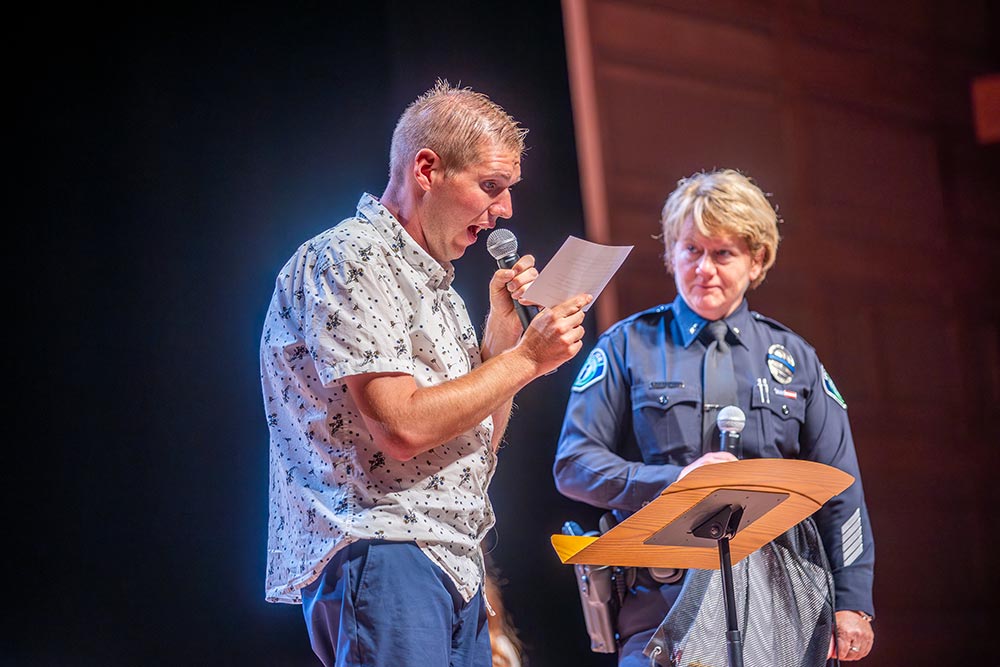
Kaustinen: I think the one thing that I love about this program is it’s actually very unique. Some places do great jobs, but a lot of times they don’t do it from various perspectives. To me, our training is unique in the sense that we not only have an officer who has a passion for it, but we also have our presenters who are two amazing adults with disabilities—And they just shine. I would say they steal the show. When we present, they do just such a fabulous job. I know, in education, we pay for different speakers to come around, but there’s not necessarily certain pieces that make it more memorable. I think our training is memorable because they can tie what we’re talking about to the interaction that they’re also having with presenters.
As a school psychologist, coming from the school setting, I had that lens. We have Kaylie, who is a speech pathologist, having that lens and looking at the communication and the words that we’re utilizing, And then additionally, we have John, who is a BCBA (Board Certified Behavior Analyst), who provides input because there are basic things that I think you look at, “What is autism?”, the characteristics and the definition… But when we really look at those miscommunications or misunderstood behaviors and the language that we use, having multiple perspectives and how it’s viewed have really made an impact.
Cooper: How did John get involved? How did he know what you’re doing, vice versa?
Kaustinen: John is a BCBA here at the Thompson Autism and Urban Development Center. I work with him closely. We were trying to actually run a study on virtual reality training. And so, I was training our patients here at the center on how to act with officers utilizing virtual reality. However, that study never took off, but it was a passion of his.
When our behavior group was looking at starting that study—It was around the same time that our conversation started. — I said, “Hey, if you want to help us develop this training, we’d love it to have that perspective and that lens.” I still think there’s a hope that eventually we’ll be able to try to transition and do some study utilizing virtual reality and then seeing if that virtual reality piece does generalize. And I know Cathy was really on board for that generalization. It just, unfortunately, has not taken off.
Cooper: Have you brought in other people who are on the spectrum to see what their views are on the program?
Kaustinen: We’ve talked to several different people. We really wanted to get some feedback
Holke: I was wondering if this would be relevant, that a derivative of this program being the Blue Envelope* program in Arkansas will be meeting with the Autism Society within that? Elissa, do you think that there will be opportunity to present?
*Blue Envelope is voluntary program that allows drivers with autism to place their license and registration inside a designated blue envelope, which serves as a non-verbal cue to law enforcement about the driver’s condition, improving communication and safety during traffic stops.
Kaustinen: Yes. We do think the Autism Society of Arkansas will have a chance to take a look at it before we start training officers and look at necessary feedback or tweaks that they would suggest or think needs to be made. We’ve gotten a lot of great input. And even as this evolves and as we grow, it’s one of those live documents that is probably going to change or add to or maybe take away. I think we’re always looking at feedback. If there are willing participants to come in, take a look, I’m really happy.
Cooper: You said Arkansas. Can you briefly talk about how you moved from local in Southern California, Irvine, specifically, to jump state boundaries?
Kaustinen: Yes. I did a presentation at Tash Conference in New Orleans in December of 2024. We actually presented our training—not every detail but the core components of our training—to a pretty large audience. And one of the gentlemen sitting there was the director of the Governor’s Council of Disabilities in Arkansas. He was getting ready to push forward this Blue Envelope legislation. So, conversations started that this would be a great program that would couple with this legislation. It’s not something that we’d have to start from scratch. He works very closely with the Autism Society of Arkansas. He’s been a part of them regarding the training and seeing what the rollout looks like there and really wanting to connect with people out there so we can then start training their officers. The legislation was passed February of 2025. We’re looking at starting training in the academy in October.
Cooper: Are you going to try to tie in some of the work that Cathy has been doing since she’s the first to be on the ground utilizing?
Kaustinen: Yes, it’s tying in Cathy. It’s tying in the Tactile De-escalation (sensory) bags. All of those components are very vital and key. We are looking at a train the trainer model there. One of the key pieces is that you need adults with disabilities to present. That and an officer component are very crucial to it. You don’t need me, but I think the adult with a disability and an officer are the two pieces that are the most important. That’s because, when it comes from an officer, they have the perspective of boots on the ground. They know what it’s like to pull over a car and not have any information. I don’t know what it’s like to get an emergency phone call and show up. That’s not what I do. I think that perspective, to have them talking to officers is very important and informational because they’ll have questions, and Cathy has answers that I don’t.
I also think it’s really important to have an adult with a disability because, with that, comes a lot of experience and their own personal input. Just because one adult thinks one way, doesn’t necessarily mean all adults do. I think all of those voices are very valuable.
I also think it leaves a lasting oppression. When officers are interacting, they can go back in their mind and think that Spencer is so memorable. There are officers that I run into after the training, especially with Spencer, and they’re like, “Oh, I met somebody and I was able to bring some of the things that we learned. And it reminded me of Spencer. The way I interacted was just a little bit different. It may not have been night and day different, but just those little changes.” We want to look at behavioral changes that are sustainable. When you can have that personal touch and you can relate it to somebody personally, you can see those behaviors.
Diana Pastora Carson: You mentioned that you would have an adult with a disability who’s one of the presenters. How do you select people? And how do you provide them with training?
Kaustinen: Have you ever met anyone from Glenwood Housing Foundation? We have a very a close working relationship with them. It’s an adult-supported living facility in Laguna Beach. They do amazing work. And so, we do things, really naturally, with them. A lot of their residents—They call them G-Force. It’s their community or group of the residents who give back to the community because they just really strongly believe in it.
G-force has volunteered with Laguna Beach. We’ve gone to different activities at festivals within the beach. I’ve taken some of our patients there. As we were looking at developing, the key piece was that we need some adults with disabilities who want to do this. There were several residents who got really excited about it. Two in particular, Amy and Spencer, were chosen. Now that Amy and Spencer have done it, there are several others who are like, “Can we come do it, too, now?”
We met with Amy and Spencer several times. And they had input on the content as well as the flow, for example, what signal they want on their slide. In our actual training, there are little pink and green dots. They’re not very noticeable at all, but it gives them the signal of “this is my slide. I do this one.”
We’ve met several times. I’ll go (to Glenwood), and we’ll practice. There are still other times where we’ve made some tweaks just because they are really out in the community in Laguna, and with different interactions, they realize, “Oh, I don’t like that, even though I thought I did like that.”
Products & Services


So, there are times where, in our presentation, we do draw from research, and we’ll pull in the research piece. But then we also make sure that we have their own personal experience, to give the officers a wide range. Just because one person likes it doesn’t mean that everybody else does. But here are some things that can help ease an interaction. Unfortunately, Spencer and Amy cannot travel to Arkansas with me. My task for Arkansas was to find some adults. I think they’re working with Autism Society to identify some people.
Carson: What are some of the discomforts in law enforcement, where they wish that they knew more?
Holke: In the literature, there’s not a wealth of information of published studies about interactions between officers and individuals with autism. There are some—but also few in number— that are survey-based. For example, what would officers like to see? The outcome is very consistent. They would like to have training. Often training about autism is linked with mental health disorders and in recognition that they cannot be treated the same. Officers would like to have more training.
Then the same thing, surveys that go out to people with autism say, yes, we also want officers and first responders to be aware that I have characteristics that have the potential to be misinterpreted. That stemming behavior has been misattributed to erratic behavior, suspicious behavior, lining up items on grocery shelves has led to conflict, things like that that would be nice if a responding officer was able to recognize signs and say, “Okay, this person does not need to be escorted to the hospital, but we could handle this a different way.” So, the research has been pretty clear on that.
To add to the training, we have surveys and interviews with people with neurodevelopmental disabilities talking about what they would like officers to know about them. Then the same question was asked to caregivers, What would you like officers to know about your son, daughter, the person in your care? We pulled together those answers, also with input from residents at Glenwood. For example, provide personal space if possible, turn lights and siren off if possible.—That’s something that’s big for Spencer; he volunteered that on his own. That one is said loud and clear in the research as well. He also said, “I would like an officer to approach by himself, not with a whole group. I would prefer it be walking, not at a run, that lights and sirens are off, and that the officer narrate to me what they’re doing. If they needed to touch my arm, they would say, I need to touch your arm now. And just saying different things and the why, but stating before it’s done.” For instance, instead of wrapping headphones on his ears, they would say, “I have headphones. I want to put them on you.”
I think there was another piece of your question, though, that sparked a thought. For me, one of my biggest ahas was after the first training, how many officers came up afterwards, as parents, to say, I want to talk to you about my son or I want to talk to you about my nephew or something like that, where I think there’s a greater learning and understanding of bringing people together in the same room.
Lt. Cathy Scherer: I’ve actually had officers get up and walk out of the training. And calling me and texting me later and apologizing, they’re like, I’m so sorry. It’s just everything we were talking about was just too close to home because their child has autism. And for them, this is just a Tuesday. But when they come to work, it’s different. They are working and dealing with it at home. But then they come to work, and we’re presenting about it. It just triggered some officers. What Kaylie was talking about was the aha moment for me, too. I didn’t even realize how prevalent it is. In one briefing setting, how many people are impacted by it, whether it’s their own child or it’s their niece, their nephew, whatever it is. And so that was the part for me that just solidified that this is absolutely necessary.
It’s having a conversation, but it’s also validating those officers that are parents that this training is absolutely necessary. It doesn’t matter if you live and work in the same place or if it’s two different places. This training is vital because this is occurring in the human race, and it’s not differentiating if you’re a police officer, a doctor, a lawyer, anything else. I think that part of it for me was very validating.
My passion came from my godson with autism. That’s what’s driven me to do this and realizing my interactions with him and realizing that other officers are going to have the same thing. And mine is a little bit further away because he’s my godson; he’s not the child I wake up with every day. And when those officers were coming forward and talking to Kaylie and just getting with me afterwards, it just solidified the fact that this absolutely needs to be done.
I’ve been in law enforcement for almost 30 years, and it all was training on mental health and had nothing to do with developmental disabilities. The spectrum is what has been on and off throughout the years. But I think that getting very specific neurodiverse training is not happening in law enforcement, and we have done a disservice because we’ve lumped it all together, which I think a lot of society does. I think, as law enforcement, we have treated it the same because for us, a short-term fix might be taking them to the hospital. But it doesn’t help in the long term with the development of that person. So, that’s my goal and challenge and willingness to help and train and do all the things that we’re doing to try and make it better. And for people to understand that there is clearly a distinctive difference. And you might have a little bit of both, but that’s a little bit more rare. But you’re going to have more multiple disabilities from a developmental side versus mixing in the mental health and the developmental disabilities. I think these guys have taught me that, and I’ve learned that through the training. It’s just a different level of communication and a different style of teaching.
Carson: What a profound aha for you and for the people that you oversee, Cathy, that you support in law enforcement. Kaylie, how far reaching is the program that you and Elissa are working on?
Holke: Right now, we’ve done a few different presentations in Orange County. That piece was taken to the Tash conference, and that’s where Elissa was connected with the governor’s office of Arkansas. Then we also took the data from the first round of presentations and presented at the American Educational Research Association in Philadelphia. So, little sparks here and there. At some point Elissa began doing a part of the training for Orange County Fire Authority, which was filmed. Then to the Falk Ambulance Company that operates in Orange.
Carson: Is there a plan to take this training to every police department in California or nationwide?
Scherer: Yeah, the first step, I told Elissa that she needed to get this class POST-certified, which is an arduous task because they do exactly what we do as law enforcement. In California, we have Peace Officers Standards and Training (POST). It’s overarching; all education goes through POST, and that’s how officers throughout California are certified to be police officers in California.
They said, “Oh, we have mental health training.” And Elissa said, “But no, this is different. This is different. This is different.” And she kept having to represent and message things out. It took over a year for her to get it POST-certified, but now it’s a POST-certified course, which means you can present to any police department within the state of California. They get training credits for this course, which in turn is important from an agency’s perspective because, if I’m going to send my entire police department, I need to know they’re getting certified hours for this training.
I think it’s vitally important to get that. Not every state has a POST-certification program, and no POST-certification program is the same. So, that’s the downside. It’s just a huge task. When she goes to Arkansas, there are different state laws, there are different parameters. Everything’s different. And there’s not a national equivalent to this.
Products & Services

Elissa and I went to the Orange County Police Chiefs Association and presented to all of the police chiefs in Orange County, including the Sheriff and the district attorney. And from that, we had the agencies send personnel to the training and take the course. Also, it is something that I suggested to her to go to Orange County Fire Authority because Orange County Fire Authority is the overarching fire authority within the county. Some cities have their own fire departments, but Orange County Fire Authority is the largest fire protector in Orange County. Because we have contract cities, Irvine contracts with Orange County Fire Authority.
Then came the Falk Ambulance. I think somebody heard about it through the fire authority. Falk is a contract ambulance service throughout Orange County. And they wanted the training also, partially, because one of the examples that we talk about in the training has to do with a fire department.
Holke: And about POST-certified classes, at the time that we checked the course catalog. If you typed in autism in the search, the only thing within an 80-mile range was mental illness crisis training. It was embedded in there somewhere, but that that was the only thing that was offered. There were online trainings, but the research that’s come out has been pretty consistent that to have disability-specific training, you need to have people up in front of you to be able to just see mannerisms, to look at how people are in space, ask questions and be more dynamic. Having a computer-based module just doesn’t quite work for this type of experience. So, that’s what we were bringing to the table. It’s not mental illness training. It is autism specific. We are going to co-present in person, and we’re going to be able to be dynamic and take questions and be physically present.
Carson: So do the officers go to this training on a volunteer basis, in your department, Cathy, or is it something that everybody receives?
Scherer: At the time when we originally presented it, it was for research. When we presented it, it went to everyone, every single person who was a sworn officer attended. Then I also have a large portion of professional staff that are in the field and interacting with folks that—They may be our traffic personnel. They take traffic collisions. So, they’re involved in a traffic collision and somebody’s driving a vehicle and they have a developmental disability or are a passenger in a vehicle, something to that effect. So, our field personnel were present for that.
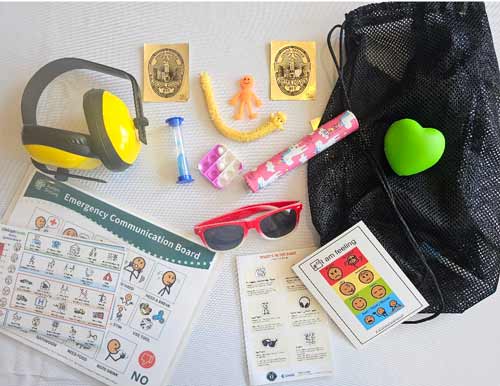
The sensory bags were developed by one of our DARE (Drug Abuse Resistance Education) officers, Matt, who’s in our Youth Services Unit. And he is the one that originally developed our sensory bags. He came to me and said “Hey, we don’t have these in all these cars. We only have them in supervisors’ cars. Can we get them in all the police cars? And I’ll do the training.” And so, this was all coming about all at the same time.
Elissa met him and they looked over the sensory bag and said, “Hey, these are the improvements that you can make to your sensory bag and this is why.” Then we enhanced it with everything that Elissa’s team brought in. And with John, the BCBA and the suggestions that they made, it just enhanced the bag for us. Then we went out and did additional training for the personnel to understand what was in it and how to utilize it.
I still, to this day, get emails from people, from the officers that like, oh, my gosh, this was so helpful. It totally de-escalated the kid. We put the earphones on. He had the sunglasses. He’s working with the fidget spinner, and it just totally calmed him down. And they were thanking me for it. It’s such a low-cost item that is so necessary.
Carson: All the collaboration you’ve done to come up with the things that need to be in the sensory bag, all the tools that someone might need. I mean, everybody’s different. You meet one person with autism, you met one person with autism. I know you guys have heard that a million times. But to have the tools ready and available, it could make a huge difference. I think it’s really important, paired with the right mindset.
Scherer: But I think having those bags as a resource, automatically, in my opinion, sets the tone for that mindset. Knowing that this could make your job easier is what they’re going to go to. They’re going, Okay, this will hopefully help. And they’re looking for those tools because (officers) are there to solve the problem or whatever issue, lack of communication, whatever it is. Sometimes bringing in something from the outside can alter and change behavior for the parent, for the child, so on and so forth. I think that just having the bag accessible changes the mindset of the officer.
I think all of those things go hand in hand. The bottom line is it’s all about dignity, compassion, and how you’re taking care of people. I mean, for me as a law enforcement officer, that’s why I got into law enforcement. I got in the law enforcement to help people. And that is what is the important part. Sometimes, I help people go to jail. It’s different help, right? But that’s not the primary function. Nobody calls us when they’re having a great day. They only call us when they’re in some level of a catastrophic event and/or tragedy. And that’s when we show up. You can either be the bad news bear or you can be helpful. And that’s really what our goal is: taking care of the community. A lot of our calls are taking care of our community, caretaking calls.
Cooper: How do you find the Cathy’s of the world within the police departments?
Scherer: Well, a lot of times, they’re out there. I can assure you, because there’s a lot of people just like me that got into law enforcement, like I said, to help people. And as prevalent as disabilities are, there are people that are touched by it. So, I think you just have to find those key people. Most people that are trainers are very good instructors. Teachers are oftentimes teaching classes already. And so I would when Elissa goes back there and has that initial conversation, it may be a fact-finding for a little bit to get the right person. She took a chance with me and didn’t know anything about me. I’ll go back to that. Remind me to go back to how we connected.
But I think that once you figure out who those people are, they have to be people that have the confidence within their personnel. If you put somebody in front of them that they don’t respect and they don’t understand or don’t believe that they have the skillset, then you’re not going to win them over at that point. But I think there are plenty of officers out there that will have very similar stories to myself or have been touched by somebody with a disability and more than willing to teach and be able to articulate the need and desire of why it’s necessary in law enforcement.
Holke: I wanted to say, too, I guess, along with what you were just saying, Cathy, that when the development of the training was happening, I was thinking, “How in the world am I going to stand up in front of a room of officers and tell them how to do their job?” A lot of what helped me see the multiple perspectives and how we all come together for this training is the idea that I can look at body camera footage from a certain angle and think, “Oh, as a speech pathologist, that man did put his arms behind his back. He just didn’t put it in the way that was expected from the officer.” But he did. His hands were slightly behind his hip level, so he was responding to the direction.
I can provide that input, but it really was great to have Cathy stand in front of her department with the respect that she has and say, “Let’s go through this video together. Let’s discuss it.”, which is an authority and a respect that I couldn’t just come in from an outsider and have.
I think that that’s something, going to Arkansas, hoping that officers there have that respect and rapport in their departments and say, this is the input I can provide you as a speech pathologist and who’s worked on this training. But knowing that it coming from my voice is not going to have the same impact as someone who’s embedded in the department.
Scherer: I think part of it, too, is when Kaylie and I talk. One part of our training is the officer is tasing someone. I’ll review the video and say, “Why did this person get tased?” And the officers are like, “Wow, they didn’t do what he told them to do.” And I’ll pitch over to Kaylie and go, “Well, Kaylie, from a speech pathology standpoint, how did this person do?” She says, “Oh, he did awesome. He told him to put his hands behind his back, and he did. He put his hands right back there. No, they’re not touching, but they’re behind his body.” And then the officer’s like, “Oh, okay. All right”. And so, it’s an aha moment and an aha training for the officers all the time.
Elissa always uses the term “take a seat.” Then we show the picture of the girl walking along and she has a chair on top of her head. Well, she took a seat. Then they’re like, “Okay, I get it.”
But when we can interact and have conversations, and they understand why certain things are happening, it helps them, I think, in the future. I’ve gotten the emails afterwards, and they’re like, “Every single thing you said, I told them to do this, and they did this.” They want to share it, and they say, “Oh, it’s great. We got through, we de-escalated, and we didn’t end up going to the hospital. We didn’t end up arresting someone and putting them in a county to jail when that’s not what they needed.” And so, I mean, every single one of those emails was a win for me. But I have gotten a lot more than just one. So that’s the payoff for us.
Cooper: Do you train them to know that sometimes just touching another person, that whole sensory component, and then there’s another reaction, another trigger that could occur?
Scherer: Yeah, we do discuss that, and we also discuss not separating the person from the caregiver. Whether it’s a parent or a caregiver that’s always with them, not separating them from that because those people know what those triggers are. If the officer takes the time and opens up that bag and pulls out the headphones, I can tell you a lot of times those kids are going to go right for the headphones. They will grab them themselves and put them on because that’s what they’re used to. I’ve seen them where they take the sunglasses and put the sunglasses on. Those are things that are, often times, in everyday life for a person with a disability. Kaylie, you might have a different opinion of it, but I think that, for us, when you open up that bag, it changes the mindset. And if they see things that they’re accustomed to seeing, they gravitate to that. And that’s why we developed the bag in the way we developed it.
Cooper: So, is this a part of the training where you would literally open the bag to show what’s in it? Here’s a good approach. We’ve seen best results. Is that part of it?
Scherer: Yes. And part of what Elissa covers when she covers in the training, she discusses the sensory issues, whether it’s the bright lights or the loud noises. She discusses those sensory issues and then breaks it down in ways to help or solve those problems. It could be that they’re pulling on their ears or they’re just covering their ears or they’re screaming louder, covering their ears because they’re trying to get your attention. But opening up the bag— and we actually opened the bag up for Amy and Spencer. And Spencer went to one thing Amy went to something different. And it’s just different. The interactions with them are just different. We’re trying to cover all the bases on that.
Cooper: Are there stats that data are being developed now?
Scherer: No. And that’s the biggest downfall I can tell you from law enforcement perspective is that there is not an avenue for us to say, “Okay, we’ve used this bag many times.” I mean, we know when we replenish it because it’s a single use, whatever it is. So, we would know from that perspective, but we wouldn’t know necessarily the background behind what the issue was going on. Because the data is not there for us in law enforcement because we don’t differentiate if this person has a disability. That’s not a checkbox on any of our forms, anywhere.
The lack of data is probably one of the biggest driving factors in this training. And I mean, if you’ve worked in academia at all, you know and understand you live by data, and research lives by data, and grants live by data, and nothing else gets accomplished without data. And unfortunately, law enforcement is not helping their own cause when it comes to data because that’s just not something that we track. Unfortunately, I do believe it’s an uphill battle in law enforcement because once you track that data and all of our data is open to the public, and then the general public understands and can get certain portions of data that it’s not always the data that can be released or that there’s certain levels of HIPAA issues, confidentiality, so on and so forth.
So, it is something that is a downside side. But if you look at law enforcement in general, ever since George Floyd, everyone who wants to know how many times we use a baton and how many times we use a taser how many times… And those data numbers are kept now, but they haven’t always been kept. And so I think this is an area that at some point in time will probably end up being researched. But at this time right now, the data is not there for us. I know how many calls we respond to regarding mental illness, but there’s no other data right now. We’ll pull it and group it together with mental illness, and that does a disservice for us. But differentiating developmental disability versus mental health is not a differentiation in law enforcement right now.