










Students with non-visible disabilities are facing a system where rights remain guaranteed on paper with IDEA (Individuals with Disabilities Education Act), but resources and oversight are rapidly disappearing. A 2025 reduction in force at the Department of Education has closed regional civil rights offices and cut staff in Federal Student Aid, making an already difficult landscape harder for families to navigate. At the same time, discretionary grants that train special education teachers, provide technical assistance for deafblind students, support parent centers, and fund research in special education are being cut, undermining the very programs that prepare educators to recognize and respond to non-visible disabilities.
The need for special education is growing as services are becoming more difficult to access. In fiscal year 2024, 37% (8,457) of complaints to the Office for Civil Rights (Dept of Education) involved disability discrimination, while enforcement capacity is shrinking. Instead of expanding teacher education, the U.S. is moving in the opposite direction. In July 2026, “One Big Beautiful Bill” Act is slated to reclassify education professionals, cap education loan amounts, and restrict access to teacher training. At a time when more educators are needed to identify and support students with non-visible disabilities, the pipeline is narrowing, leaving families with longer waits, fewer protections, and schools less equipped to meet the needs of every child.
In the climate of 2025, Jennifer Chang, JD shared an account of her experience as a Korean-American student growing up with a disability as well as her perspective as an attorney who represents families fighting for educational resources for their children with disabilities. Chang examined the current state of non-visible disabilities of school aged students. She shared an aspirational statement of need in current education system to address and accommodate students with non-visible disabilities.
As 2025 marks the 50th anniversary of the IDEA, Chang’s aspirations may be increasingly difficult to achieve. Long-time champions, including Senator Ed Markey (D-MA), are raising alarms about current plans to move the IDEA from the Department of Education to the Department of Health and Human Services. Advocates warn that, combined with deep budget cuts and the broader effort to dismantle the Department of Education, such a move could erode hard-won protections. Without consistent federal oversight, families and students with disabilities risk losing both accountability and the uniform system of support that has helped ensure equal access to education nationwide.
While the education of students with non-visible disabilities becomes more challenging for parents to address with the current changes in IDEA, ABILITY Magazine’s Chet Cooper followed up with Chang to dig deeper into the legal aspects of disability services. They also discussed what parents can do if they have a child with a disability and their educational needs are not being met.
Products & Services


Jennifer Chang, Esq.
Beyond the Surface: Non-Visible Disabilities in Schools
The American education system was not built to recognize students with non-visible disabilities. I know this because I lived it. As a child, I sat at my desk trying to unjumble the words on the page, frustrated and invisible while my classmates breezed through the same assignments.
My parents, like many others, were unaware of the resources that could have helped me. In our Korean-American community, conversations about learning differences carried stigma and undertones of shame. Each day became a battle to keep up, prove myself and hide my discouragement.
Those experiences shaped my path into education law. Today, as an education rights attorney, I fight for families whose children fall through the cracks of a system that too often overlooks non-visible disabilities. My mission is to ensure that children receive the services, support, and opportunities they are entitled to under the law, and to empower families with the knowledge and resources they need to advocate for every opportunity.
The Hidden Crisis
Conditions such as anxiety, autism, dyslexia, dysgraphia and sensory processing disorders rarely manifest in ways teachers are trained to immediately identify. Yet they profoundly affect a child’s daily life, learning, and interactions. Because these conditions lack easily observable symptoms, they are often missed.
Research highlights the scale of the issue. The National Center for Learning Disabilities reports that up to 40 percent of students with learning differences remain undiagnosed (1). The Learning Disabilities Association of America adds that roughly 60 percent of adults with low literacy skills have undetected learning disabilities (2). These statistics point to a systemic failure: too many children slip through unnoticed when early intervention and support could have improved their access to learning.
Instead of receiving services, students are too often mislabeled as lazy, disruptive or indifferent. Those labels carry consequences. Children tend to internalize the stigma of a ‘problem student,’ disengage from school, and lose confidence in themselves, all while being passed through grade levels as their baseline needs remain unaddressed.
Compounding the problem is a nationwide shortage of special education professionals and educators. The U.S. Department of Education has identified special education as an area of persistent shortage in nearly every state. This results in delays in evaluations, longer wait times for services and a shortage of trained educators to meet urgent needs.
What the Law Promises
Federal law provides strong protections to all children with disabilities on paper. The Individuals with Disabilities Education Act (IDEA) guarantees eligible children a Free Appropriate Public Education tailored to their needs. Section 504 of the Rehabilitation Act of 1973 prohibits discrimination against students with disabilities, including hidden ones. The Americans with Disabilities Act (ADA) requires schools to provide accommodations for disabilities that affect reading, concentrating, or thinking.
Yet too often, these rights remain abstract. Families often don’t know they exist, schools lack the resources to enforce them, and implementation varies widely by state and district.
Products & Services


Breaking the Cycle
Real change begins with earlier identification. About 90% of a child’s brain development occurs by age five(3). Universal screening in early childhood can flag potential development challenges before they become ingrained. Evidence-based educational frameworks, such as multiple intelligences curricula or teaching models like Universal Design for Learning, make classrooms more accessible by offering students multiple ways to learn and demonstrate knowledge. These approaches to teaching are shown to help all children in the classroom, not only those with formal diagnoses.
Educators require more training to recognize the less visible signs of learning differences. General education teachers, not just specialists, should be equipped to identify red flags and adjust their instruction accordingly. Investment in teacher training, endorsement courses for teacher certificates, and the hiring of school psychologists and trained interventionalists is essential for conducting timely and reliable assessments.
Families must also be empowered. Clear, multilingual information about IDEA, Section 504, and ADA rights should be readily available. Community partnerships and school English Language Learner administrators can help immigrant and non-English-speaking parents access and navigate paperwork, assessments, and Individualized Education Plan (IEP) meetings without fear or stigma.
Finally, transparency matters. States and districts should publish data on non-visible disability identification, broken down by race, income, and language. Data drives accountability, and without it, inequities remain hidden.
A Call to See What’s Been Overlooked

Invisible does not mean insignificant. Every child deserves to be recognized, supported, and given the tools to succeed. That requires school districts willing to look beyond the surface, families confident in their voices, and policymakers committed to enforcing protections already in place.
As someone who once sat in a classroom feeling unseen, I know the cost of neglect. But I also know what’s possible when families, educators, and communities act together. An education system that recognizes non-visible disabilities is not only more just but also more human.
Discussion with ABILITY Magazine’s Chet Cooper
Chet Cooper: How did you decide children’s education rights as a specialty within your law practice.
Jennifer Chang: I went to law school with the intention to work with juvenile participants. I thought I would make a bigger impact on the youth who are going through the system and give them a second chance to turn their life around. But in law school, I clerked at the DA’s (District Attorney’s) office, and I realized that you can work at the juvie (juvenile) department, but it’s just part of a rotation. You can’t only do juvie cases unless you become a supervisor of that department. I had no intention of going against murder, racist, whatnot. So, I was looking at what I can possibly do.
My professor told me about a children’s rights clinic within the school, where we represented low-income families with children with special needs. So, I applied for the clinic. I really loved the work, and I went to Southwestern Law School, which is right in middle of Korea town. But I noticed that the families that were coming in to utilize our services were non-Korean and non-Asian for that matter. So, I started doing a little bit more digging, and I realized that there is a big need, but there’s also a stigma in the Asian community.
You want to showcase a child that’s going to go to Harvard. No one talks about a child’s disability.
So, I speak the language, and I wanted to become a resource to my community. And so, that’s how I got involved. Then I started writing newspaper articles in Korean, educating what services there are. For example, autism. It’s not terrible, but you can still improve the quality of the child’s life and the parents as well. There are things you can do. And so that’s how I got into it.
Cooper: Yeah. And was there some personal connection to the work as well?
Chang: I don’t have a family member who has autism, but I, myself, have a learning disability. I didn’t realize I had dyslexia until I started work. I realized because I had a very hard time with reading comprehension. That was always my weakest, even in high school, college, law school, anything text-heavy. I couldn’t visualize when I was reading. And I soon realized that I also have a learning disability. For some reason, I was able to get by and did well. But kids nowadays, it’s just even harder for them because, when I was going to school, it was paper and pencil. Now, everything’s a lot of things are on computer, and that’s even more difficult to do if you’re dyslexic.
Products & Services


Cooper: Why do you think that? I think it’s easier. I also have dyslexia and ADHD. What I’m doing now, I’m using technology to make it easier for me.
Chang: I didn’t have text-to-speech or have the ability to record. I don’t have good auditory processing skills either. So anytime if the lecture was just all verbal without any visuals, I tanked on those classes because I couldn’t visualize anything. So, audio recording didn’t really help. I had to be able to see the text, the different highlighters, those will pop up during my exam. That’s how I’m able to remember. Things like that. I needed the touching. There was the sensory component to it that I required for my learning disability.
Cooper: Right. Some tactile. There’s a better connection with the brain if you have multiple senses working together. If they’re not transferring that digital form into something that has another sensory component to it, I get that.
Your work is basically with parents or the schools? What makes up your day in the sense of your work?
Chang: Generally, parents reach out to me because they are dissatisfied with how the school is responding to their concern. It starts with the parent, right? I can’t represent a child because they are a minor, so they can’t consent. The consent is provided through the parents. The parent will retain me, and then I will deal with either the school district staff or, if we’re in litigation, their attorney to try to resolve the case.
Cooper: And the area that you’re working with, whether it’s IDEA or Section 504 or any form of ADA. That’s federal, but what about California law? How does that work?
Chang: The Cal Code, education code, mirrors the federal code. So, it’s not like I have to use two different codes. Generally, it’s the same thing. It’s just under different codes sometimes.
Cooper: Okay. And what’s happening now? Have you seen anything happening with this administration and what’s happening with the Department of Education?
Chang: Oh, absolutely. The change is, I mean, it’s horrific what’s happening. They pretty much dismantled the special ed department so they know the funding is drying up. For school districts, they’re already cheap to begin with. They don’t want to spend money to change programs and educate students. Now it’s gotten worse because where’s the money going to come from?
Cooper: What’s going to happen? Because that’s what I was picking up just in the terms of being a layperson within this area and not having children and not being directly involved. What’s going to happen to these kids, to the parents, trying to fight a system that’s already difficult to fight?
Chang: Before parents had a recourse, if they didn’t have the funds to hire an attorney, they would be able to write compliance complaints and go about it that way. But now that’s pretty much gone. So, if parents are able to hire attorneys, then they’ll get some services recoup, but, if not, then they have to go with what the district may offer them.
I’ve seen a lot of districts now offering ADR with the alternative dispute resolution. I don’t think that’s appropriate because it’s not like there’s a third party judge or a mutual party coming in and trying to resolve. It’s called ADR, but essentially, you’re in the room with the special ed director trying to resolve the case. So, who’s really watching out for your best interest?
Cooper: As this federal money is drying up, do you think California is going to be in a better position than other states?
Chang: I would say I’m hopeful because of Governor Newsome. He talks about dyslexia. He put screening in place for that automatically. I think by the third grade, you have to be screened for a learning disability. And also California residents have Regional Centers. You have funds there that you can somewhat tap into. So, we may be better off than other states. But, still, we’re not going to be that much better off, I don’t think.
Cooper: So, what do you suggest parents do? I mean, I get that you’re an attorney and you get hired, but do you give any talks? I know you talked about your community, your community within the Korean community, but what else can you do or are you doing to support parents that are in need?
Chang: I honestly have to take it one family at a time. I can’t save the world.
Cooper: Come on?
Chang: (laughs) And some parents just want the easy way out. Other parents work hard. So, it’s just on a case-by-case basis. If the case is extremely egregious and parents really don’t have funding, I may take it on contingency. And there are firms who do that as well. But not everything is going to be that way because everyone’s bombarded right now.
Cooper: If you’re a parent whose child has certain learning disabilities that are affecting their education and you can’t afford an attorney, what would you do?
Chang: You need to start with the local nonprofit legal aid organizations out there. For example, if I have a colleague from legal aid calling me and they say, “Hey, this parent came in through the clinic. They really need services. We’ve done the initial intake. They have no means.” Then I would more than gladly take it on contingency because it came through the proper channel. But there are parents who show up in my Zoom meeting.
Cooper: If you are the parent that doesn’t have the resources and is completely unaware of what’s out there… The first thing I think I heard you start with is find a nonprofit that works in this area?
Chang: Yes. Look for legal aid offices in your area. Start from there. Then they will either refer them out to whatever resources they have. If the family is in rural areas, I would suggest just reaching out to as many attorneys as possible to see if someone is willing to take the case. Don’t give up.
Jennifer Chang is a California special education attorney committed to advocating for students with disabilities and their families.
Products & Services

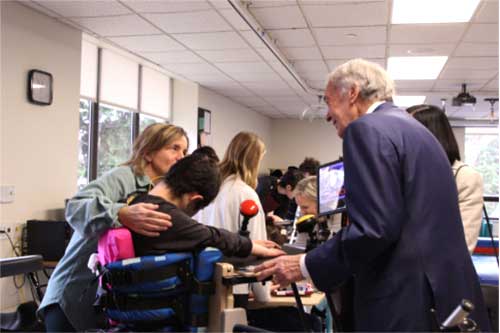
Senator Ed Markey
The IDEA was enacted to ensure that students with disabilities had access to the same educational opportunities as their peers.
Senator Edward J. Markey (D-Mass.), member of the Health, Education, Labor and Pensions Committee, visited the Campus School at Boston College, and met with students, parents and educators about the Trump administration’s effort to dismantle the Department of Education—including rumored plans to move the office that executes the IDEA to the Department of Health and Human Services (HHS)—and how he has been fighting on behalf of students across the Commonwealth. Moving IDEA programs to HHS would bring the programs under the control of HHS Secretary Robert F Kennedy Jr., who has spread misinformation and ablest hatred about children with disabilities.
“On the 50th anniversary of the Individuals with Disabilities Education Act (IDEA), we should be thinking of ways to expand services for students with disabilities. Instead, we are fighting to defend the programs students, families, and communities rely upon from President Trump’s pro-privatization and anti-student agenda. Attacks on public education especially hurt the most vulnerable students, including students with disabilities. With their continued callous cuts to the Department of Education, Trump and Education Secretary Linda McMahon are locking the promise of education in an ivory tower and throwing away the key. Dismantling the Department of Education is dangerous for students with disabilities, and I will continue fighting to provide the resources and support they need to succeed,” said Senator Markey.
“In celebrating 50 years of IDEA, the landmark law based on Massachusetts’ own Chapter 766 law, the Massachusetts Association of Approved Special Education Schools (MAAPS) was honored to name U.S. Senator Ed Markey a ‘Champion of IDEA’ for his unwavering commitment to all learners having access to education,” said Elizabeth Becker, Executive Director of MAAPS. “But MAAPS is deeply concerned about the future of special education and the IDEA. Dismantling the US Department of Education introduces uncertainty, lack of national continuity, and is frankly demoralizing. Eliminating the Department would effectively remove the only national accountability framework ensuring that students with disabilities are not underserved.”
Senator Markey leading the fight against the efforts to dismantle public education and to provide essential resources for students with disabilities.
- On November 18, Senator Markey released a statement after the Trump administration announced its plan to further dismantle the U.S. Department of Education, closing six offices and moving critical functions to other agencies.
- On July 24, Senator Markey introduced the Pay Paraprofessionals and Education Support Staff Act, legislation that would create $25 billion in annual federal funding for schools that set a minimum wage for school staff of $45,000 per year, or $30 per hour.
- On July 17, Senator Markey reintroduced the Preparing and Retaining All (PARA) Educators Act, legislation that would establish higher wages, career pipelines, and professional development opportunities for school paraeducators.
- On April 4, Senator Markey, Massachusetts Governor Maura Healey, and the entire Massachusetts congressional delegation wrote to Secretary of Education Linda McMahon after the Department of Education notified the Commonwealth of Massachusetts that the Department would rescind $106 million in funding already disbursed to school districts across the state for K-12 education.
- On April 3, Senator Markey and Representative Jahana Hayes (CT-05) introduced the Paraprofessionals and Education Support Staff Bill of Rights.
- On April 1, Senator Markey slammed the Trump administration after the Administration announced its decision to cut $106 million in K-12 education funding in Massachusetts, and more than $2 billion to K-12 schools nationwide.
- On March 20, Senator Markey slammed Trump’s Executive Order to dismantle the Department of Education.
- On March 11, Senator Markey delivered remarks on the Senate floor to spotlight Trump’s plan to gut the Department.
- On February 27, Senator Markey introduced the No Cuts to Public Schools Act, which would prevent any cuts to federal education formula funding during the Trump administration.
- On February 10, Senator Markey held a press conference in Boston with Massachusetts educators and teachers’ unions on Trump’s vow to dismantle the Department, and the impact on Massachusetts students, educators, and communities.
- On February 6, Senator Markey, members of the Massachusetts congressional delegation, along with the Massachusetts Teachers Association, American Federation of Teachers Massachusetts, Massachusetts Association of School Committees, and Massachusetts Association of School Superintendents, released a joint statement after President Trump vowed to dismantle the Department of Education.
ed.gov/media/document/ocr-report-president-and-secretary-of-education-2024-109012.pdf
 * Footnotes:
1. ncld.org/ld-identification-through-process-data-analysis
2. ldaamerica.org/support/new-to-ld
3. files.firstthingsfirst.org/why-early-childhood-matters/the-first-five-years