






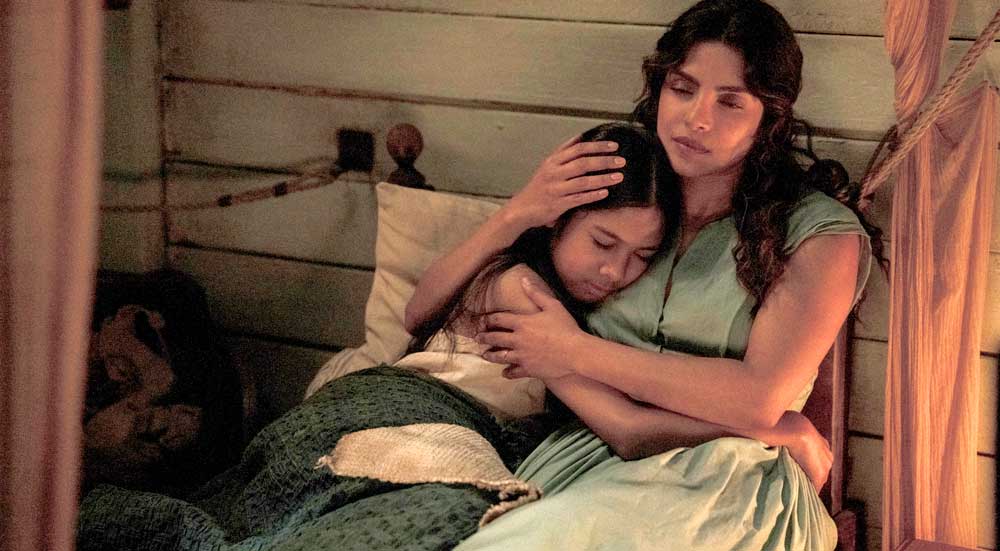
When Vedanten Naidoo stepped onto the set of the international action film The Bluff, he was doing more than playing a character. Accompanied by his mother, Nadine Naidoo—an actor, director, and Ashoka Fellow—he was stepping into a narrative that mirrored their own family’s history. For this mother and son partnership, navigating the entertainment industry is about more than securing roles. It is a shared mission to use media to tell untold stories, advocate for authentic representation and shed light on complex global histories.
“I’ve always taught him that we’re not here as actors, we’re here as activists,” Nadine says. “I’m very grateful that at this young age, I’m able to hand the baton to him.”
This activism is deeply rooted in their heritage. Nadine was born in South Africa, marking the third generation of her family in the diaspora—a lineage that began when her grandfather was brought from India to South Africa as a seven-year-old child with his parents to work as indentured laborers. Long before Vedanten was cast as Isaac—a character who is also a descendant of indentured Indian servants—Nadine made sure he understood this history.
Products & Services

Years before the film, Vedanten had exposure to his family’s history during a trip back to South Africa when Vedanten was in the second grade. Nadine took him to the Indian History Museum. Even at that young age, the reality of indentured servitude and the brutal conditions faced by his ancestors left a profound and lasting impact. They encountered a specific historical plaque detailing the devastating toll the journey and the labor took on the indentured population.
“He was tiny, but of course he could read at that stage,” Nadine recalls. “He couldn’t move from there because he was reading, and he was reading it out loud, and he says, ‘The suicide list.'”
“I felt like I was sinking,” Vedanten says. “Every death was like one inch lower into the ground.”
The weight of that early museum visit stayed with Vedanten. Now a middle school student, he sees the stark contrast between the global history he learned from his family and the standard curriculum he experiences today.
“I am in grade eight,” Vedanten says. “When you go to eighth grade, it’s only American history. And it’s like, what happened to the rest of the world?”
The historical context they absorbed directly informed Vedanten’s understanding of the film’s script. The Bluff explores how populations were manipulated and transported across the globe.
“History shows they were shipped around the world to work on British colonies after the slave trade was legally abolished,” Vedanten explains. The indentured workers were forced to sign documents with their thumb print. “If I can’t read what I’m volunteering for, how am I going to know if you volunteer me to jump off a cliff?”
Nadine continues, “the fictional story of Isaac and his mother Ercell—living peacefully, coming under attack, protecting one’s family and fighting for freedom—closely mirrored the real life generational trauma endured by families in the Indian diaspora spanning life in India under the British Raj, to Indentured servitude on British Colonies around the world, to oppression under Apartheid in South Africa after indentured servitude was abolished.
Between 1834 and 1920, 1.6 million Indian nationals were taken as Indentured Laborers to almost 19 British colonies around the world including Mauritius (453k), Guyana (238k), South Africa then Natal (150k), Trinidad and Tobago (145k), Reunion (120k), Fiji (60k), Jamaica (32k), and East Africa (30k), Singapore (3k) and Dutch Suriname (34k).
The Bluff is powerful in that Ercell’s story, as a survivor, raising a family on a British Colony—lifts the lid on the origin story of how the world’s largest diaspora, the Indian diaspora, came to exist across the world. Few Hollywood films have touched on this significant chapter of world history that unites us—as descendants of both the colonizers and the colonized.
But in addition to the historical significance, writers Frankie and Joe, the Saldana sisters, the Russo Siblings, Priyanka Chopra Jonas and AmazonMGM studios brought visibility to the role of mothers as primary caregivers of disabled children. It is the first time I have seen both those aspects of my own reality on screen to that extent and Priyanka brought such gravity to this representation.
Frankie and Joe credit Priyanka, Zoe Saldana and her sisters at Cinestar for shaping Ercell as a wife and mother. I appreciate how their feminine influence shaped Ercell’s quest to fulfill her soul’s purpose. She will not be defined or defiled by the trauma she suffered as a little girl, nor the horrors of her survival as a pirate. It’s hard not to watch this film as a woman and not be reminded of the moment we had to choose: to be the victim of a past trauma we could not control, or to be Who We Really Are. When we meet Ercell, she has already chosen. She has created for her child, the peaceful loving home that was stolen from her during childhood. She has redefined her worth as a person in the arms and eyes of her husband and child. She reminds us that we too can choose transformation—regardless of the past. That’s the path that our forefathers chose all those territories. And that mindset of choosing self-actualization in spite of oppression, was passed down from generation to generation.”
The alignment between the script and the family’s lived experience was profound. When casting the role of Isaac, the film’s director, Frank E. Flowers, was looking for a very specific intersection of talent, heritage and physical reality.
“…12 years old. Mixed race, has to carry the emotion of the film, Priyanka Chopra’s son, and also has palsy,” Flowers says. “And literally I was like, there’s no way. Like, there’s no way that person exists. And I saw him and I go, ‘Oh my gosh. It’s our guy. You were created from our brains four years before. How is this possible?'”
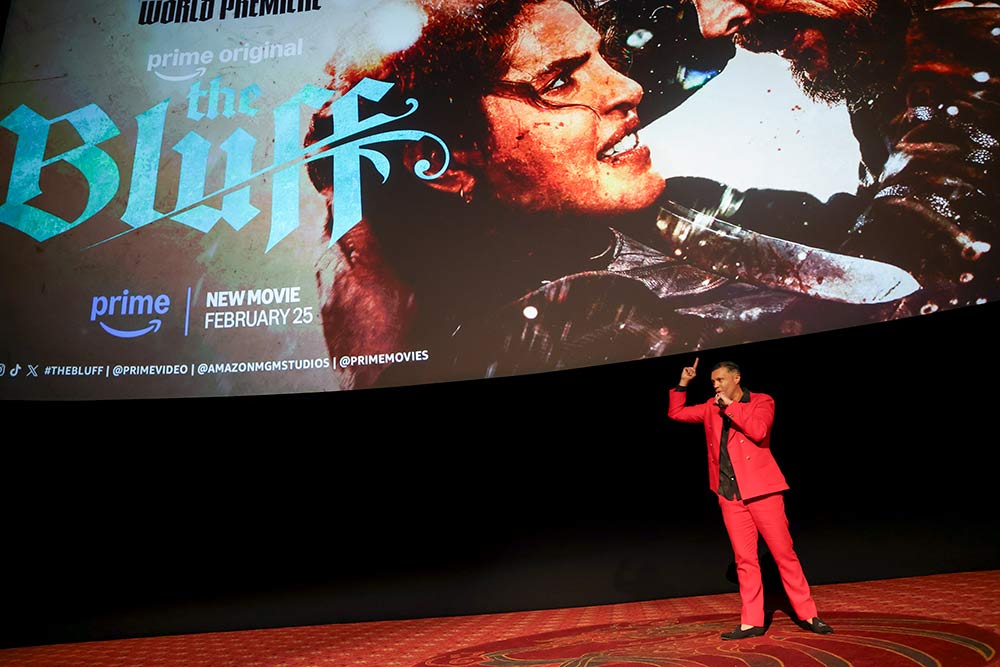
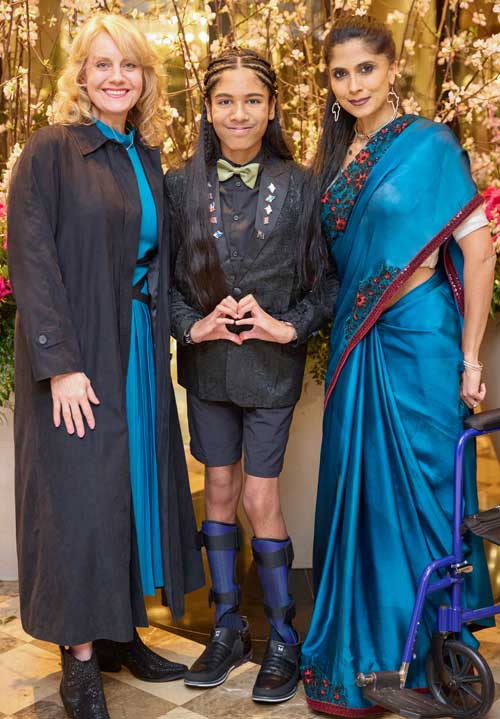
The commitment to authentic representation extended beyond the screen and onto the red carpet. At the film’s premiere, Vedanten chose to wear his heritage and his solidarity with his cast mates prominently.
For The Bluff, I wanted to honor my cast members and the crew and our wonderful captain by raising their flags on my tuxedo,” Vedanten says. “We have so much to be proud of because we’re part of a lineage that has survived colonization.”
To successfully bring this deep, historical representation to a Hollywood production, Nadine had to carefully navigate the realities of a live action set while advocating for Vedanten’s physical needs of cerebral palsy. Ensuring the set was accessible required open communication and collaboration with the production team.
Products & Services


Nadine approached these accommodations not as demands, but as logistical enhancements that often benefited the entire crew. When she inquired about wheelchair access for the beach set, the production laid down mats. This accommodation ultimately helped various departments move heavy equipment and vehicles across the sand more efficiently. When it became clear that the location had only one accessible trailer, which was unavailable, the crew built a custom ramp.
Nadine explained, “When we left Australia, we left with this idea that this custom ramp can now attach to any trailer and turn a standard trailer into an accessible one. So, that was a huge impact that I could say Vedanten was able to have through The Bluff.
“The key was Director Frankie Flowers’ approach that really set the tone. From the initial Executive meeting with Amazon and AGBO, Frankie and the team had prepared many thoughtful questions. And while we may have had the answers for what Vedanten was capable of in the past, we could not predict his condition post-surgery. Frankie was so invested in hearing our thoughts, that I ventured to share what may have cost us the job:
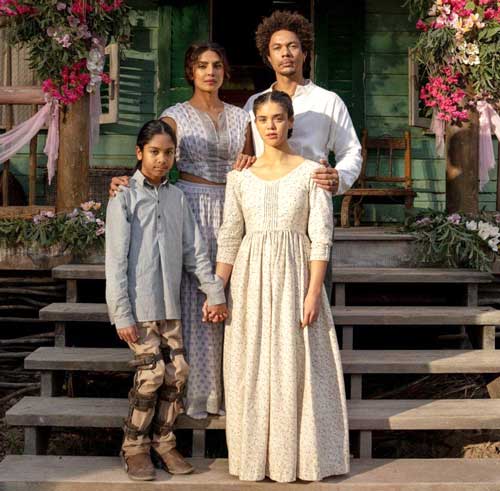
I explained that the more Vedanten had to focus on his balance and movement, the quicker he would become fatigued as he has to think about every step he takes. His stamina in terms of being on his feet was proportional to the level of orthopedic support he had. He would be able to focus more on his performance and for a longer period, wearing his orthotics while filming. And as I shared that, I remember thinking, “that’s it, they’re just going to make Isaac able-bodied to bring this production in on time and budget.” But instead, Frankie was taking notes and you could see in his eyes that his mind was at work. Months later when pre-production began, Frankie shared that Costume Designer Antoinette Messam and Set Designer Phil Ivey would work with us to create a custom shoe for Vedanten’s actual orthotic to be worn inside his costume, and his prop brace would be designed to fit over his pants. So, throughout the shoot day, for the full three months of shooting, Vedanten wore his actual carbon fiber orthotics inside his shoe. That was a game changer!”
Drawing from this positive experience, Nadine offers advice for other parents navigating the entertainment industry with a child who has a disability. She emphasizes the importance of partnering with the filmmakers rather than creating an adversarial relationship.
“In a production setting, our role as parents is that of being our child’s advocate while they are there to do their work as a performer on set,” Nadine explains. “Our role is to be our child’s advocate and to be an aid to production.”
She notes that a successful set experience relies on using a parent’s specialized knowledge to support the filmmaking process.
“We should be doing it in conjunction with the production team so that they see us as an asset adding value, being able to achieve that goal on budget in the shortest amount of time,” Nadine says. “And that way they’ll tap our knowledge because we’re the ones that know our children the best.”
Nadine recalls early conversations with actress Eileen Grubba. “Eileen has been a steadfast voice of encouragement ever since we met as speakers on diversity back in 2018. I had just brought Vedanten into the industry to make physical therapy (PT) and occupational therapy (OT) less painful and isolating. Her recollections of being discriminated against, treated with indignity, limited to stereotypical roles, and refused on-set accommodations, were heartbreaking. Eileen, Nic, abilityE and other advocates have fought so hard over the decades to give performers with disabilities like Vedanten the chance to be themselves without apology. Vedanten was blessed to work alongside an exceptional cast and crew who enabled him to express ‘the ability within his disability’. They truly raised the bar and Vedanten now has high expectations for how performers with disabilities should be treated: as equals. I hope his next productions meet the bar that The Bluff has set. Disabled performers and crew deserve the same respect and dignity as their able-bodied counterparts.
By intertwining their historical heritage with active, on-set advocacy, Nadine and Vedanten are helping to shift the landscape of the entertainment industry. Their work ensures that authentic casting and accessible production methods are not just anomalies, but achievable standards for telling powerful, inclusive stories.

Soulgroup Studio — Video
On the opening weekend, The Bluff was streaming No1 around the world on Amazon. Off-screen, the youngest actor Vedanten Naidoo, an alum of the Easterseals Disability Film Challenge (EDFC), and a disability advocate, was joined by Director-Writer Frank E Flowers, Co-Writer Joe Ballarini for an insightful conversation hosted by Nic Novici, Founder of the EDFC, now in its 13th year. On The Bluff, Vedanten plays Isaac, a 12yr boy with Cerebral Palsy,  the son of Ercell Bodden Priyanka (Chopra Jonas) and TH Bodden (Ismael Cruz Cordova); and nephew of Elizabeth Bodden (Safia Oakley-Green). Together they discuss the origins of the story, the characters and the Filmmaker's commitment to authenticity in bringing this hit to screen.