






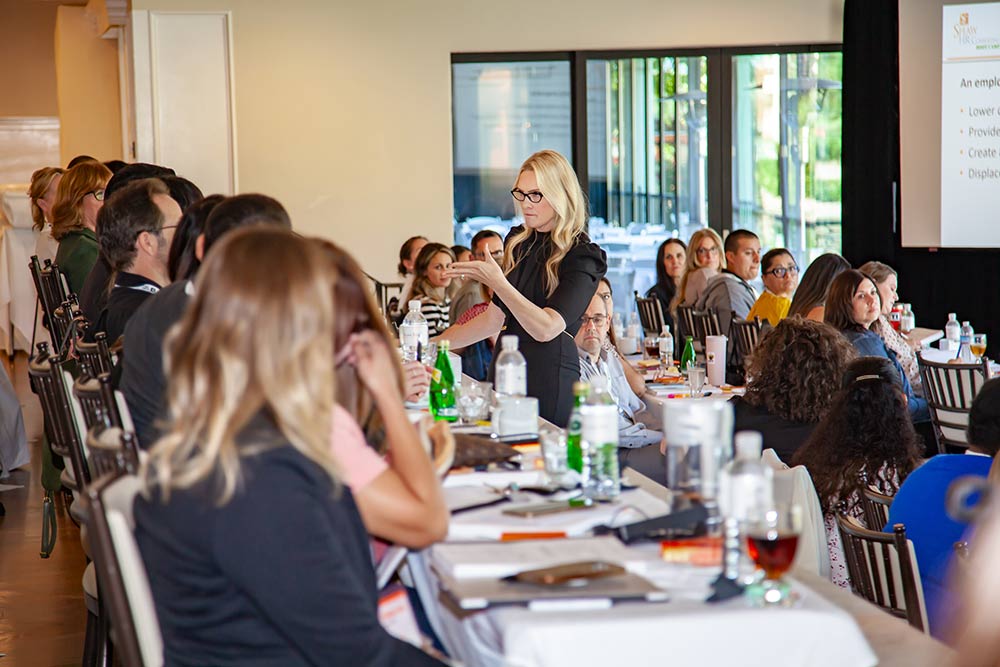
Employees with disabilities have the right to request reasonable accommodations to perform their jobs. With the recent rise of Long COVID—a series of symptoms that remain after recovering—requests to work from home have surged, often clashing with mandatory return-to-office policies. When employers and employees disagree on these accommodations, the results are often costly litigation, lost productivity and high stress for both parties. Rachel Shaw, president of Shaw HR Consulting and Rachel Shaw, Inc., specializes in resolving these high-stakes workplace conflicts.
ABILITY Magazine’s Marge Plasmier and Chet Cooper spoke with Shaw via Zoom to discuss her approach to helping employers make workplaces more accessible. Starting her career shortly after the Americans with Disabilities Act (ADA) passed, Shaw has spent decades developing a trademarked protocol to guide an interactive, data-based process that helps employers and employees work together to find functional solutions. She also touched on how her process helps both employers and employees move past emotional reactions to find effective, inclusive outcomes for the workforce.
Marge Plasmier: Tell us a little bit about your background.
Rachel Shaw: Sure. I’m an HR consultant. I have been doing HR since 1996. In 1999, I was hired at a school district to implement their Americans with Disabilities Act program. I did that until 2004 when I broke out and started consulting with another company.
Then in 2011, I started my own company, Shaw HR Consulting, and we focus only on disability compliance. It’s a super niche market, but my passion is to create accessible workplaces. I specifically support employers and employees with disabilities to figure out how to implement compliant disability programs.
So, that’s really all I do. My bachelor’s degree from Brown University is in history. I think I thought it was. I didn’t plan on going into this, but kind of naturally got into HR early in my career. Although the Americans with Disabilities Act was passed in 1990, in the late ’90s, this was still very new. Employers were still figuring it out. It wasn’t working very well.
California was just on the brink of modifying their disability law, the Fair Employment and Housing Act, which passed in 2000. So, there’s a lot going on, and we were really learning. It gave an opportunity for someone like me to figure out how to add process as a practitioner as opposed to just legal guidance. I’m not an attorney. A lot of legal guidance is out there but not a lot of practical application guidance.
That’s what I did. I created a trademark protocol that is used nationally to help employers navigate and comply with their obligations, but with compassion and thoughtfulness. I support them to find more inclusive spaces for people with physical, mental and emotional disabilities.
Chet Cooper: You mentioned school. Is that where you started to see some disparity or some problems around disabilities? Was that the trigger that said there’s an area that needs some looking into?
Products & Services


Shaw: I think it was just the time in the late ’90s because the ADA had been in place for nine years at that point. We were starting to see a lot of litigation in both the public and private sector. I think the reason that I got this opportunity— I was 24 years old. No one should have given me this responsibility—But the unique thing about public sector, cities, counties and school districts, is that they often will give someone who is untested an opportunity if they’re willing.
So, I think that it just gave me an opportunity to get in there and really fix a problem and create programming that didn’t exist. I think that there are issues with disability compliance. There are issues with lack of accessibility and lack of inclusion in every workforce. But we see more litigation in public sector and unionized environments. So, there is a reason why a lot of unionized environments, whether they’re public sector or private sector, focus more. They care about their culture, but they also are trying to mitigate the legal pitfalls when they don’t have compliant programs.
We also saw a lot of that with post-COVID return to work. Return to work is impacting litigation rates in every industry. We definitely are seeing greater issues coming out of public agencies where there’s unions and there’s more of an understanding of individual rights for workplace protections.
Cooper: Is Long COVID defined as a disability?
Shaw: It is generally considered a disability or what Long COVID produces is clearly disabilities. Long COVID, you’re probably not old enough to remember this, but I do. But fibromyalgia—If you’ve ever heard of fibromyalgia, it’s sort of in the ’80s and ’90s. Fibromyalgia is a lot like Long COVID where it’s hard to pin down. People are very fatigued. It impacts thinking, physical abilities and stamina.
With fibromyalgia back in the ’80s and ’90s, a lot of workplaces thought it was not real. It was made up or it was psychosomatic. We’re having some of those issues with Long COVID where some employers feel like Long COVID is the same issue when their employees are having it. It’s very hard to diagnose and there’s not really anything that proves it.
There are all these different things happening, like fatigue, brain fog, stamina issues and physical atrophy. There are all these issues that if someone had a bad case of COVID, doctors are saying is likely related. So, it’s hard because it is considered, but how it affects the person is what usually guides to the disability.
So, yes, in every state, if someone approaches their employer regarding Long COVID or a disability that’s impacting them, a performance issue, a leave issue or a remote work issue, employers are having to engage with them in the interactive. But one of the struggles is, I think, a lot of employers feel like Long COVID is maybe either not legitimate or not all cases are legitimate. That makes the person that is struggling with this difficult diagnosis feel often very alone and very unsupported.
Cooper: What is happening now with the request to stay remote or be remote in the workforce?
Shaw: So, I’m sure it doesn’t surprise you that the reason we’re seeing 40% to 50% increases in disability claims nationally, not just in the states that touch an ocean, but nationally. A big driver of that is remote work is accommodation requests. Because an employer can decide how they want work done, they can decide they want everyone in the office from 8 to 5 or they can decide they want hybrid.
Employers get to decide how the work is performed. Sometimes that’s driven by clients. You can’t have remote workers if you’re a barista. When an employer has made a decision about how they want the work performed, whether they want it in person, hybrid, an office culture or a cubicle culture, an employer can dictate that.
But where they lose power over dictating that is when someone has a qualified disability, a disability that entitles them to accommodation. So, what happens is that, let’s say, you tell a whole work group everyone’s returning to the office full-time or hybrid. There are some employees who don’t want to return to office.
Some of them just quit because they can and they have talent, they have a big bank account or they’re close to retirement. There’s a group that have disabilities, legitimate disabilities, that are much easier managed. Their life is better, their health is better and their longevity is increased if they work remotely or have more of a hybrid.
Then there’s, probably in most work groups, a group of people who don’t want to come back to the office. They don’t want to quit. They may not have the ability to find equal employment or equal pay somewhere else. Maybe they’re asking for a disability accommodation and maybe they don’t need it. There’s always been that. There’s always been employees asking for stuff they don’t need, disabled or not.
One of the struggles employers have is you have 100 employees saying they medically can’t return to the office. In that 100, if you’re going to say yes to everyone, you’re done. But if an employer doesn’t want to say yes to everyone who asks, they have to engage with each of those people to determine if you really have a covered disability. Is it temporary or permanent? Can you do your whole job remotely? If yes, is there an alternative? If not, you got to let them work remotely.
That is the disability interactive process obligation for employers in the United States. It is time-consuming and it can be very frustrating. Some employers think that people are asking to work remotely medically but they actually don’t medically need to work remotely. They’re asking for it because they believe it’ll give them leverage or power against the employer’s decision of how they want the work performed.
I don’t know that that’s true in every workplace, but we work in a lot of workplaces where there is a subgroup of people who can work in person, but they don’t want to. So, they’re going to try to use a law or a right. What that does sometimes is cause people who legitimately need that to look like they’re also maybe not in need. That’s where we see a lot of conflict and a lot of litigation.
Cooper: You mentioned earlier you have kind of a format of giving some advice to employers about how to deal with this?
Shaw: So, we train employers on what is basically a trademark process. We consider it when they are triggered. Under the law, there are three ways an employer gets triggered: request, perception or knowledge of disability. When that happens, we train on two key conversations, four pieces of paper and one meeting.
We use a hallway protocol or a hallway visual. The idea that when someone triggers you under the ADA or your respective state law, like the Fair Employment and Housing Act (of California) or the Massachusetts general law, the employer has to have an intro conversation to understand the request. They have to give employees a similar process. The decision might not be the same, but employers have to give employees a similar process to evaluate the request if they’re not going to say yes to everyone.


So, we train on a hallway protocol. You get triggered and you have a foyer conversation. Are we in the right spot? After you determine yes, we’ve been triggered, whether we believe them or not or whether we think there’s an alternative accommodation we prefer, we’re going to get into the disability interactive process. This is a legal obligation.
It’s a four-step or four-door process. Those steps are to gather very clear data. One of the things that happens is, oftentimes, you don’t have really good data and that allows employers to make assumptions. That can be disproven in litigation. It also allows employers to make things up. Let’s say somebody has a work-from-home request. Why? An employer might think it’s because they live two hours away or it’s because they have a 1-year-old child. The employer can make a lot up about why that’s being asked for.
So, you have to talk to the employee. Then you get to ask the healthcare provider or their doctor why they need to work remote. That’s an accommodation. Why? What’s the restrictions and what’s the limitations that makes their body medically better or medically only able to do this work remotely? The employer has the right to get that data, but they have to ask for it. So, we teach employers how to get the good data.
The other three steps are to communicate the data that you receive, research accommodations, find yeses, meet with the employee and then implement. That protocol allows employers to take what is often emotional, sometimes difficult and complex. These are high-stakes issues for employees with disabilities and high-stakes issues for employers.
It allows them to remove some of the emotion and get into a four-step process that guides them through making a decision based on data. It allows us to best protect our organizations from letting things like bias, preference or perceived value of an employee seep into our decision-making, which always gets us in trouble.
Cooper: Is there any problem with HIPAA when you’re asking about medical issues?
Shaw: Great question. No, because under federal and state disability laws, employers are allowed to ask for what’s considered reasonable medical documentation confirming they have a covered disability and clarifying their functional limitations and duration. We’re not allowed to ask what diagnosis they have or what specific medication they are on. That’s considered PHI, or protected health information, and that’s what an employer is not allowed to receive and doctors are not allowed to give to us.
At what I call door number one, or step number one, we give clients sample questionnaires that are already compliant. We’re very clear that we’re not asking. We don’t need to know if they have lupus. We need to understand what it is their body can’t do, like lifting, pushing, carrying, exposure or sunlight. So, we ask very targeted questions. It’s very clear that we’re trying to understand what it is that the body or mind cannot do or needs to be supported to do differently.
That allows the employer and the employee to then have an interactive discussion. Okay, you’re indicating you want to work remotely. That is not a preference that we have perhaps as an employer. So, we want to support you alternatively. Here’s what we can do to make sure that you don’t violate any of these restrictions.
A great example is about mobility. I have four clients right now where, from the time you park in the parking structure and you get to the front door, it’s like half a mile. Those employees have mobility issues and they cannot walk more than five minutes. Those employers got the doctor to clarify the work from home is because they cannot be on their feet standing or walking more than five minutes at a time.
So, the employer purchased these four people scooters so they can go from the parking structure where they store them and they’re plugged in overnight. They can then drive that scooter into the office and use it in the office or not. They found a way to mitigate and to implement an alternative. But there’s no HIPAA because we’re not asking why they can’t walk for five minutes. That would be a violation of medical privacy.

Cooper: That’s a great example.
Shaw: So, what I will tell you is the problem with that option. I can solve almost everything with an alternative accommodation to remote work. If an employee does not want that alternative accommodation, there’s conflict and there are issues. Very rarely when we offer someone an alternative to fully remote work are they happy.
But that’s what the law allows. If an employer doesn’t care and they’re fine with remote work, then I tell them to approve everybody. You don’t need to hire me and you don’t need your HR team to be engaged. But when employers care deeply about having people on site partially, then finding alternatives usually exists. We just have to get to the what their body or their mind can’t do. Almost every time we can find an alternative.
Cooper: And what are the rights? Are the rights different per state about firing people for not following what the company rules are? Like everybody has to come back to work.
Shaw: So, they’re pretty much the same nationally for disability. If you’re disabled, there are differences in terms of “right to work” states for just general things. Let’s say, for example, I want all reporters to work in office every single day and you’re not disabled. You’re like “I don’t want to do it.” If you say no, then an employer has rights to decide they are firing you.
Once you say “I’m disabled and I can’t do it.”, everyone’s pretty much covered under the Americans with Disabilities Act. Now, there are states, mostly states that border an ocean, that have higher obligations. But generally, it’s the same. If an employee is asking for an accommodation, they have a medical need and there is no alternative like no scooter option, the employer cannot fire them if they can do their entire job remotely.
The employer has to accommodate them. They’re not allowed to say this is our preference, it’s better for our culture or it’s better for collaboration. They can’t have a reason like that. There has to be a part of your job that you can’t do. If you are meeting clients who walk in the front door for four hours a day and you’re walking them to conference rooms, you can’t do that if you’re home.
That would be a reason for the employer to say they wouldn’t be terminated for violating a return-to-work policy, but the employer would say we can’t keep you in your job because you can’t do your full job remotely and we can’t find an alternative to keep you in the office. So, we’re going to look and see if there’s a vacant non-promotional alternative job that could let you work remotely. If not, they would be medically separated or medically retired if they’re one of the few companies that still have pensions.
That’s the process. But if it’s not a disability-related matter, employers get to make decisions about how they want work to be performed. If it’s not a protected reason that the person can’t do it, the employer gets to say, then, you don’t get to work for me anymore. That’s why we’re seeing employees raise their hands. Many of them because they need it and some of them maybe because they don’t.
It stops the employer’s unilateral power to define how work is performed when someone has a protected class like religion or disability. That’s where the employee takes some of that power back. The employer has to then bend and consider if they can let them fully work remote if there’s not an alternative and they have medical need and they can do their job.
Cooper: Yeah, and therein lies the issue. How do you medically identify Long COVID?
Shaw: What I would say is Long COVID is hard. An employee can say I worked in person before because I didn’t have Long COVID and now I have Long COVID and that’s why I need to stay home. I’ve worked with companies where they have about 100,000 employees who have asked for remote work and there are very few that are Long COVID.
What we’re getting that’s even more frustrating is someone’s had a condition their whole life. They had the same condition in 2019 and they never asked to work remote and they never had accommodations. Then they were sent home for a year or two or three. They work from home and then they got called back and now they’re saying this disability I’ve had for 25 years means I need to work remote.
Employers are losing their minds. So, here’s what I say to employers. Is there fraud in your workplace? Maybe. There’s fraud in everything. But here’s what you have to understand. Before COVID in a lot of workplaces, it didn’t even occur to people that they could work remotely. The technology wasn’t there and we didn’t have different platforms that made it easier. Everything was so different.
Someone might have had a disability where they dragged themselves to work every day. When they got to Friday at 5 o’clock and they got on their public transit to go home, they slept all weekend to survive and get up Monday morning to have a job and have medical care. When they went home for three years, they told me, “Rachel, I have never in my life thought I would make it to 65, let alone would I retire, let alone would I be able to go out on the weekend and have a life. My whole life changed when I wasn’t dragging myself to work every day physically.”
So, I remind clients that just because someone didn’t ask for something before COVID, it’s because they hadn’t lived the experience. For some chronic medical conditions that you can’t see, people will only ask for accommodations when they either absolutely have to or when they realize their life could be substantially better. So, there is a portion of the workplace that is absolutely benefiting a disabled part of your workforce that didn’t ask for this before because they didn’t know it was available.
Products & Services

You have to keep that in your brain and in your heart because if not, what employers get is really cranky. Everyone’s lying and no one wants to come back. They’re taking away my power as an employer to dictate how the work is done. There are absolutely people in every workplace I’ve worked in that are exaggerating their need or lying.
But is that one or two people or is that the whole group? That’s where employers have to say they’re not psychic. So, that’s where you have to stop feeling and you have to get into process. Whether you adopt my four-step process or you create one of your own, you have to get out of the feeling because feeling is going to get you in trouble.
Feeling causes us to treat people differently. You have to get into process. You’ve got to figure out how to get out of your feeling mind and into your data mind. I don’t care what industry you’re in. I’ve talked to people making $10 million a year who are just as emotional and they’re about to make an emotional decision.
I have to stop them. I have to say you have to calm down. You don’t want to get a $10 million lawsuit and you also don’t want to impact your culture. There are people that need this and you need to go through the process. There are people you’re going to find out that there are alternatives. You’re going to get them a wheelchair, a closer parking space or their own office so they don’t get exposed to other people who are sick.
You’re going to find all these great ways to support people, whether they like it or not. Then you’re going to find some people who are misusing and abusing the system and you’ll deal with it. I have a client who’s fired some people because they found that they fabricated medicals or went to an inappropriate provider. Within that process, you’ll find out.
I had a client who had 1,000 requests for remote work. If I had managed 1,000 requests for them, they would have spent a lot of money. I said we’re going to take the oldest requests first and we’re going to start working through them. By the time we got through the first five requests where we said we need your doctor to give us functional limitations, we went from 1,000 requests to 150 requests in two weeks. I healed 850 people right now. Some of those people realized it wasn’t worth the effort.
Within that 150 people, there were about 80 people who absolutely needed this and they got it. They medically needed it. Then there were people that we found a lot of alternatives for that didn’t like it and there are a lot of people that opted out. So, process is so important because not only does it treat people similarly, but process also ensures that people think twice about if they really need it. That’s important because you don’t want to be managing 1,000 people if you don’t have 1,000 people who need it.
But you have to be consistent. This is why employers are getting sued and they’re losing because they’re treating people differently. They do not have a process and they treat every request for accommodation like they’re shocked that it’s happening instead of it’s a cost of doing business. Every employer is going to have accommodation requests and it doesn’t matter what it is. It’s the same process where you gather data and you seek out yeses.
Your whole focus is how to support them to keep working for you, not to fire them because you’re mad that they filed an accommodation request. It’s all about intent and it’s using that data to guide decision-making every single time, whether they are your best or your worst employee. That is hard for employers.
Plasmier: So, do you find that the employers that you work with for the most part are prepared to receive the accommodation request? It seems like something some companies would be familiar with already.
Shaw: I find that most companies are unprepared because they don’t have standard process. They know how to manage leave request and they know how to manage family medical leave. But I find that most employers do not have a standard process. So, they either decentralize and let supervisors get involved, which is never a good idea. Supervisors are really good at what they supervise, but they’re not really good at consistent, legal, compliant programming.
In my trainings, I give away my process. I say here, here are the four steps and here are the sample documents. Use it. Oftentimes—and part of it is these issues are very scary—A lot of times I find employers will bring in attorneys, which are great in terms of analyzing legal analysis and risk, but they’re not process-focused.
The solution isn’t getting smarter. The solution is using a very systematic program or process to gather data so the answer is clear to both parties. The biggest issue that I find in HR is we were trained by the person before us and that person may or may not be the best person to be training us.
So, a lot of our business is training because very good people who care deeply about doing the work well are very poorly trained in this. You’ve been to trainings or conferences and most of them are awful. So, part of what we do is really try to figure out how to get people to learn and to be trained, which is why we have a certification program.
We have onsite training because you have to train people and they’re not trained. They don’t know how to do it and they don’t have programming. They’re trying to make it logical. You can’t think your way out of this and no one’s smart enough. It’s so individual that you have to get to the data point. How you get data, that’s how you start figuring out what you can actually accommodate and not.
Plasmier: So, you bring the programs within these companies. Do you work on those case-by-case, for example the 150-people?
Shaw: We have two companies. One of our companies, Shaw HR Consulting, clients will bring to us individual, very difficult cases. So, we will actually help them do the hallway or do the protocol on individual cases. That’s one part.
99% of the work I do is I go into organizations, I audit their current programs and I implement fixes where they need it or sometimes complete overhauls. I work with their team. When you have a smaller company, it probably makes sense to outsource 5 to 20 files a year. But when I’m working with my big Fortune 100, you need me to get in there and help build the programming, which is easy, but then helping the team build capacity. It’s the repetition and it’s the comfort of knowing that they’re learning these tools and they’re practicing these four steps. I build these teams and then I go away.
We do spot training or they’ll come out. We could have never foreseen 2026 in 2019. The stuff that employers are dealing with, the volume of requests, the volume of leave, the remote work requests and the wonky requests for accommodation, we could have never envisioned this before COVID.
Rachel Shaw Inc. is just me working on anywhere from 4 to 10 projects a year where I help big, large companies do this right. They might have 1,000 disability accommodation files they’re managing and they need to figure out how to do that themselves. Your internal HR teams have to know how to do this stuff.
Plasmier: Do they use other resources for those accommodations like JAN, Job Accommodation Network?
Shaw: They do. I think JAN is actually the most helpful for someone who has a disability trying to figure out how to ask for what they need. The problem with the Job Accommodation Network is that, first of all, it’s mostly listed by disability name. If we’re doing it right in HR, I don’t know your disability name.
Products & Services

Also, there’s a million and a half ways to accommodate someone. I have someone with diabetes right now and they have asked to work fully remote because they said it’s easier if they have their medication in their refrigerator at home instead of in the office. Well, sure, that’s definitely a possibility. But isn’t another possibility that you bring in a lunch bag with an ice block or you have a refrigerator in your office?
So, that’s one of the struggles employers have. Employers have preferences and remote work is a good example. Employers who care about hybrid or in-person work care deeply about it. They’re allowed to. But when you get an employee asking to work remotely, they have passion behind why they want that.
The employer really needs to understand what are the physical limitations. You’re never going to convince that employee who wants remote work that I need you in the office. So, you’re going to have to show them “I can accommodate you differently and I know you don’t want it.” If you want to decline the accommodation I’m offering you, then you’re going to quit or we will not accommodate you. You’re going to have to really fight for understanding the limits, otherwise it’s just super risky.
Plasmier: You said that the employee is asking for a reasonable accommodation, they don’t disclose their disability.
Shaw: Correct. They’re never required to and they shouldn’t. Employers aren’t allowed to ask.
Plasmier: Right, but do the employees share?
Shaw: What I find is employees will often do that. Especially when they have invisible disabilities you cannot see, they want you to believe them. What an employer needs to do is they have to redact the medical if it says the disability. They have to tell the employee please don’t share that with me. I want to understand functional limitations, work restrictions or leave.
Employers often want to know what’s wrong with you because they think that if they understood the disability name, it would be easier. That’s not this process. This process says you don’t. Because all of us could have lupus or any disability name and it’s going to affect every single person differently. Our age, underlying medical conditions and access to medical care.
Then there’s just personality. I had a guy who got a paper cut and he wanted to take 12 weeks off. I had a gal that was going through chemotherapy and she’s working every single day. People are different. So, what employers need to understand is that you don’t want to know the diagnosis name. It doesn’t help you and it can actually make your brain do bad things.
You need to protect your organization because your brain is going to want to take shortcuts. In no state is an employer allowed to ask for diagnosis, condition or treatment. We don’t need it and we need to protect our organizations from knowing it.
Plasmier: So, the employers redact it?
Shaw: And if a doctor provides it, it’s technically a HIPAA violation on the doctor. The doctor’s not allowed to share that. We should be redacting it because it’s technically not information we’re allowed to have. If we don’t redact it and we use it out loud, we then have violated medical privacy rights. So, we have to be careful.
It’s pretty rare that an employee sues their employer for disclosing a disability unless they don’t get hired because of it. But what employers need to protect themselves from is our brains. Our brains want to take shortcuts. If someone has Long COVID and I think Long COVID is fake, I’m going to be like, “Oh, here we go again.”
We have to protect ourselves from what even the most trained HR person and our supervisors want to do when they hear a disability. I have clients who will say to me that their mom was diagnosed with schizophrenia and they cannot do this file because they cannot treat this person just as a medical condition. They’ll outsource that because they’re aware of it.
So, that’s why employers don’t want a diagnosis. Supervisors don’t want it because they’ll use it inappropriately sometimes, and that’ll get us in trouble. I always tell women don’t ever walk in an interview and say you’re pregnant or trying to get pregnant. You’ll never get hired. There’s just things you shouldn’t say because people can’t help but use that information against you or inappropriately using it to be a mother or a father to someone. None of that’s good for a workplace.
Plasmier: Makes a lot of sense. Chet?
Cooper: Right, but you do talk about who you voted for?
Shaw: (laughs) Right, exactly, and what religion I am or am not.
Plasmier: (laughs) So, you said that disability claims are up 40 to 50%?
Shaw: So, the numbers for 2025 say that filings for disability discrimination are up 40 to 50%. It’s at 46%. That’s just employees who are suing through the Equal Employment Opportunity Commission process because they believe they’ve been discriminated against based on their disability status.
A lot of that is remote work stuff. In California, those numbers are even higher. We’re also seeing those numbers higher in states where they’ve had return to work. You have white-collar office workers where return-to-work is more arbitrary. Some people are going through the EEOC and they’re also doing civil claims. In places like California, they want to go right to a lawsuit because they feel like there’s money in it. Or they feel like they had to leave a job because they didn’t get the flexibility that they needed medically.
Plasmier: Do you have any idea what the outcome of those claims?
Shaw: There are a lot of filings. So, we’re seeing a mix. In the middle of the country, we’re seeing a lot of the circuit courts. As long as the employer did a process and they can identify that the person couldn’t do their full job, we’re seeing some good results for employers. But it’s expensive and time-consuming.
In the more liberal states, we’re seeing straight to litigation and we’re seeing a lot of negative judgments against employers. Especially where employers want to be very aggressive, but their closets aren’t clean. They want to be aggressive, for example “we know Chet’s a liar and he’s bad. So, we’re denying him, but Marge we said yes to because we believe her and she’s valuable.” That discrepancy always comes up.
Cooper: Not sure I liked the example (laughter). It seems like you’re kind of an arbitrator in a sense because your different clients are opposed to each other. You have clients that are employees that are feeling discriminated against and then you have employers that feel like people are trying to abuse the jobs. Do you ever find yourself in a strange position to where you have both employee and employer coming to you?
Shaw: Yes. So, when employers hire me, you hire me to keep you safe, not to like me. You hire me to keep you safe, not to give you the answer you want. Companies want that. Ultimately, they need to keep their shareholders happy and they want to keep their culture intact.
So, a lot of times it’s talking an employer through and reminding them when there are higher stakes or more emotional issues. For employees, I’m never going to convince an employee. We always say that accommodation requests are like peach pies. Imagine a doctor writing that Rachel needs a peach pie, a corner office and work from home. Any solution is an accommodation. That’s a peach pie.
The law says employers shouldn’t be getting peach pies from doctors. They should be getting ingredients, like peaches, flour, butter and sugar. So, the goal is an employee walks in and says I need a peach pie. That’s the only thing that will fit and will work. They’re coming in positional because they know their disability or they know what they want.
Through process, we need ingredients. We’re going to look at those ingredients and maybe the outcome will be a peach pie, but maybe the outcome will be peach focaccia or peach pasta. In my interactive process hallway protocol, it’s the idea that I have imperfect humans who I have to walk through.
Products & Services


Employees may never have heard of the ADA before. They don’t understand that the employer has a right to implement alternative effective accommodations or that they have the right to challenge a medical if they think that it may not be appropriate. So, I have to help educate and inform. I have to remind that employee that we’re going to find out how to support you there. But it may not be the peach pie you asked for.
I always say at my consulting business, we always think of ourselves as the big sister. We’re going to tell you what you need to hear and we’re going to be honest and fully transparent. Is it always perfect? No, because some people thought they were hiring me to help them fire people. They become very aware very quickly that that’s not what I do. So, we part ways.
I have employees that come in and it doesn’t matter what. If they don’t get their peach pie, they’re suing their employer. This whole process is about protecting everyone in that process. If you do it right, it’s going to be much less painful.
Cooper: So, the employee typically won’t have money to pay for consulting. How do you deal with that difference between the two clients that you have?
Shaw: So, we never bill. Our clients are always both. They’re our dual client because our real job is compliance with these disability laws. Who pays us is often the employer or it’s the insurance company, or it could be one of the attorneys. But the obligation to engage in the interactive process is the employer’s obligation. So, typically, the employer is ultimately paying for it.
Cooper: So, an employee doesn’t come to you per se?
Shaw: Yes. Now we do some mediation work, but rarely. If the employee comes to us, usually it’s either through their union or their union gets us brought in. Sometimes we’ve done free work with people because they’ve done a Google search. You’re right, they can’t afford us. If they need support and there’s not a conflict, we will help them.
But usually, the employer will then pay because it’s in their best interest. You don’t sue the employee. The employee sues the employer if they don’t do it well. My job is to keep an employer from being sued because we create understanding through data and process.
Understanding is what never happens when an employer walks in with the power. They don’t use a process to gather data. Data lowers the power differential because then we’re using information as opposed to “I interpret work from home to be not legitimate.” An employer has all this power and that power is more equitable when they bring in data. They’re lowering the risk and the impact on their culture, their reputation and their goodwill when they have a bad outcome.
Plasmier: It makes a lot of sense for the employers to have a system in place that is based on factual information.
Shaw: I think what you guys get really well is that you’ve got to want to find a yes. You’ve got to want to figure out how do I keep this person working? How do I find a way to solve the disability issue so that they’re still working for us, maybe in a different way.
I think what happens so often is employers. These are sometimes already difficult situations and difficult relationships. You really have to protect your organization from making that bad decision. Part of that data gathering is medical and part of it’s knowing what’s out there. There’s a lot of yeses. There’s a lot of technology, like a foot mouse. It’s so simple and yet it mitigates so many issues.
There’s the mouthguard mouse called the Augmental. It’s the idea that you’ve got a mouthguard and it is your entire mouth mouse. You click with head movements and your tongue. You don’t need hands anymore to do a computer. So, there’s so many great yeses out there, but you got to want to find one.
Cooper: What was that called?
Shaw: It’s called a Augmental MouthPad. I found it because I had a client who couldn’t use a foot mouse and she was about to be fired because her hands have so low usage. The problem is voice-to-text software doesn’t work with the technology her company uses.
I found this company and they mostly do this for people who can’t even move their necks. It’s a mouthguard and you wear it. If you can move your head, that’s how it moves it and you can click in and out. It allows people to use all this super proprietary software that you usually can’t use voice-to-text on.
Cooper: We did a story on this years ago. I love the fact that you seem to be compassionate on both sides.
Shaw: I think what’s so important is how little time I spend on what used to be such a big issue, like accessibility, wheelchair ramps, vision impairments and hearing impairment accommodations. When I get something about accessibility, there’s so much out there.
I had a client in an old building. They can’t retrofit it and they can’t put an elevator in. This woman had MS and couldn’t walk anymore. She had to work on the second floor because the first floor was like the jail of the county. They were able to look at ways where she had two wheelchairs and she used this little stair lift to get her upstairs. There’s always a solution and not expensive.
I always say it’s budget dust. Whatever you’re worrying about it costing $10,000, that’s budget dust for you. Accommodations are usually so cheap. They’re under $300, typically, and most of my accommodations are free. This is just cheap stuff that keeps someone working for 10 or 20 years.
That’s where I talk to employers about how you kind of want to find a yes. If you’re going into this wanting to make a supervisor happy about giving them a no, then you’re going to find the no. You’ve got to want to find a yes regardless of if that person deserves it or not. That’s a mindset.
I need to change hearts and minds and how you approach the work. If it’s a no, it’s a no. I’ve fired a lot of people who have disabilities. The difference is they get it and you treat them with dignity. We help them transition or move on. Not everyone gets a yes, especially in physical demanding jobs.
Cooper: I love the problem-solving that’s in your psyche.
Shaw: I love what I do because all I’m trying to do is to create more space for people who typically are not given space. In my next five years we’re going to be talking so much about neurodiversity. I’m so excited about it.
Products & Services

We’re getting these kids that are now grown-ups in a workplace that have significant neurodiversity or autistic spectrum disorders and employers don’t know how to deal with it. We’re going to help these employers become more inclusive workplaces. I feel super lucky to do it.
Plasmier: I’m curious about the accommodations. Are you seeing a lot of neurodivergent people here or is that kind of on the horizon for you?
Shaw: We’re starting to see enough cases where every employer is having a couple. Some people say it’s the TikTok generation where you’re diagnosing yourself on TikTok. There are some adult diagnoses happening because there’s less stigma.
What I’m seeing is this new generation entering into the workplace. We’re seeing folks that have some significant communication and thinking differences. We’ve seen this forever with physical differences, but we’re starting to see it with thinking differences. I think in 10 years, autism will be discussed very differently.
It’s such a wide spectrum. For many people with autism, it’s a superpower. These are highly intelligent people who may have thinking and communication differences and they are hugely conflicting with the workplace. Standard norms like talking over the water cooler are for some folks not there and it’s causing a lot of conflict.
Neurotypical people expect the neurodiverse people to change for them. I love that I’m going to get in there and say we’re all going to change. We’re going to learn how to communicate differently. We’re going to learn how to accept different types of communication and thinking because at the end of the day they’re doing their job.
But it’s early days. What we need is more people who can go into a workplace as coaches and really teach neurotypical people. When I get employees who have had children, it’s much easier for them to realize they are not going to take this personal and they’re going to be more open. But we’re in super early days, so it’s going to be a little bit painful for a while.
It’s kind of like ASL interpreters. 20 years ago, I used to have to fight with employers over ASL interpreters. Now they call me and I’m like you’re getting it; we’re done. It used to be such a fight. Nobody wanted to pay for that. We’re in that early stage now where a lot of employers don’t feel that they have to accommodate for some of those more significant learning and thinking.
Cooper: Have you heard the term, if you know one person with autism, you know one person with autism?
Shaw: Yeah, exactly.
Cooper: So, that’s going to be the challenge. I like the idea of having a different company that has autism training. It’s just I just can see it just being really hard.
Shaw: If the person’s doing a great job and not having any issues, there’s nothing we’re going to do. But I also think it’s about volume. When I get a call from a client who has a new employee who’s autistic and there are issues, it’s usually the first person that’s been in the workplace.
Imagine if 20% of your workforce is people that are on the spectrum. Employees are going to have more experience and it will change the communication culture. I think it will be easier, but it’s always when they first start. Part of it is just that it’s new and there’s not experience.
A neurotypical person may not have had any experience other than watching a Netflix show about neurodiversity. After you’ve had coworkers that maybe have learning differences, I think the neurotypical people will do a better job because we do this in the workplace anyways. You have an employee who’s super sensitive. If I sit in her office and say what the hell, she’ll cry and she’ll want to quit because she’ll be so upset.
I have other employees where if I’m not like look, this is what happened, they won’t get it. We already do that for people. We manage them differently and we communicate with them differently. We have employees that are super sensitive or a little arrogant. But we don’t extend that same willingness to flex always.
Long COVID refers to symptoms that persist or develop four or more weeks after an initial SARS-CoV-2 infection. It often manifests as a combination of respiratory, neurological, and cardiovascular issues.

Studies show that Long COVID can significantly increase the likelihood of developing ME/CFS, with many patients reporting overlapping symptoms.

Post-exertional malaise is a hallmark of both ME/CFS and Long COVID, severely limiting patients' daily activities.

Understanding these conditions is essential for effective management and treatment, as they can profoundly affect quality of life.
Postural Orthostatic Tachycardia Syndrome (POTS), Myalgic Encephalomyelitis/Chronic Fatigue Syndrome (ME/CFS), and Long COVID are distinct but often overlapping chronic conditions. They frequently share symptoms such as profound fatigue, cognitive impairment, and autonomic dysfunction, leading researchers to investigate their common physiological pathways.
POTS
POTS is a form of dysautonomia characterized by an abnormal increase in heart rate after sitting or standing up. Symptoms include dizziness, palpitations, and fainting.
ME/CFS
ME/CFS is a serious, long-term illness that affects many body systems. The hallmark symptom is Post-Exertional Malaise (PEM), where symptoms worsen after even minor physical or mental activity.
Long COVID
Long COVID refers to symptoms that persist or develop four or more weeks after an initial SARS-CoV-2 infection. It often manifests as a combination of respiratory, neurological, and cardiovascular issues.
Key Symptom Overlap
- Fatigue: Profound exhaustion not relieved by rest is central to all three conditions.
- Brain Fog: Cognitive difficulties, including problems with memory, focus, and mental clarity.
- Orthostatic Intolerance: Difficulty maintaining an upright position due to circulatory or neurological issues.
- Sleep Disturbances: Unrefreshing sleep and altered sleep patterns.