






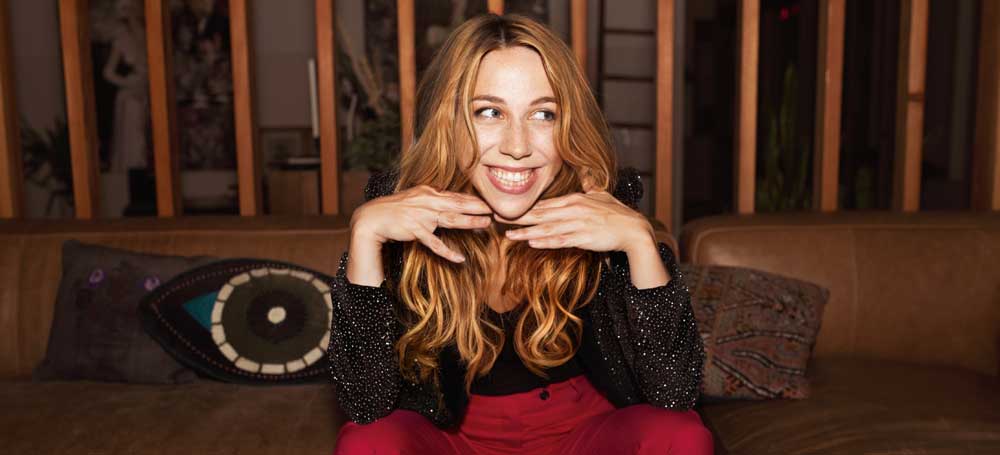
Tina Friml is a stand-up comedian whose sharp, off-kilter humor has earned her national attention. She has appeared on “The Tonight Show Starring Jimmy Fallon,” “Comedy Central,” and “The Drew Barrymore Show.” Her live performances span major comedy festivals and international stages, including the “Netflix Is a Joke Festival,” “Rogue Island Comedy Festival” and clubs across the U.S. and Europe. With a style that turns life’s darker moments into something laughable, she brings a fresh mix of honesty and wit to the stage. Friml doesn’t shy away from weaving in comedic twists about living with cerebral palsy, using humor to take the sting out of the hard stuff and flip it into something empowering.
ABILITY Magazine’s Chet Cooper and Olivia Austin met with Friml to talk about her approach to humor and her comedic idols. Sharing insights into her journey from aspiring actor/musician to stand/up comic, Friml revealed how her comedy began as a tool that grew into a passion and developed into the career it is today.
Chet Cooper: I should start off by telling you I was trying… Well, I did. I set up a surprise for you, I hope it was going to be a surprise, to have Geri Jewell on the call.
Tina Friml: No way!
Cooper: Way. But she just called and was so apologetic that she can’t make it and wants me to tell you how much she loves your humor. I asked, “Should I give her your phone number?” She said, “Yes and she’d like to meet next time you’re in LA.”
Friml: Oh, my God. Wait, it’d be awesome because I’ll be in LA next month for Netflix. Oh, cool. That’s beyond incredible because I get comments all the time. I’m like Geri Jewell. I never met her.
Cooper: That’s why I’m here.
Friml: (laughs) It’s amazing. I never connected with Geri because I didn’t know if she was just trying to just live a life. I didn’t want to impose.
Products & Services


Cooper: You’re definitely imposing. And I pressured her.
(laughter)
Cooper: I said, “You’ve got to talk to Tina!” Seriously, she was so excited for me to ask her to be part of this. She really loves your work. I was surprised how much she was gloating over how she thought you were great.
Friml: (laughs) That’s incredible.
Cooper: That is really nice. The last thing she said before she so rudely hung up on me, “You reminded her of her younger days of doing stand-up.”
Friml: I think when people mirror each other in some way, there’s even more of a bond that’s there. I owe it to people like her and people like Josh Blue. Josh and I actually do connect. We’ve done stuff together before, and I’m just totally in debt to those two people for just… I mean, they’re the OGs. They’re golden in my head.
Cooper: Definitely… Did you ever see her interview in ABILITY? Geri also wrote for us for several years.
Friml: She wrote articles in ABILITY Magazine?
Cooper: Right, she wrote a column and did some interviews. But we first interviewed her. You should take a look at that article. It shows images of her early days of stand-up. She looks so young and excited to be on stage.
Back to you…Most stand-up comedians do so well because they rehearse. They practice and practice and then they do their thing. I guess everybody has to, to some degree, to feel comfortable with adlib?
Friml: Well, the funny thing is I may have always been a person that speaks in humor. I see humor as a language, and I always, even before comedy, was a funny person. At the same time, I do get the reaction a lot, that I’m one of those people that’s always joking, always quipping.

Cooper: I really like that you said you use the “language of humor.”
Friml: The reason I call it a language is not just to sound poetic. As a kid, I used it as a language to diffuse people who were meeting me for the first time and who were either very uncomfortable or didn’t really know and couldn’t really sus me out. Even as a kid, that’s what I used it for.
Cooper: How did you decide to make it a full-time career?
Friml: I got into comedy accidentally because I wanted to be an actor and a musician. My entire teenage years and college years, that was my dream, my goal. In college, I got very into British comedy. It was a hobby.
Olivia Austin: What made you start performing?
Friml: Actually, right after college, my family gifted me a graduation gift of a trip out to London. Going out there and seeing the comedy really solidified that passion. On a whim, I signed up for a six-week stand-up comedy class at the Vermont Comedy Club, which was the only comedy club in the whole state. Here’s the funny thing: I was somewhat embarrassed to be trying comedy, and I told my friends and family that I was signing up for a stand-up comedy history class. I was like, “Yeah…I’m just- I’m learning about the history of comedy.” I think they knew that I was a big fan of comedy, so to me, it was just cringe to be like, “I’m going to try comedy!”
Then, pretty quickly into the six-week class, I began to realize, “Hang on, there’s something here.” Part of it was that I was getting external validation. I was having people pull me aside to say, “Keep going.” Actually, even one of the teachers of that standup class pulled me aside after four or five weeks and said, “I have a bar show on Mondays. I want you to do that five-minute set there.” I was already booking gigs, but I hadn’t even graduated yet!
Cooper: What was your major?
Friml: Oh, my major was Journalism and media arts. I had always been known to be a good writer so journalism was just- “I guess I’ll do it.”
Products & Services
Austin: Your writing skill comes out in your comedy. Your jokes reach audience members who are non-disabled and who do have disabilities. Do you find that balance difficult to achieve?
Friml: Well, it’s so funny because I, primarily, write for non-disabled audiences, and that was purely due to a reflection of my day-to-day life, where I basically did not know a single other disabled person. I didn’t know anyone else who had cerebral palsy. So, a lot of the experiences and things that I had to say were directed at non-disabled people. Mainly, in my hour, I make it clear that I’m basically addressing non-disabled people, but as I began to grow, I got feedback from disabled fans that they totally got it. That it was cathartic to hear what I had to say, addressing these non-disabled people. I think after a while, it naturally found an even footing to both. I wouldn’t be surprised if in the next ten years of comedy, I do even dabble more into things that disabled people can really relate to; the very niche experiences of having a condition.
Austin: I’ve heard it can be hard to break into the comedy industry as a woman or a woman with a disability because it’s a very male-dominated field. Have you encountered any of that?
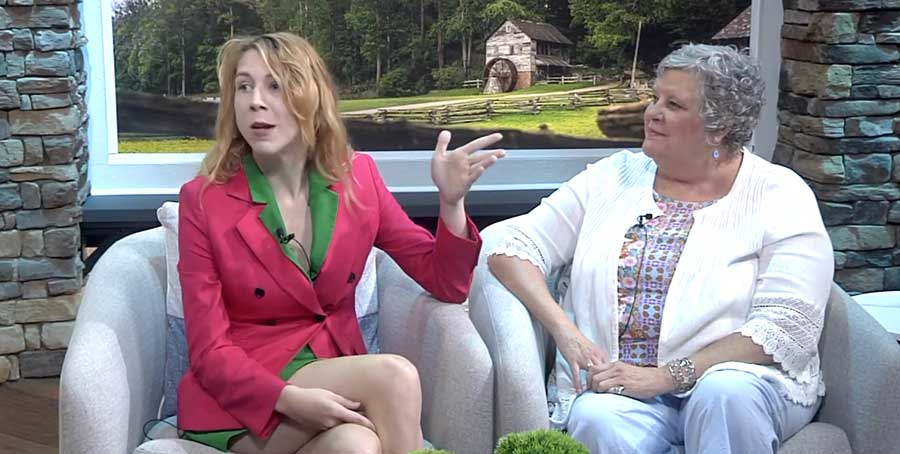
Friml: Definitely, at the beginning, it was very apparent that I was in a male-dominated field. There is a leg up that you do have. Being a disabled comedian is a bit of a double-edged sword. I do get into rooms easier. I get more noticed than maybe other comedians in the industry who really have to find a way, in their comedic voice, to stand out. I mean, regardless of my comedic voice, I stand out anyway. The tricky thing for me, is not getting into the rooms, it’s proving then why I am in the room. And for me, where at the beginning it was daunting to get into a field that was male dominated, the trickier thing now is to not be put in a novelty box.
Now that I’m actually successful, it’s a little bit easier. It’s a little bit like if someone tries to put me in a box of like, “Oh, she’s a disabled comedian,” I can point to a larger background of accomplishments and credentials, and it doesn’t really bother me as much anymore. There is always going to be a little subsection of the industry and comedy fans and comedians, where they just say that’s my whole shtick. Like, I’m more of a novelty act or a diversity act rather than a real comedian who happens to be disabled and talks about it. That’s mainly the way that I find I have to prove myself among certain people in the industry.
Austin: What do you enjoy about the industry and the comedy you do?
Friml: The fantastic thing about it is that even though it’s a full industry and it’s big, comedy is actually very small. What I love, that I find so lucky, is that I can go to any city in the country, or beyond that even, and I have people that are either comedians or comedy fans who I can instantly connect with. We know the same things and we deal with the same problems. On tour, that’s made it really easy. Touring doesn’t feel lonely to me because I feel like I just have friends everywhere. A lot of them I’ve met before, and some of them I haven’t yet. I’ve always got people.
Products & Services

Austin: I guess I’ve heard mostly about the competitive nature of the industry, and I always wonder about that.
Friml: There is that also. There 100% is comparing. In the comedy industry, you’re not literally competing against anyone, but you are ‘keeping tabs’ and so are people around you. I think for me, once I got to a certain level where comedy became my career and something I’d rely on to pay the bills, I realized I was getting very ‘comparative’- as opposed to ‘competitive’- to the other comics that I follow and being like, “Oh, they got this, they sold out that city. I didn’t sell out that city.” But I think all comedians, finally hit a wall. We realize, “This is doing me no favors to be so focused on what they’re doing and what I’m not doing.”
Austin: How do you get to that point? How do you find that sense of self, that sense of confidence?
Friml: Well, it’s a work in progress for me to find that out, but I mean, one way of thinking that helps me is a note I made to really set aside time to watch comedy specials, full hours, because I’ve been ingesting so much short form comedy on the internet, on TikTok and in reels. When you actually watch someone’s whole hour, you get their voice and you get their story. Comedy really is, at the crux, all about an individual perspective; whether that be their life story or just the combination of things that have happened in their life and their really unique way of thinking about things. At the end of the day, literally, the point of comedy is that we’re all different. No person will ever write the same jokes. And really coming back to the heart of that really helped me; that the only person you’re really competing with is yourself and your only job is to really just make your hour, your voice, the best it can be.
Austin: What comedians do you feel drawn to in terms of their ability to do that?
Friml: I always point to Maria Bamford. She’s in her own lane. She’s got such a unique and bizarre style and yet, I love the comedians that, even if you cannot relate to them, they make you think you relate to them because they’re so good at painting the picture of their perspective, and she does that.
I also recently watched the hour, the recent hour for Marcello Hernandez, who put out a Netflix special called “American Boy.” I thought that was an incredible hour. It’s the same deal. Even if you can’t relate demographically, he brings you right into it. I’m a big fan of people like Marc Maron, also, who are just not afraid to go into the darker parts of life and really bring them to light.
Austin: We interviewed Maria Bamford. I always wonder—isn’t writing those dark jokes hard?
Friml: The ending, the crescendo, of my hour right now is, very intentionally, about an incredibly dark thing which is how I became disabled, traumatic birth and infant death. When I wrote that, it was very intentional. I’ve been doing comedy for a number of years about disability and really wanted to challenge myself. How can I write about the thing that I still deem completely not funny at all?
It’s from that challenge where some of my most profound jokes came. I think for some comedians, it’s very natural for them to lean into the darkest things. For me, it’s more of an intentional personal challenge to do that, but I know it’s rewarding. Right now, I’m at the beginning of writing a memoir where I go into another incredibly difficult, dark period in my life. Reliving it and finding the humor in it takes work, but it’s some of the best stuff you can do.
Products & Services


Austin: Comedy really does have the power to lighten those hardest moments.
Friml: The jokes I have about my traumatic birth, took the power away from it. When I did the beginning of that section of my debut show—for some reason I decided to make it extra hard for myself—and I did it at a cerebral palsy conference. So, it was bomb, but I remember that afterwards, a woman came to me and she said, “My son had a very traumatic birth. I never, ever thought I would laugh about that or laugh about anything like that, but you just made me laugh so hard.” And so that was it. That was a powerful moment. I’m not just doing this for myself—I’m doing it for other people.
Austin: Do you ever get any negative reactions?
Friml: It’s hard not to, but I’m very lucky that I only feel it few and far between. Every now and then, I do get comments about: “Oh, she doesn’t know this but we’re all laughing at her not with her,” or pity laughs. It’s very obvious that the person saying it is just seeing this from a certain lens that they have for whatever reason and that there’s nothing critical about it and it’s just how they perceive the world. It’s not about me. It’s about any disabled person and they just don’t get it. My friend pointed out one time that, these people literally don’t know you because they’re all just internet comments.
Cooper: A lot of comedians transition into acting. Do you see that in your future?
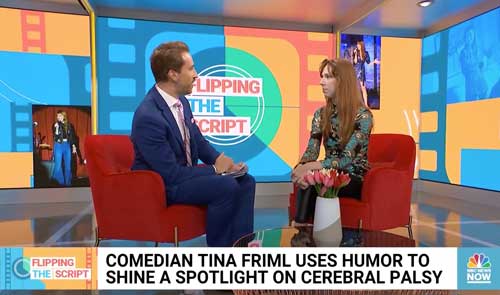
Friml: That’s always been a goal. I’m also equally, if not more, interested in doing behind the scenes, producing, consulting, directing even. I want to find my way into an equally creative part of a bigger effort to bring worlds and stories to life. There is one project I’m working on that’s a short film, and two other big projects.
Cooper: Can you tell us about your music?
Friml: I’m a self-taught pianist. For actually ten years of my upbringing, I was a songwriter and I would play piano and I would sing. I haven’t written a song in years, but it scratched this unbelievable itch for me that even comedy can’t.
Cooper: Have you thought about combining music and comedy?
Friml: I am very convinced that it’s not the last that these talents will come up in my career. You know what I’ve had thoughts about, even down the road, writing a musical. I mean, that’s a very ambitious thing. The songwriting could come back in the mix there.
Cooper: It sounds like you’re getting into your other strengths as you think about other things you’re doing. Even in your short film you could throw in little beginnings of this or some piano riffs within the movie itself.
Friml: In a special or something just the background track, written by me. The exciting thing about finally finishing, crafting this hour, that’s been ten years in the making (laughs), is that after it’s done, after it’s shot and it’s out there, naturally, you have to start over. You have to write a new hour or whatever, and it will really give me that crossroad. Like, “Okay, now what? Now that it’s out there, What’s next?” And that’s where something like this could really come into the forefront.
Products & Services

Austin: It sounds like you see that as an opportunity. I think a lot of people might feel intimidated or afraid of it. Does that come up for you at all?
Friml: Oh, yeah. I mean, there definitely is that because the best-case scenario is you put an hour and it’s a hit and people love it, and they want more. They want to go see you on stage now. Then you have to come out with new jokes. You do have to be pre-prepared. People put out an hour and then go on tour. They’re collecting all the patrons that saw the hour and loved it. Now they want to see you. You do have to have something lined up to catch that energy. So, yeah, it is a little bit.

Austin: What else do you have coming up that you’re looking forward to?
Friml: I just announced my European tour in June. Nine cities in nine countries across Europe.
Cooper: Are you going back to England?
Friml: Yes. London’s actually the last one. This year is turning into one of the crazier years where I’m seeing the fruits of my labor.
Austin: That sounds so gratifying.
Friml: (laughs) It’s overwhelming, but incredibly exciting.