







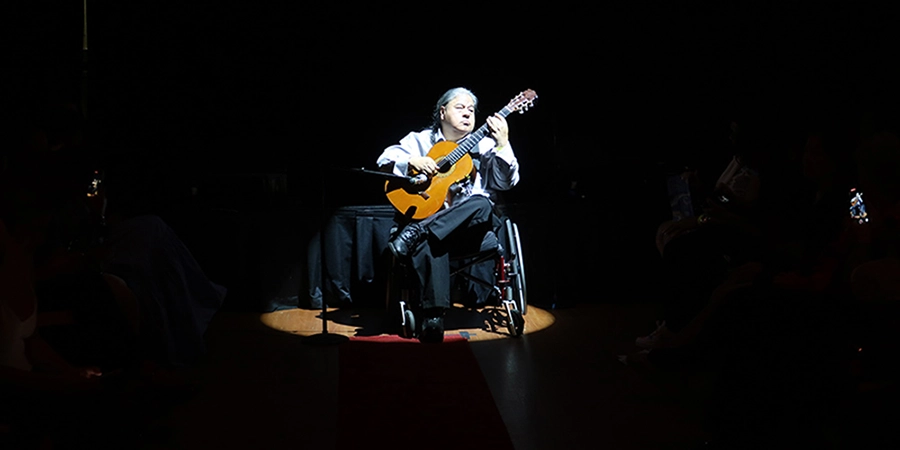
Music is the throughline that carried Dr. Fabian Carrera from his earliest memories in Ecuador to a career as a classical guitarist, music?therapy practitioner and university professor. What began as a comforting sound filling the hospital room of a small child in Quito became the discipline, resilience and purpose that shaped his life’s work. The music animated the small child with polio who grew into a dedicated student, renowned performer and person of service.
ABILITY Magazine’s Gina Velasquez, also from Ecuador, recently sat down with Dr. Carrera to discuss his musical journey, family and faith. Their heartfelt conversation traced the medical challenges of his early years, the influence and support of his father and the bold leap that brought his talents to the United States. They also spoke of his profound work in music therapy, exploring how a simple melody can soothe patients in palliative care and even helped solve a heartbreaking medical mystery.
Velasquez: Can you talk to us about your early life in Ecuador?
Carrera: These topics are very heavy. I can talk a little bit of how tough it was, how beautiful it was and how amazing the provision of God was in my life. By no means this is religious or preference for anything. I consider God in a very wonderful personal knowledge. It was really tough because we had to overcome a lot.
Velasquez: Can you talk about your experience as a child with polio? How old were you?
Carrera: Nine months old. My father was in the army, and my uncle was also in the army. He was high up in the military. And he said we needed to be at the military hospital. So, we went from Cuenca to Quito. It was like 10 hours’ drive on dirt roads. Highlands, very difficult to drive.
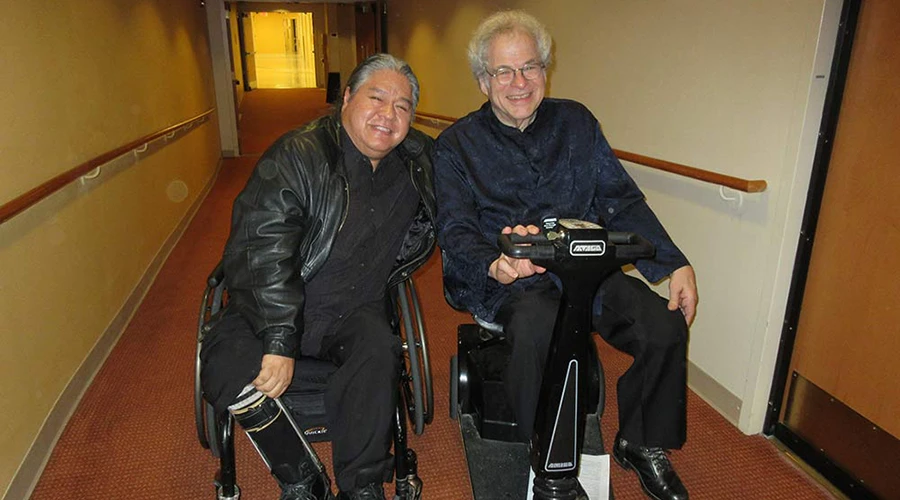
When we arrived at the military hospital, they said “He cannot be here. If it’s polio, we cannot let him because he’s going to be very contagious for all the kids that are here.” They set me up in an old military hospital in San Juan in Quito. It’s in a very old part of the city. So, behind the hospital, they have some tool sheds. They created a space for me to stay there until, finally, the polio broke down. And then I was able to enter the military hospital.
I don’t know how I survived that. They got me into the hospital and gave me the medications that I needed. And the physical rehabilitation that was required. (There were) a lot of processes because my two legs were compromised, my spine was compromised. I had to be fitted with two braces. The braces were from the toes to my hips connected together for both legs, connected at the top of my waist.
Besides that, I had to use two crutches, which made it so difficult, so painful. And then the therapy process. I continued my rehabilitation for five years. I had to be in the hospital because I had lung complications. I was also confined to an iron lung for a season.
It was a very hard case of polio. I grew up five years in the hospital, I didn’t leave. The doctors used to always tell me, “You are my king.” I was like, “What are you talking about?” They said, “All the kids that had polio died, and you are alive. That’s why you are my king.” Of the kids in 1966 that were affected by polio, from 75 to 80% died. They didn’t arrive even to one year old.
Velasquez: What is your earliest memory and what kind of mobility did you have then?
Products & Services


Carrera: My first memory, I would say, was music because my mother left a radio next to my bed. A radio station that was constantly playing music. I start listening to music and start moving my head side to side, left, right, left, right, left, right. And then little by little, start moving my shoulders. That’s why I’m a firm believer that music therapy has power.
I would say, without being the beating or playing violins next to me, it was a lot of pain. It was a lot of crying. It was a lot of tears. And the nurses that they used to work at the hospital, some of them, were nuns. They were in the military. I don’t know what branch, but they used to take care of us all night long.
And I understand completely, there were a lot of kids that were in pain and they needed to sleep, the nurses needed to sleep. And then they used to come at us and tell us, “Shut up, we need to sleep” “What do you want?” And start yelling super loud. I couldn’t understand what was wrong with these people. When you yell at a child, it makes the brain lock. You don’t hear anything else. You don’t follow any more orders.
That was the part at night. In the morning, it was a different story because we had different nurses. I was able to see my mother. I was able to see my father. My mother used to come and read books or magazines to me. And singing songs for me.
Velasquez: And those are your first memories?

Carrera: Yes. I don’t remember anything about Christmas, about my birthday or anything. That was since I was six years old. That was the first time I could say, “Oh! This is Christmas.” Oh, my birthday. Oh, nice.
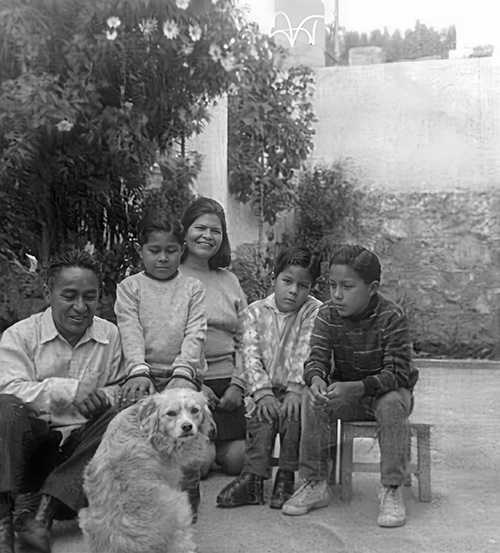
It was really tough in those stages, even my mother told me something disturbing. She came with a camera and the nurses and the soldiers that used to care, “Excuse me. No. We don’t allow this.” “Why not? He’s my son.” They said. “This kid is going to die and what are you going to do with his pictures afterward? Cry more? That’s why you need this? No, put it back, we cannot allow this.” So, I do not have pictures of me as a (young) child. I have pictures of when I got to see my family. It’s a beautiful picture in black and white.I got to experience this wonderful thing of being with a family. I went home and what a surprise! I met my big brothers. I didn’t know I had brothers. My big brother is five years older than me and the middle is three years older than me. And it was tough for them too because they have to stay all those years with my grandparents. They forgot about me and they started calling my grandparents mom and dad.
So, when we came back, my daddy came back and talked to my grandfather, “I’m going to take the kids.” “What? No, you’re not taking the kids. I love them.” And the kids didn’t want to go with him. It was a tough story though. Finally, my father reunited all of us. I will say this was like a traumatic encounter though.
Velasquez: When you finally left the hospital and went back to Cuenca, what was your condition then?
Carrera: The doctors told my father not to go back to Cuenca because they don’t have hospitals there. “We need to have special treatment for him, and he eventually is going to need two major surgeries on his legs.” My father talked to my uncle, who was high up in the military. They transferred him from Cuenca to Quito.
With therapy, I thank God, I recovered the mobility of my left leg. Unfortunately, my right leg is still paralyzed. Because I did recover the mobility of my right leg, the doctors told my father they were going to put staples on my kneecap because he said this leg is going to grow and the other won’t. And we needed to stop the growing of the left leg, so when I got to puberty, the difference would be minimal. The doctors said, “We learned because we didn’t do this before. The patients that got polio had 8 to 10 inches difference between legs.”
Velasquez: So, what happened?
Carrera: The surgery needs to be when you’re a child. If you already passed that threshold, it’s too late. I was in the perfect stage. I think I was 10 years old. When I had the surgery, the first surgery, they put eight staples—four on the left side and four on the right side of the leg. They were going to stop the growth plate.
A year later, I was playing with my friends at school and I fell down. And one of the staples came out. I was scared. I forgot completely that I had staples on my knee. They took me to the hospital and they did x-rays. They saw the staples were opening up already. They couldn’t hold the growing.
By then I was maybe 11 or 12 years old. The doctor said this is what you’re going to get—my height—and we need to remove the staples. Today, I only have 1.5-inch difference between both legs.
Velasquez: That worked out. That’s great.
Carrera: When I was a kid, a teenager, I only used the right brace. The shoe had a sole like one inch. So, you can even look at the difference between shoes.
Velasquez: Right.
Carrera: Yep. That was it. And then the doctor said, “My king, this is how far we can go with you. You are alive. Of course, you’re going to limp a little bit but continue doing your therapies. As far as this polio, this is how far we have gone. Enjoy your life and follow your dreams.” And then he hugged me and kissed me on the cheek. And here I am.
Velasquez: It worked.And you regained use of your arms?
Carrera: My arms weren’t affected as much as my legs were. What was affected was my lungs and my legs because that affects the muscles. When they realized I had polio, it was too late for the right leg. They tried to, they put needles in the bottom of the heel, and they didn’t find reactions like the nerves. They poked me on the other leg and started having reflex of the nerves. That’s when they said, we need to take this kid right now to the military hospital Quito.
And then a new chapter begins. I was going to regular high school. We didn’t have to go to kindergarten. You went straight to first grade. (The school) said, “No, he doesn’t deserve to be here because he’s mentally challenged.” They assume instantly, right? I needed to be in a school they call Artes y Oficios. It’s a school for kids that have mental challenges.
Those kids were going there to learn how to be carpenters, how to do plumbing, or things like that. After maybe three years, you’re ready to work, or some carpenter will hire you, plumbers or something. And my dad said, “Wait a minute, he has a physical disability. He doesn’t have mental disability.” He fought for me to get into regular education. That’s when I finally went to a regular school.Elementary school.
Products & Services


Velasquez: Were you behind? Did you miss out on a lot of education?
Carrera: I was the oldest in the classroom. Because I was the oldest, I needed to sit down in the back. If you learned and didn’t ask questions, it could be better if you just stay invisible. So, the years went by, and when we finished 6th grade, this teacher said to me— I was excited, I was like, yes, I want my diploma because I’m going to move into high school.
Carrera: But then the teacher said, “You’re going where? This is it for you, man. You just need to go and shine shoes in the house, in the bus depot. Look at you.”
Velasquez: This is what your teacher said?
Carrera: Yes,I went to tell my dad. I considered him, when things like this happened, I unleashed the lion. I said, “Dad, this guy said this.” Oh boy, he had an interesting talk with that teacher. So finally, he said, “We just need your grades, grade reports, and then we’re ready to move to high school. So, forget about this man, you’re not going to see him anymore, and everything’s going to be different now.” So finally, when I was in high school, well, it was a different time. I was— That was my connection with music already.
Velasquez: You were exposed to music when you were very young. Were you already in high school, was it before high school that you started to learn to play guitar?
Carrera: Yeah, the guitar, let’s put a pause in the guitar because my mother left that radio station when I was a kid in the hospital that was constantly playing music. I don’t know if you’re familiar with the Spanish singers like Rafael, Leonardo.
Velasquez: I love Rafael. I grew up on Rafael from the ’60s.
Carrera: I listened to that music every day.And then I started singing and the nurses started laughing at me. I was like, “Why are you laughing? Was that bad?” They said, “No, you sound like a parrot. You imitate those guys to the T.” I was like, really? For example, I used to listen to Leonardo Favio. I got all those people to the T. I’m going to go fast forward 10 years. My mother bought me a guitar.
My father played guitar. I listened to how he played music. That was so beautiful. Just when he put his hands on the strings, that really captivated me. I was in shock. I was like, this is so beautiful. Teach me. So, I was practicing all the regular songs, all the traditional songs that he knew about Ecuador.
Velasquez: Yes, my father loved pasillos.
Carrera: We started playing all of that. We played Julio Jaramillo, and my father was also in shock “You just sound like Julio Jaramillo.” I started playing that and then I stopped. As beautiful as this was, for some reason it didn’t move me.
There were three radio stations that I used to hear in the hospital. It was HCJB, it was Radio Nacional Espejo and then Radio Musical. HCJB used to play traditional folk songs, pasillos, alabazos, tonadas, all that stuff. And then in the afternoon, they used to read the Bible. They used to tell Bible stories, which was amazing. And then I moved to Radio Nacional Espejo. It was soap operas like Calimán, Por Fin, things like that, Calimán, El Hombre Increíble. So, I was listening to all of that. And then at night, I put it on Radio Musical. They started playing the Top 40s, started playing Deep Purple, they were playing rock. They started playing music by The Doors.
I was like, this is unbelievable. I didn’t understand what they were saying, but this was my thing. Well, a flash forward, in this case, to my years in high school, it was pretty much rock music. Everything—hard rock, heavy metal, progressive. Pink Floyd, Deep Purple, KISS, all that beautiful stuff.
That was my mission. And then when I was 16 years old, I saw a TV program— they were featuring Maestro Andrés Segovia from Spain. Blew me away. He played music called Asturias, when they have different voices in the guitar, very fast piece. That’s when I knew. As much as I have that passion for rock, I said, “This is the way I’m going to go.” So, I told my dad, “Listen, I’m going to do this. He said, “Sure, let’s get you in the conservatory then. And as far as I can see, this style of music is very difficult. And the teachers have to be a very skillful, trained musicians, refined musicians because not everyone’s going to be able to teach this.” So, perfect. So that is my beginning with the music and the guitar.
Velasquez: Did you audition for the conservatory?
Carrera: Yes, but the situation is this. Do you have an ear? Yes. Do you play an instrument? Yes. Do you read music? No. I was at an advanced stage by then. Because people, if you go for 16 years old and they do not have music, they don’t read music, they don’t play instruments, they might say, “Sir, you came here too late.” “What? But I’m only 16.” “You should have come here when you were eight. Next.” What?
In my case, I have that advantage. It wasn’t that difficult for me because I used to sing the songs. I used to play the songs. I had an advantage because I had already started playing classical.
So, the only thing I had to start working on was reading music. I started taking lessons at the conservatory. They call solfeo, teoría, dictado, which means music theory, ear training and then instrument principal and secondary. And I had to be enrolled in the choir as well. A lot of requirements. It was a very demanding schedule. We had classes from Monday through Saturday with performances every three months. And don’t you dare play the same pieces for the second semester. So, very demanding.
I was studying like crazy. I was also taking private lessons at Consejo Provincial de Pichincha. That was across the street from my high school because I wanted to go faster with my studies.
Velasquez: Right, but you were there 11 years.
Carrera: Yes, right, 11 years.
Velasquez: Was that your choice or was it because you were adding new techniques or different types of training, or was that mandatory by them?
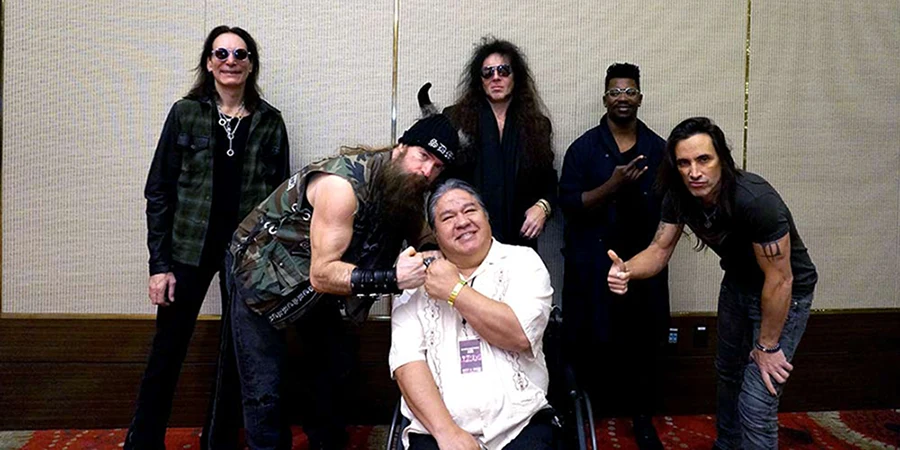
Carrera: The level of musicality is way advanced, especially when you play music by Johann Sebastian Bach. Spanish composer like Isaac Albeniz or Manuel de Falla. It requires years of training. No one’s going to jump and say, I’m going to play El Concierto de Aranjuez by next week. No one will do that.
If you don’t practice that concert at least 5 years and you’re already a solid guitarist, that will happen. That was what my father saw; he said this is what you need to do. You need to have the instruction. And finally, I graduated in 1996. I played a concert with the Symphonic Orchestra of Ecuador called Raíces. It’s on YouTube.
This was one of my biggest challenges. It gave me identity. It gave me a voice. It gave me a channel to express myself. I wasn’t anymore in the back seat. I was now always in front. I was always invited to different events, different parties, different trips. Come, we need you here, but bring your guitar, by the way. “Oh, I thought you were inviting me because you were nice to me.” “No, bring your guitar.”
So that was a wonderful experience with the guitar. And in 1997, I got invited to play in New York and New Jersey by, at that time, president (of Ecuador) Fabiana Alarcón.
We stayed in New York for a month. We had a wonderful time. I played in different places, different universities, different auditoriums of banks. I played even in the Ecuadorian consulate in New York. And we had a chance to meet the mayor. I couldn’t believe it. It was Rudolph Giuliani.
Products & Services

Velasquez: Giuliani. Oh, you met Giuliani?
Carrera: Yeah, from New York. And then we finished in New Jersey, and that was the inspiration for me. Ecuador, as beautiful as it was, in my career, I don’t think it was going to offer me more. I need to keep growing. I see the amazing teachers that lived in New York or the United States. I had to do that jump. I’m going to fast forward a little bit. In 2002, I got invited by the ambassador of Ecuador in Washington, D.C.to play a concert there. And then I knew that was my moment. This is when I decided to take that jump of faith. I did a concert, amazing. I started making connections. I started finding amazing guitarists, amazing friends, and among them I found my wife.
We used to work together. She was a music teacher. She’s retired now. So that’s why I decided to continue and project my studies in the United States, keep growing. I have a long list of teachers that I had here, the master classes that I was honored to attend., continue my education in music. I studied in Miami at Miami Dade College.
I finished and then I continued to Florida International University. I decided to continue my music studies. Alternating with psychology and social work. This was going to be my connection to trying music therapy. And then, I am a performer. It’s going to be tough because I was doing social work, psychology and music. When I look back, I say, “When did I have the time to do this?”
I always said I had an advantage because I already mastered the instrument. I was very fluent in reading music. I don’t need to sit and learn that. 20 pages long. I just put the papers in front of me and beep, next and next. So that was a done deal; to continue my education, I went to finish my master’s in Florida International University, and I got accepted at the University of Miami.—I used to work there. Every summer they have music guitar camp. I was one of the instructors. They knew me very well, so when I made my application, they accepted me, full scholarship. Thank you, God, because that school is very expensive.
So, the pandemic came. It was a challenging time.
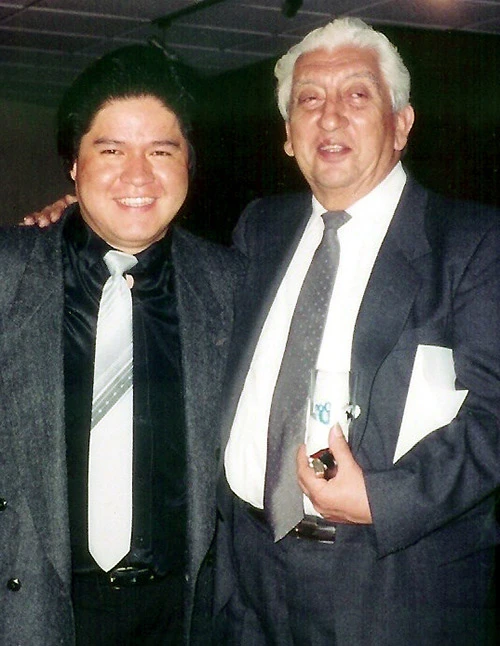
Velasquez: You started teaching in 2011, and then the pandemic happens.
Carrera: Yes, but listen, when the pandemic had already hit, I had two masters, I had a minor in psychology, and then I was thinking to go completely (into) music therapy. But then I saw all the things that I had to write, all the practicums I had to do. That was very demanding.
Velasquez: What is a practicum?
Carrera: Internship. An internship was too much because I already did an internship as a social worker. It was to be from 8 in the morning until 5 PM, and then you had classes around 7 PM.I was like beyond exhaustion, to the verge of burning out. And then I said, I’m just going to continue my degree. I’m going to get my doctoral in musical arts in performance because this is what I’ve been doing for years.
I am not a certified music therapist, but I have major experience in music companionship, which is the same thing. I have been working with patients with palliative care, dementia patients that are in hospice. Sometimes those patients we have only for 29 days, and then they pass away. So, we continue with different ones.
Velasquez: Can you explain a little bit about what you do when you provide the music therapy?
Carrera: I consider myself a poster child for music therapy because that is what helped me to move my arms, to recover my leg. For example, I go to the patient— I had a conversation prior with the nurses or the doctor who’s treating them. And I try to find out what could be the most effective treatment in music with this person. Because, as you know, there is a part in the hippocampus that is only focused on music. People don’t remember their names, but they do remember ? Happy Birthday to You. ?
They remember the lyrics, they remember all of that stuff to the T. And then I say, what was your name again? “I don’t know.”So, the process that I do with the patients is according to their needs. For example, there were a couple of old ladies, African Americans. When I entered the rooms—They were devoted Christians. That is telling you hints of what you’re going to play, what you’re going to do. I cannot go there and say, “okay, lady, I’m going to play a song by Metallica called Creeping Death.
Velasquez: (Laughter)I’m sorry, the image of that just made me laugh.
Carrera: Thank you. So, I sat next to them, with the guitar very soft, just playing the melody. ?Ti ri la ra ri ra li la. ? You should have seen their faces. They started opening their eyes and looking at me: “What is this, so beautiful? Thank you.” I remember I played Christmas carols for an old lady. She said to me, “Did I die?” She passed away after that.
It’s pretty much you feel led to the needs of the patients. There were patients that the only power they had was just to say “no.” I had other patients that I knocked at the door and said, “excuse me, would you like to hear music?” And they say, “no.” “Okay, thank you. I’m sorry.” I close the door and leave. I cannot impose myself. No, you need to listen, or if you strum the guitar too loud and they cause them to stutter. Yeah, that’s no good. I try to create an environment with soothing music. And I watch them when I play.
There was an old gentleman from Cuba. I remember playing for him “Guantanamera.”
Velasquez: Oh, “Guantanamera,” yes.
Carrera: And then he started singing. ? Guantanamera, yo vengo de todas partes. ? And the nurse that was in the other roomdropped her tray with stuff and said, “What is going on here? He doesn’t talk, you know.” I was like, “What? He has been here a year; he doesn’t talk at all?” No, he’s singing “Guantanamera.”
Unbelievable. And little by little, we found out that he was run over by a car. He was 80-something by then, and he forgot completely. He had a stroke and nobody knows even his name. So, little by little, I spent 6 months with him. We have a card with letters. And we play “Guantanamera” and all Cuban songs, all boleros, things like that.
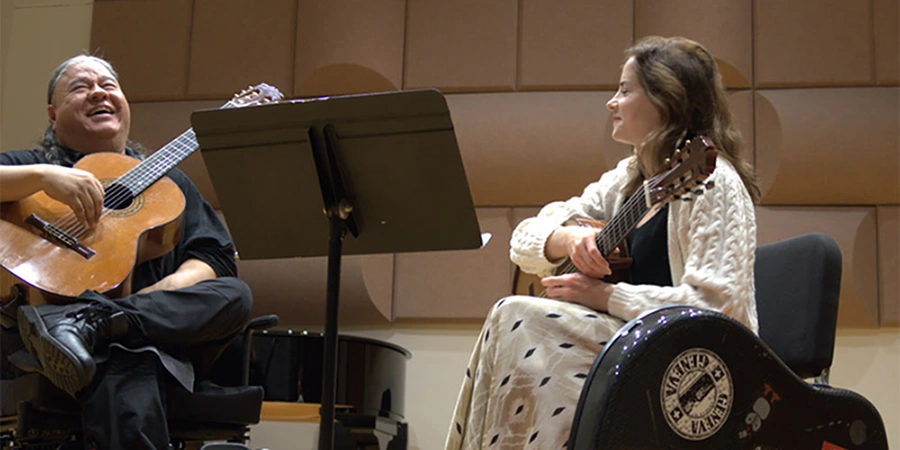
We asked, “What is your name?” Ishowed him letters, and then letter O. O. And then what is next? Omar? No. It was Orlando. Orlando. And then he nodded his head yes. Now your last name, brother—because by then he was in the hospital as an unknown.—His name was Orlando Moreno. And guess what? We found his brother and sister. They were desperate. What happened to him? Nobody knew. And in the hospital, he couldn’t talk. Just remembering this made me cry. What a beautiful moment. We found him.
I don’t know if you know Miami. There is an area calledHialeah. So, we asked there, “Do you know this guy?” And they said, “Yeah, actually his sister and his other brother live down the block, brother.” So, we went and they were, “wow.” So, we took them to the hospital. “Is this the guy?” We cried for a month. These arethe rewarding things of music therapy. And I see the beautiful results.
Velasquez: That’s beyond music therapy. That’s remarkable.You’re a performer, you’rea professor and you do music therapy. You do all three?
Carrera: At this time, I’m focused 100% on my teaching because I was hired at the university in September 2024. I have students that I connected with hospitals here. They started doing music therapy themselves, —not like I used to do with patients.—They play in the main entrance of the hospital where people are going to see and takepatients for evaluations. Then they have exposure to music. It could be a piano or classical guitar. At this time, I play a little at home because I’m in the process of recording. I record an album every two years.
And this is my second year. I’m going to start focusing on all this project. And it takes a lot of time, a lot of selections and a lot of practice.I need to be very ready when we have the studio because I don’t want to keep repeating or messing up or continuing with the same thing.
Velasquez: Are you working on a solo album or is it with other musicians?
Carrera: No, it’s a solo album.
Velasquez: Did you compose it?
Carrera: I see myself as a performer. I tried to compose, but, for some reason, I couldn’t find that. I did compose once for my mother, though.
Velasquez: You are recording and you’re also a professor. Is the music therapy work on hold for now?
Carrera: At this time, yes. I was planning to do music therapy in June, July and August, but this time I focused on recording because I do recordings every two years.
I did one of the last music therapies last February with a friend of mine.It was sad, though.All of a sudden, he had stage four cancer. I had a special request from his wife.“He wants you to play for his funeral.” And I did. Very sad, but I did. So, he had music even at his funeral. very sweet guy and his family.
Velasquez: So, is there anything else that you’d like to mention about all the steps that you took to get here where you are?
Carrera: I would like to say that what brought me here is my faith—and I’m not here to promote churches or religious movements at all. I’m just talking about our relationship straightforward with Jesus. This ride has been very tough, but I have beautiful moments, beautiful rewards, beautiful times when I see the provision of God in my life.
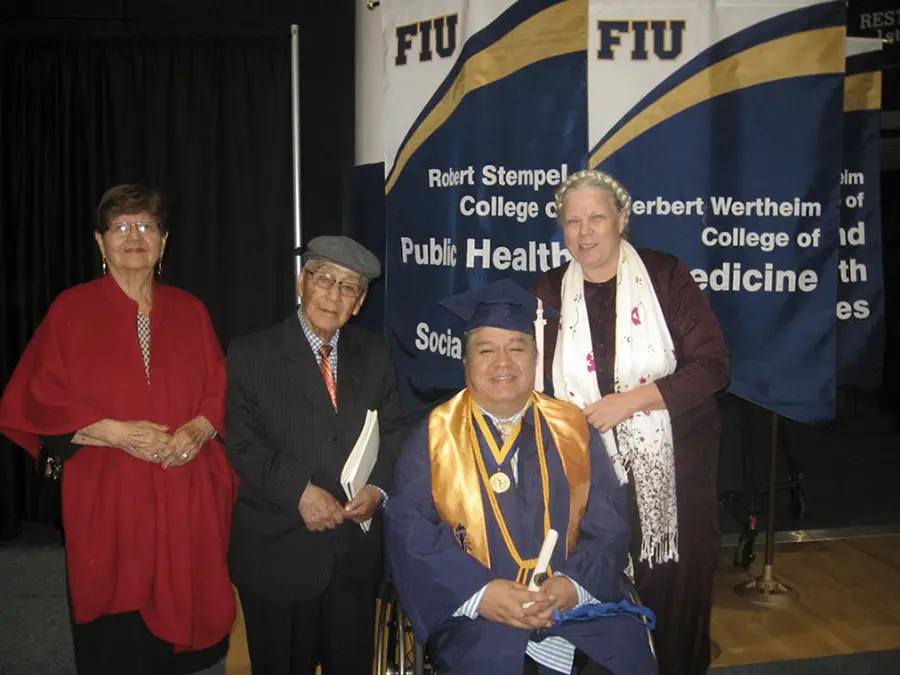
I have seen God taking care of me, and that has given me strength to continue. For example, when I, in the middle of this pandemic, decided to go for my doctorate. Deep inside, I was like, you’re not going to do this. This is going to kill you. This demands a lot, the papers that we need to present, the projects. But I did it. I graduated. I got my doctorate in May 2024. Unbelievable.
So, I did it, and I didn’t die. I had energy, I had the album. And then, with that degree under my belt, the doors start opening, different universities. So, we decided to move here with my wife. I have a stepson. He lives here in Spokane. What a sweet guy. And we are next to him. We spend time with him a lot, many years that we haven’t been able to because of the distance. And now we spend every Christmas, every Mother’s Day, my birthdays, New Year’s, and July 4th, and all that stuff we spend together. Because finding family is everything.
Velasquez: You’re making up for all the holidays and birthdays you didn’t have when you were a child.
Carrera: Exactly. This is pretty much how this jump of faith has been. I’m very pleased.
Velasquez: Even the difficulties can be beautiful because of the way you overcome them and all the stories you have.
Carrera: And that is part of my resilience. Thank you for the support of my parents, my mother, my father, my brothers and the constant support from my wife. That I can be here and playing music and talking to Gina Velázquez and beautiful things like this.
Velasquez: And ultimately, all the ways you’ve impacted people at the end of their lives.
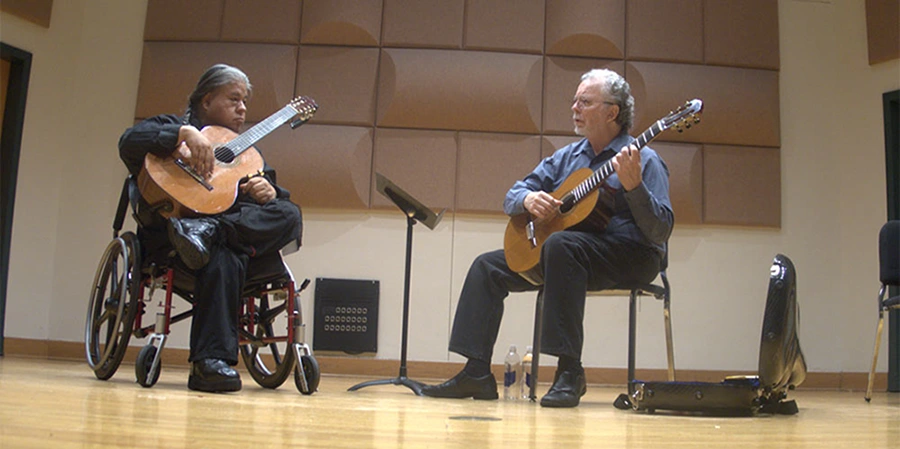
Carrera: I fulfilled my mission.Just to show you that we can do this. Even if you are disabled and, in a wheelchair, we can do this. I would say I’m living proof that. I’ve been playing with three symphonic orchestras. Amazing. If you ask me these things years ago when I was in Ecuador, I would say, “Me?”
It was like how God is opening doors for me. And in the classical guitar area, I was so blessed. I’ve been in master classes, in concerts with all of them, with all of the heavy players, all of them. They know me, they know about me. I have the chance to play for them. Beautiful critics, encouraging critics. That makes me so proud. Every time I go to bed, it really makes me very happy, puts a smile on my face. I put a board here on my desk and I have pictures and I look at those moments. I’m like, ah, yes.
Velasquez: People can do things that they didn’t know they could do.
Carrera: Exactly. No limitations. I cannot walk. My legs don’t work, but my fingers do. They fly; they dance. They move fast. I have a good ear. I have wonderful students and encourage them to continue teaching, performing, taking the baton from me, doing the music therapy stuff, doing the performing, the teaching. And that makes me very happy. I said every second that I invest in this, totally worth it.