






Blind athletes across disciplines, from extreme swimmer Gerrard Gosens to elite climber Erik Weihenmayer and soccer player Oseas De Leon, share a common message: young people who are blind need more opportunities in physical education. Ray McAllister, a burgeoning acrobatics artist, adds his voice to that call. His unlikely journey into partner acrobatics highlights how access, creativity and trust can open doors for blind students who are often sidelined in traditional sports.
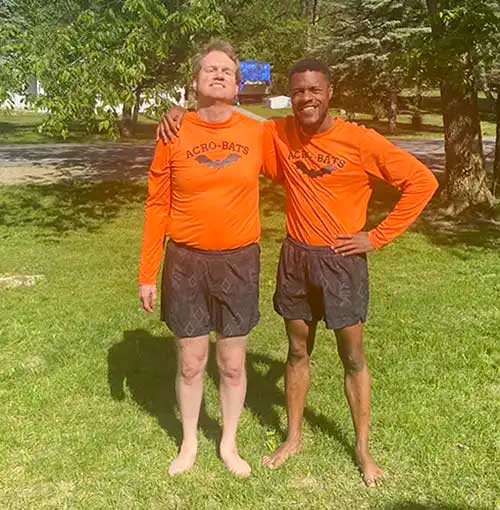
Together with his partner, Daseph Edwards, McAllister founded AcroBats, a performing acrobatics duo. This partnership would later become central to McAllister’s acrobatics journey, which he began later in life at the age of 45. Before that, his life was comprised of academics and professional accomplishments.
McAllister was born with an inherited condition, Peter’s anomaly, and lost his sight entirely at age twelve. Peter’s Anomaly is a rare, degenerative condition involving glaucoma that ultimately causes a general system failure of the eye, as McAllister explains it. “Pretty much everybody I know of in my mother’s side of the family has it in some degree, he said. “It’s just a matter of waiting until the clock runs out. Mine ran out when I was twelve. My eyes are now totally prosthetic.”
Before delving into acrobatics, McAllister was dedicated to his academics and professional careers. He earned a PhD in Old Testament and Hebrew Scriptures from Andrews University. He is the first totally blind person to receive a doctorate from the university’s seminary and the first completely blind person in the world to earn a doctorate in Hebrew Scriptures.
Adding to his accomplishments, McAllister worked to make ancient biblical languages accessible to the blind. McAllister collaborated with a small team of scholars to establish specialized Braille coding for complex ancient texts. “I set up coding so that the biblical languages could be put in a Braille format and still be Hebrew and Greek,” McAllister explained. “I took some of the more technical accents in Hebrew and set those up to be readable for the blind so that the blind could actually sing the Hebrew Bible and study it in more detail.” He even expanded this coding to include Ugaritic and other obscure ancient languages.
In 2016, his efforts earned him the prestigious Dr. Jacob Bolotin Award from the National Federation of the Blind. The award included a financial prize that provided McAllister with the down payment for a house—a home featuring a room with high ceilings that would eventually become his dedicated acrobatic training ground. Alongside his rigorous academic work, McAllister is also a master reflexologist and an adjunct teacher.
His unexpected journey into the world of acrobatics began in 2019. At the time, he was writing a novel exploring the concept of an island where the majority of inhabitants possessed wings. The wingless minority, considered disabled by the society, survived by becoming skilled acrobats who climbed onto each other’s shoulders to reach high places. Realizing he needed a practical understanding of how to describe these physical movements accurately, McAllister began experimenting.
He started simply by offering his friends shoulder rides. He quickly discovered that his six-foot frame and stable core allowed him to easily perform squats and spins while safely supporting another person’s weight. Seeking a more formal understanding of the mechanics, he reached out to the gymnastics program at Andrews University and attended an open gym session. During his very first visit, coaches had a young female student stand on his shoulders. As he supported her just under the knees with his hands and head, she was able to stand perfectly balanced while he walked across the floor.
“I’m amazed how easy this is to do,” McAllister recalled thinking. “I didn’t know I could do stuff like this. I couldn’t see well enough to see what acrobats were actually doing. I never got to see the man behind the curtain. So, it was all this really complicated stuff. And I got to see the man behind the curtain. I thought, oh, this is all okay. You just do this, it works.”
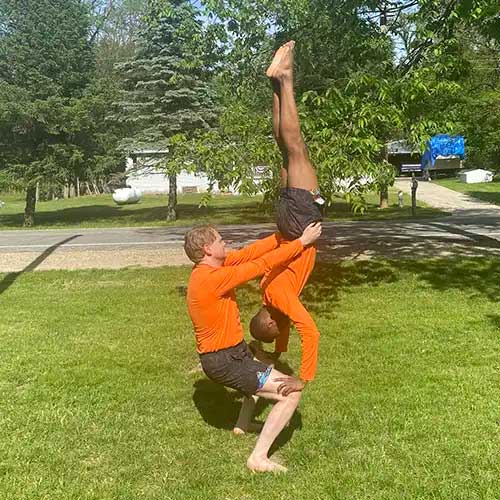
McAllister enthusiastically became a regular attendee at the university’s open gyms. He quickly observed that his training varied depending on his partner. Partnering with female students allowed him to practice complex partner acrobatics and acroyoga (acrobatics plus yoga) moves. Then, working with male students often meant focusing heavily on solo tumbling, headstands and handstands because the men were generally too large for him to base safely as a beginner.
When the pandemic shut down all local gyms in March 2020, McAllister didn’t pause his training. He bought a set of used floor mats, kept himself conditioned with Zumba, and practiced balancing drills with the exchange students living in his home. That stretch of isolation ultimately sharpened his distinctive method of tactile coaching and physical communication.


McAllister described his coaching, “I figured out that I could teach them stuff. I’m blind, but I can feel if their body is leaning wrong.” He explained his directions, “I could also tell (them). ‘You’re wobbling around. Your body needs to be tighter. Tighten your muscles a little bit. Lock your knees, tighten your hips.’ “
In 2024, Daseph Edwards moved into McAllister’s home as a tenant, a decision that ended up transforming both of their lives. The two had met only briefly when Edwards was a child but reconnected as adults under the same roof. At 145 pounds to McAllister’s 190, Edwards was perfectly sized for an acrobatic top, despite having no gymnastics experience and a long?held belief that he wasn’t good at movements requiring balance or coordination.
“I never really played any sports growing up because I honestly didn’t really think I was good with anything involving balance or coordination,” Edwards admitted. “I always had that stigma in my mind that I wasn’t really good at things that involved the finesse, the fine motor movements, the balance, the coordination, the keeping the core tight and all those different things. So, all of it was basically new to me when I started doing acroyoga with Ray.”
Despite his hesitation, Edwards accepted a shoulder ride from McAllister soon after moving in — a moment that unexpectedly ignited his interest. Seeing that spark, McAllister began training him in earnest. Drawing on his skills as an educator and a former licensed massage therapist, he introduced Edwards to the fundamentals and guided him through each progression, starting on his massage table and a therapy ball long before Edwards attempted a backbend on the floor mats.
“He was able to learn things a little faster than I was because I didn’t know what I was doing as much.” McAllister noted. “For example, it took me like 2 years to be able to do a backbend. That’s where you just bend backwards and put your hands on the floor. I had him doing it in about three weeks.”
Because McAllister relies entirely on spatial awareness and touch, safety protocols became the bedrock of their training. Before ever lifting anyone in his office, McAllister meticulously mapped the space.
“Before I started giving shoulder rides in my office, I’d jump up in the air and tap the ceiling with the tip of my fingers all over the area I’ve been doing to make sure there weren’t any light fixtures or other junk there, just to make sure that I knew the area was safe,” McAllister explained. ” I always do it with music on so I could always orient to the music—so I don’t worry about bumping people into stuff as much.”
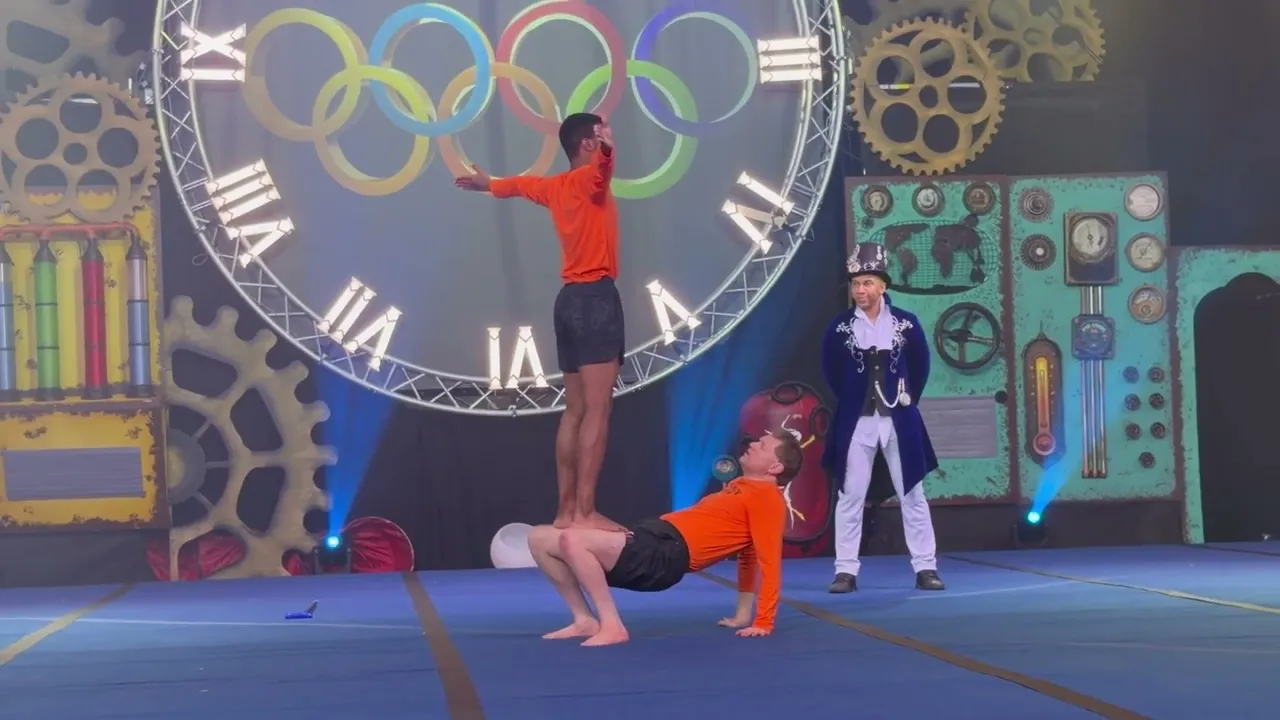
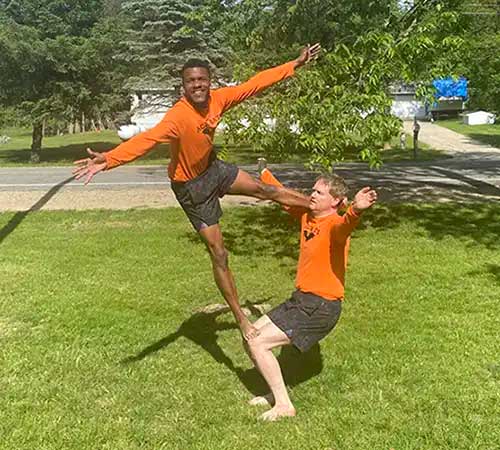
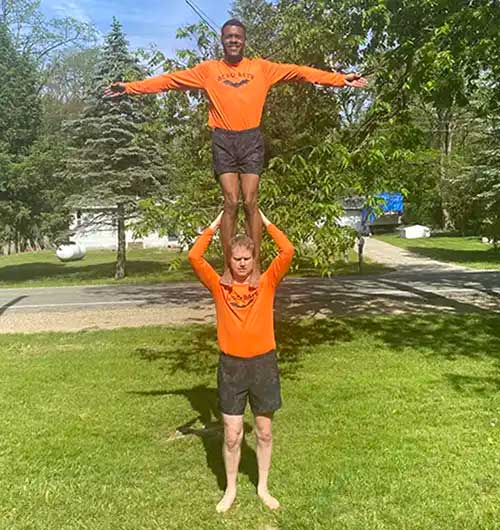
The pair rapidly advanced together, mastering a wide variety of physically demanding moves. They learned the “basket,” a foundational maneuver where they face each other, lock arms and wrists, and Edwards jumps onto McAllister’s thighs as they counterbalance by leaning backward. From the basket position, they can transition smoothly into the “flag,” striking a pose where Edwards is suspended entirely horizontally in the air.
Products & Services
They also execute the “camel,” a challenging overhead lift that requires McAllister to carefully maneuver Edwards from a humped position over his shoulders to a fully extended hold high above his head. Because McAllister uses a non-traditional method to achieve this lift, the mechanics are highly specific.
“I hold his lower thighs, he puts his hands on my shoulders, kind of ends up in a big hump over my head,” McAllister described. “That’s why they call it camel. And then I move my hands from his thighs to his hips, get him in a position, he lets go, and then he’s over my head.”
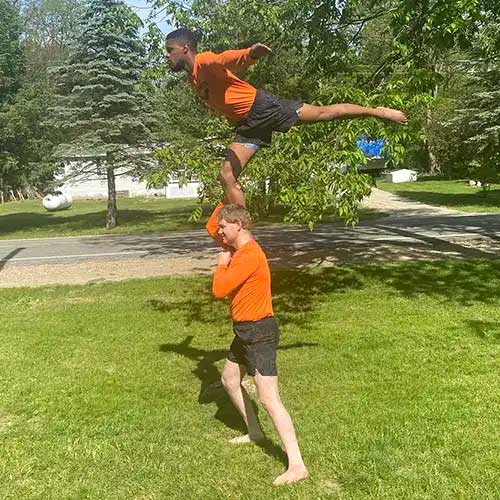
Another signature pose in their repertoire is the “arabesque,” where McAllister kneels solidly on the ground while Edwards stands on one of his shoulders, leaning his body horizontally with one leg extended backward. Training for the arabesque required highly creative safety measures to ensure Edwards would not fall. McAllister had Edwards practice the precarious balancing act inside a very narrow hallway leading into his office.
“He couldn’t spread his arms out, but he could at least get used to what it feels like to be balanced properly,” McAllister explained. “If something goes wrong, you can reach out and grab the wall. So it’s safe.”
As they perfected their routines, both men quickly realized that advanced acrobatics relies far more heavily on skeletal alignment, pure physics and seamless communication than it does on brute muscular strength.
“When you are first learning a move, especially with a partner, there’s a lot more strength involved because you don’t have that balance and coordination down pat yet,” Edwards noted. “But then once you actually get better at the move and better with transitioning and so forth and getting to that point, that you learn just to use the natural body weight of you as a person to counteract or counterbalance the weight of your partner. It’s just pure physics.”
McAllister echoed this sentiment perfectly, relying entirely on his highly developed tactile senses to guide their joint alignment.
“I can tell if someone’s not tight, they’re going to be wobbling around,” McAllister said. “You don’t want to be really bendable. You want to be in position and hold that position. And someone who isn’t tight, I can feel it.”
The transition from practicing in a controlled home office to performing in a sprawling public gymnasium presented a unique set of challenges for the McAllister. In his office, he knew his exact orientation. In the gym, he often lost his bearings, requiring Edwards to step up and physically guide him.
“We had a little bit of a problem for a while because Daseph was used to trusting that I knew where to line myself up to do all the moves in my office,” McAllister recalled. “But we go to the gym and I’m not as well oriented there. I finally said, ‘Okay, Daseph, now I’m going to purposely misalign myself in my office so you have to correct me if I’m wrong.’ I’d be forty-five degrees off or something, he’d have to tweak either my feet or my shoulders.”
Embracing their unique dynamic and growing skill level, the duo officially formed a performance team named the “AcroBats.” The name serves as a playful nod to their respective roles: Edwards flies high as the top while McAllister acts as the completely blind base. They wear distinctive bright orange and black uniforms adorned with a custom-embroidered bat emblem sewn directly onto their shirts.
Products & Services


With their identity established, they began performing publicly with a performance at Blossomland, a local educational center dedicated to children with disabilities. Although they admittedly blundered three or four moves during that nerve-wracking initial show, the enthusiastic audience of children was absolutely thrilled by the spectacle. They continued to perform regularly, refining their stage presence with the help of the Andrews University gymnastics coaches.
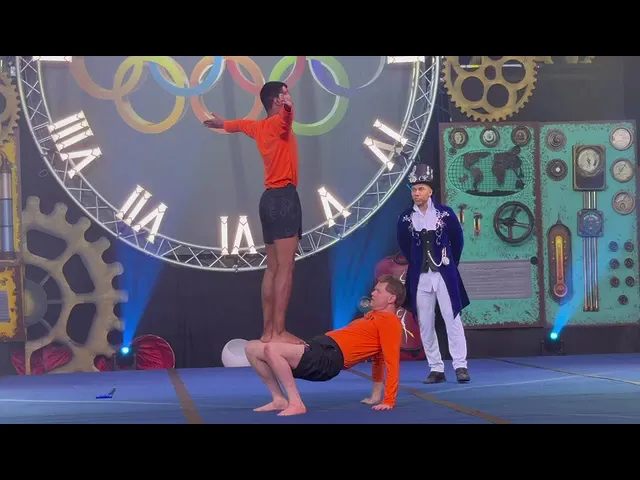
Edwards had to consciously learn to maintain eye contact with the audience, hold dynamic poses longer for dramatic visual effect and remember to smile throughout the grueling physical exertion. Eventually, they choreographed an intricate four-minute routine set to Aaron Copland’s soaring “Fanfare for the Common Man,” completing fifteen distinct moves and multiple transitions. They performed this advanced routine successfully at the Andrews University Home Show. Their accomplishments even garnered significant local media attention, landing them a featured spot on the front page of the “Herald Palladium” newspaper.
For both men, the demanding practice of acrobatics has provided profound personal growth. McAllister, who was diagnosed on the autism spectrum as an adult with what was previously called Asperger’s syndrome, found the highly direct, purely physical communication of the sport to be incredibly comforting.
“I’ve actually found acrobatics to be rather healing in that it’s an environment where communication is paramount,” McAllister reflected. “I don’t pick up on social skills, social cues that well from people, but acrobats don’t play around. You don’t expect someone to understand what you’re trying to say. You say it like, ‘Look, I need you need to lean this way, I need to end the move, break, stop the move.’ We communicate really well and I like that.”
McAllister also deeply appreciates the sport’s emphasis on safe, purposeful physical contact. “I also like having safe touch, being able to work in a physical—doing touch with people that’s safe,” McAllister added. “A lot of things I think have really been good for me with being on the autism spectrum.”
The partnership sparked an equally significant, life-altering transformation for Edwards. Prior to moving in with McAllister and discovering acrobatics, Edwards was switching between substitute teaching jobs in local special education classrooms while actively making plans to move to Korea to teach English. Working so closely with McAllister shifted his entire worldview and career trajectory.
“Through working with him, and then at the time I was floating around doing substitute teaching, it convinced me that instead of going to Korea, I want to actually stay here, go back to school and try to actually learn how to work with special needs people for a long time. There’s just so much potential they have,” Edwards stated passionately. “Just like what I saw, same thing I saw in him, I saw in my students. The potential, the stick-to-itiveness, the discipline, the intelligence and the special gifts they have. That was a big inspiration for me.”
Looking forward, McAllister is deeply passionate about expanding physical education opportunities for blind individuals across the country. “The blind find it very difficult to find fun ways of getting exercise,” McAllister noted. “I’m sure you have experiences being in school, sitting on the sidelines, or of course you never chose for the team. You never get to do anything with the team unless you can have a beeper ball team nearby, which almost never happens. And so, we miss out on working with the team.” He strongly believes that partner acrobatics offers a highly unique, engaging alternative to the isolation many blind students face in traditional team sports.
Products & Services
He suggests that specialized schools for the blind, or even mainstream public gymnastics programs, should actively consider introducing simple partner moves or basic acroyoga to their visually impaired students. Beyond the obvious physical benefits, McAllister views acrobatics as a uniquely powerful educational tool for teaching trust and interpersonal problem-solving.
“If something goes wrong, usually, it’s both our faults,” McAllister observed. “An audience doesn’t care who messed up. They just care if the move goes right or wrong. It has some good lessons for life in it, especially marriages. It doesn’t matter who messed up. What matters is did you do it right? If it didn’t work right, then you need to both look at what you can do better.”
To further his advocacy, McAllister continually leverages his technical skills to push for far greater accessibility in digital media. He actively explores innovative ways to integrate AI-generated audio descriptions into performance videos, ensuring that visually impaired audiences can fully experience the visual artistry of modern acrobatics. He even composed a highly complex reversible sonnet—a fourteen-line poem that conveys one uplifting message when read top-to-bottom, and an entirely different message when read bottom-to-top—to creatively celebrate the trust and dynamic of their partnership. He jokingly notes that when you read it backward, the poem itself is doing a handstand.
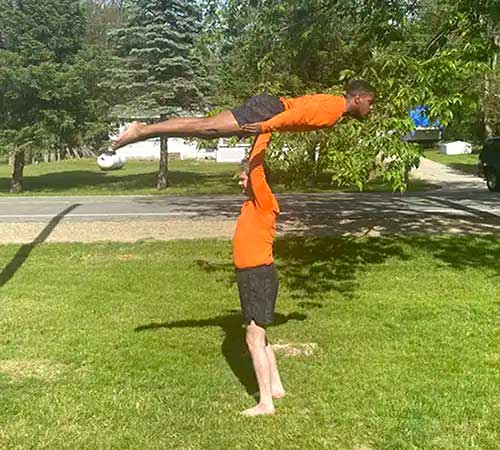
“I think the only thing, in a poetic sense, a big lesson to get from this is that if you don’t have your wings, you can make your own,” Edwards explained. “With Ray, with his disability, he doesn’t have wings, but we’ve been able to make it work. We’re able to make our own wings in the sense that we’re able to still inspire people and perform and do all the things that regular acrobats do, just in a different way with different accommodations, but it’s still possible.”
As the AcroBats look toward future performances and potential collaborations with other blind athletes, their primary overarching goal remains incredibly consistent: to motivate others and dismantle preconceived societal notions about disability. McAllister even expressed a strong desire to eventually train at a completely blind top, eager to prove that no position in the sport is off-limits.
By Gina Velasquez
Video: Acrobatic Routine, to Aaron Copland’s “Fanfare for the Common Man,” with Daseph Edwards
Below are two versions of the same presentation. The second version features audio description.
Acrobatic Routine Video
Acrobatic Routine with Audio Description