







During the 1980s and 1990s, Dr. Thomas Flynn worked as an ophthalmologist and retina specialist in New York City. Looking for the most difficult job he could find, Dr. Flynn ran toward patients who were going blind while dying with AIDS (Acquired Immune Deficiency Syndrome), which is caused by HIV (Human Immunodeficiency Virus). At the same time, those working around him asked, “Why are we doing this?”
When Dr. Flynn started his medical career, HIV infections were exploding. The largest affected population was gay men, but HIV was also spreading through unprotected sex, blood transfusions, shared needles, and childbirth. HIV targeted the immune system by attacking T-cells (specialized immune cells). If HIV was left untreated, that T-cell count would drop. While a healthy person has a count of about 1,000, once T-cells fall below 200, the diagnosis becomes AIDS, and the body can no longer fight everyday bacteria, viruses and fungal infections. Everyday germs, easily fought by a healthy immune system, become opportunistic infections that wreak havoc in a person with a defenseless immune system.
While movies like Philadelphia and The Dallas Buyers Club often highlighted wasting syndrome and Kaposi sarcoma (skin lesions) as the main markers of AIDS, another major threat was Cytomegalovirus (CMV). CMV is a very common childhood infection that the majority of people fight off, yet it lies dormant in the body. With a broken immune system, the body can no longer keep the virus in check. CMV wakes up and attacks internal organs and retinas, causing blindness.
During the crisis, when a person was diagnosed with CMV, their T-cell count was critically low, meaning they typically only had months left to live. Initial signs were usually severe organ symptoms in lungs, digestive tract, liver, brain and blood, but also included eye symptoms like floaters, blind spots, and blurred or wavy vision. Dr. Flynn saw these patients.
In 1997, Dr. Flynn met ABILITY Magazine’s Gina Velasquez while she was a patient at New York City’s Roosevelt Hospital with an unknown AIDS related infection. She had been diagnosed in 1990 and given a prognosis of three to five years to live. She was placed on prophylactic antibiotics to keep infections at bay and spent a short time on AZT—the only AIDS medication available at the time—until it caused severe anemia that required multiple blood transfusions. For years, she endured repeated hospitalizations to fight opportunistic infections as her immune system continued to decline
In one of Gina’s many hospitalizations at Roosevelt, doctors spent a month performing tests and biopsies on multiple organs. The medical team identified disseminated PCP (a fungal infection) throughout her organs. With her health steadily declining and still with another unknown infection, the prognosis was not good. In the midst of all the testing, Gina noticed something wasn’t right with her eyes and told her primary care doctor, Michael Rendel. He called in a specialist to examine her eyes. That specialist was Dr. Flynn who diagnosed Gina with CMV and handled her treatments. Ultimately, new antiretroviral drugs became available in time to restore her immune system, and Gina survived. She later completely lost her vision due to complications stemming from the original CMV infection.
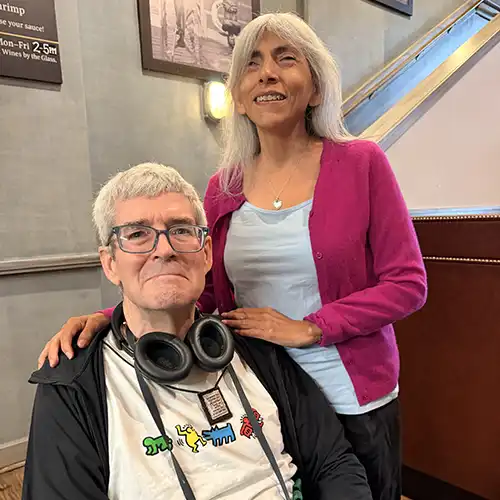
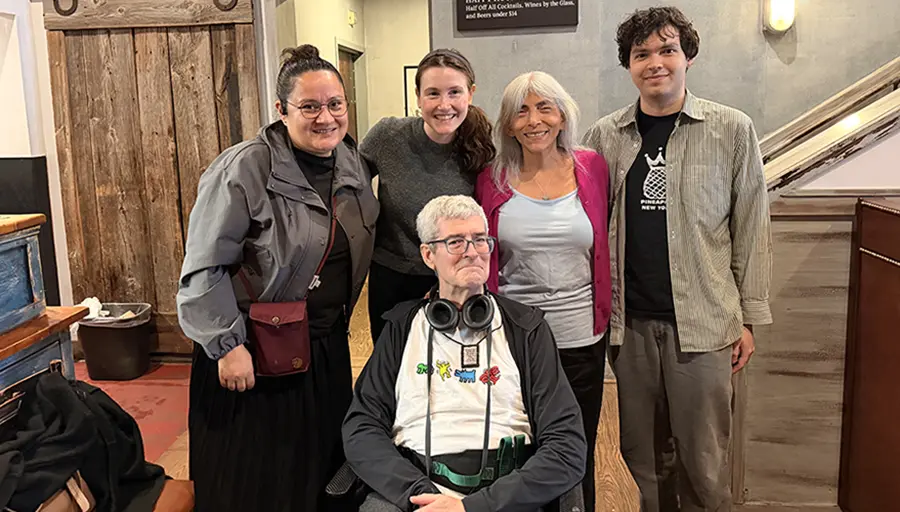
Recently, Gina Velasquez reconnected with Dr. Flynn and his daughter, Dr. Erin Flynn, who is also an ophthalmologist. They met at The Sitting Duck Tavern in Stratford, Connecticut, where Dr. Flynn and Velasquez discussed their shared history during the AIDS epidemic, the medical realities of Dr. Flynn’s work, and the fact that Dr. Flynn is now navigating his own terminal neurological diagnosis.
Products & Services


Editor’s note: Due to Dr. Flynn’s medical diagnosis, he experiences difficulty speaking. Dr. Flynn’s daughter assists in communication and expanding on Dr. Flynn’s comments. Additionally, Velasquez’s son, Aiden, ran the audio equipment for the interview.
Gina Velasquez: okay, so as background, you were my doctor. You will always be my doctor, Dr. Thomas Flynn. You were my doctor for many years, my ophthalmologist, my retina specialist as I was going blind. The last time I came to see you I didn’t know that it would be the last time. I’m excited to have this opportunity to catch up with you again.
Dr. Thomas Flynn: This time for me to get a fatal diagnosis.
Gina: Oh, really?
Tom: We’ll see.
Gina: That’s something I do want to touch on. I want to go through your own life journey. As much as you can, can you speak about your background, what drew you to be an ophthalmologist? What were your influences?
Tom: I grew up in an affluent home in Coral Gables, Florida. My father was a full professor of ophthalmology at the University of Miami. And his work concentrated on retinopathy of prematurity, a disease that causes babies to go blind if there’s no oxygen. So, he’s a legend in the field. And I came, so to say, after him. I originally wanted to be a neurosurgeon, but I looked at my friends who were neurosurgeons—I was 7 years in. They weren’t neurosurgicaled yet, they were living out of a box. They hadn’t unpacked their stuff from their apartment. Their marriage or relationships were long gone. I said, “I didn’t want to sacrifice my life.” So, I went into ophthalmology.
Dr. Erin Flynn: My grandfather was a prolific ophthalmologist, like very famous ophthalmologist. So, my dad had a little bit of a chip on his shoulder.
Tom: A little bit.
Erin: My grandfather specialized in pediatric ophthalmology, and his whole claim to fame was retinopathy of prematurity, which is a devastating retinal disorder which affects like underweight babies, premature infants, due to a combination of low body weight and also oxygen therapy.
My grandfather dealt with some of the saddest cases. And I guess— and so my father initially thought, all right, I’m going to do my own thing. I’m going to become a neurosurgeon. And `the amount of sacrifice they had to do was a lot. So, he decided to become an ophthalmologist like my dad, but not with babies, but still with tragedy.
Gina: Still with tragedy.
Tom: Well, I remember I had dinner with my father. It was before I started my residency where I said, “How can I be useful?” He said, “Well, you can try doing what I do, which is ask what kind of field anybody with any brains would want to avoid and pick that.” And I started my career. Uveitis (inflammation of the middle layer of the eye) and Retinal infections were that field that anybody who wanted to be prosperous and have a fun life would avoid like the plague. So, I wanted to pick the hardest field I could. Ego.
Gina: What year was that?
Tom: It would have been 1986.
Gina: And your dad, when was he at the height of his career?
Tom: Right about 1990?
Gina: Your dad was doing the premature babies in 1990?
Tom: He was doing it up until 2010.
Gina: Oh my God, I don’t know why I thought you would say much earlier.
Erin: A lot of the reason, though, is because my grandfather refused to retire because his career was his entire identity.
Gina: When you graduated, did you know about the field you were going into and the types of patients you would be seeing?
Tom: A fair amount because I went to medical school at George Washington University. Washington, D.C. was an early epicenter of AIDS.
Gina: When did you go to New York City? And did you know what it was like there?
Tom: I did a year’s internship in Washington, D.C., and then went to New York, 1987.
Erin: During the ophthalmology residency, before you start the residency itself— so it’s 4 years total, but the first year is an intern year where you are a baby resident. Just like in “Scrubs,” you’re the stupidest one in the room.
Tom: Perfect. Yep.
Erin: And then you master all the rest of the body, and then they say, all right, you’ve learned enough, you’ve gotten way too comfortable, let’s mess this up further and let’s throw you into the world of ophthalmology. And you get to become again the stupidest person in the room, right? So, he did his intern year in Washington, DC for full body, and then he went to New York City in 1987.
Tom: Right.
Erin: And what was New York City like when you hit the ground?
Tom: Well, socially it was a ruin because HIV obviously hit the community hard. So, we had no idea what was happening, where we were going, because the hospitals were filling up with very sick people with horrible eyes. And that’s when we began to separate ourselves. The vast majority of us said, “Ick! I want to avoid this.” And some of us ran as fast as we could in the direction of the sickest patients we could find.
So that about that time, I was one of the few Admiral Aldrich (the extreme explorer) who would operate on patients with AIDS. And I was responsible for training the residents in how to pass those instruments. For example, one of our fears was we use sharp instruments to suck fluids out of the eye. So, the AIF—we use needles. How to pass those off safely so that you wouldn’t stick somebody’s glove. This was during the time of “Dallas Buyers Club” movie is about, when patients were dreadfully sick and most doctors came in wearing spacesuits. I couldn’t abide by that. You had to be human. To take care of human beings. So, I sort of refused to do that. In fact, I refused to wear a tie because ties were virtual invitations for infections.
Products & Services


Erin: My father said he decided he wanted to run right into the fire. In terms of what he does is uveitis, which is intraocular inflammation in the eye and also vitreoretinal surgery. So, operating on eyes, generally, what we do is we use an instrument which is a vacuum and a cutter to go inside the eye and cut and suck the gel out of the eye. In those times they would have to suture the wounds with very small needles, and so there was always a high likelihood you might stick yourself. My dad said some doctors would come in in full-blown spacesuits.
Gina: I heard of the spacesuits.
Erin: But my dad never liked that, He refused the spacesuits, and in fact, he never wore a white coat and he never wore a tie because he thought it was just another thing that infection can get onto. That was , I think, his approach to it is.
Tom: And by not wearing a tie. The tie was an open invitation to infection. Ties pick up infectious junk. One of my chairmen walked up to me and asked where my tie was, my white coat. And I said, “In the locker, if you need it, feel free to use it.”
Erin: And to this end, I got the opportunity also to work with my dad in his uveitis lab. I can say he still does not wear a tie and he does not wear a white coat. He doesn’t, but also, I don’t either.
Gina: Oh, you don’t either?
Erin: I think there are different reasons. I find them kind of pretentious, but the lab coat? Yeah, I think it can be a nidus (breeding ground) for infection, right? But I also think it’s a little bit dorky, I think.
Tom: Lovely.
Erin: What my father specializes in is uveitis. And, if you’ve seen Dr. House—Dr. House is an infectious disease doctor who has to solve these medical mysteries usually caused by weird infections or autoimmune diseases. So, I describe uveitis as the love child of infectious disease and rheumatology,
Essentially, the eye is getting fucked up, and but it’s either the body itself attacking the eye and fucking the eye up, or you’ve got an infection that’s fucking the eye up. But the dangerous or the crappy part is that what helps one to decrease— if your body’s attacking your eye, you want to give the body steroids or medications— that my dad would describe as poison—is poisoning the body and lowering the immune system,
But if you miscalculated or you’re actually dealing with an infection, you’ve just thrown gasoline on a fire because, for infections, you want the immune system to be strong and you want to give antivirals or antifungals or antibiotics. My father essentially is dealing with same evil beast, which is inflammation of the eye, but what’s causing it is on an entirely different team almost, whether it be infection or the body itself.
Whenever dad counsels his uveitis patients, he describes what he’s giving them as poison. He would tell his patients, “I’m giving you poison.” And all of his patients hate all the medications he gives them.
It’s a very glamorous specialty that he’s in.
Gina: So, when you diagnose uveitis, you’re not sure if it’s the body causing the inflammation or a virus?
Tom: Correct. Particularly a disease like HIV, is to assume it’s an infection. Otherwise, assume you’re working with CMV (cytomegalovirus) or syphilis or tuberculosis. —treat that first and then rely on your colleagues to figure out what else it could be.
Erin: So, yeah, so essentially uveitis, when you diagnose it, a lot of the times you’re not quite sure what you’re dealing with, and a lot of times uveitis specialists just have to be okay with that, and they just have to know what the uveitis or the inflammation responds to. But my dad says it’s especially complicated in patients who have HIV because they have no immune system, right?
And you’re not quite— and so, so many different bugs or viruses that are no problem for somebody with a normal immune system can complicate the whole show. So, right, you’ve— so HIV patients are a conundrum, and especially those AIDS patients, because they were seeing infections in the eyes that they’d never seen before because it took that level of immunocompromised state, right, to have that happen.
Products & Services

Gina: There are things other than CMV that impacts the eyes.
Tom: Yep, there are things other than CMV that impact the eyes. Syphilis, tuberculosis, other viruses, anything that can affect the body affects the eye because the eye is one of us. The eye gets a high share of the blood that’s circulated in the body and any infection migrates to the eye over time. So, you have to be extremely cautious about putting anyone on steroids because it’s pretty much irrevocable if you’ve got an infection.
Erin: As my dad said, the eyes get a huge amount of the circulation from the rest of the body. And, there, the retina is essentially a part of your central nervous system. Anything that impacts the brain can easily spread to the eye. So, in many ways, whether it’s by blood or through the Central Nervous System, a lot of those infections can manifest or show up in the eye.
With uveitis, a big mainstay of therapy is steroids because that helps uveitis or inflammation. But you don’t want to give that to somebody if you think it might be an infection. You’ve got to figure out what you need to give this patient for their infection because tuberculosis is not a virus. It needs a whole different kind of regimen than CMV retinitis or HSV (herpes simplex virus).
Tom: How we killed Eleanor Roosevelt.
Tom: She had TB.I guess Eleanor Roosevelt died of TB being misdiagnosed. So, she was treated with steroids and that fed the infection. Big whoops.
Gina: So, you had to do it based on the way the eye looked?
Erin: Pattern recognition. Pattern recognition for how the eye looks.
Tom: It looks like CMV. It looks like shit.
Gina: It looks like shit? What do you mean?
Erin: Like you look at the eye and the eye looks—It looks like an eyeball should not look.
Gina: Oh, I thought it was like the pattern of shit.
Erin: Pattern recognition is a big part of it because different infections have different patterns or ways that they present. It all looks like shit, but I guess everybody’s got their own shit.
Gina: What was it like to diagnose young men back in the day who maybe didn’t know the severity of what they were facing? Like, how was it to give them that news?
Tom: The fact that I was offering something positive, and studies, made it easier. But I knew that I was handing them a death sentence. Invariably, the nervous, frustrated young man sitting next to the patient—his support system—knew that I was going to examine his eye. You have it you too.
Erin: I guess giving the diagnosis to the patients, as my dad has said, he’d look onto a waiting room and he’d see a lot of young handsome men. He’d look around and be like, I’m about to ruin all of their days. Because with the diagnosis of CMV retinitis, you essentially said, “Hey, you have HIV, And because you have CMV retinitis, you now have AIDS because your immune system is so compromised for you to have the CMV retinitis. You have 3 months before you go blind and you have 6 months to live.
And my dad said one of the big, also devastating, things was he’d break the news to the man, but he’d look at the partner or the support system next to him. And the recognition, the light turned on. “I have it too.”
Tom: You, too. You do. Come see me next week when I’m not so tired. And Erin was a toddler then.
Erin: My dad would think, “I’ll probably see you next week.” And I think my dad would also reflect on the fact that his life was pretty good in retrospect. And at this time, I was a toddler at his house. So, he had a kid, he had a growing family.
Gina: So, two distinct worlds.
Tom: One was a death and disappointment— Contrast between spending a day in hell and then driving and coming to home. It was really different. I had to keep the two very separate. It was similar to when in New York my reputation began to get out there. I began to get referrals for kids with AIDS, infants with AIDS. I couldn’t do it. You’ll find me hanging from a rafter. I just can’t look at kids with AIDS.
Erin: So basically, a big part of his journey through this was he diagnosed a lot of people with essentially a death sentence. And then he’d drive home to the suburbs where he had young kids at home. As he became more and more well-known for being the AIDS, uveitis guy, he started to get referrals of kids younger than me at that time, babies with AIDS. And he just couldn’t do it. He said that that would be his rule because, if he was to do that, you’d find him hanging. He just, he couldn’t emotionally handle it, so he’d probably kill himself is what he’d say.
Gina: Wow, kill himself?
Erin: That’s how my dad talks.
Gina: I know, he’s very direct. That’s why I love your dad. For so many reasons, and that was one of them. That’s intense.
Tom: It’s Erin’s fault.
Products & Services

Erin: What? Erin’s fault? Oh, it’s my fault that you didn’t see the babies, right?
Gina: Oh, because you were a baby. He must see his own child in all of those children. Being a father, being a parent changes so much.
Tom: It makes a difference, doesn’t it? Being a parent?
Erin: It makes a difference.
Gina: I know you don’t have hard numbers, but can you estimate about what percentage of the people you saw come through your office passed away? How many survived?
Tom: We were limited in the number of AIDS patients we could see because our department, which will remain nameless, didn’t want AIDS patients hanging around, scaring the ladies with poodles and furs on. I had one chairman, he asked me, did I have to see those people? Couldn’t I see those people when the site was empty? So, we were limited.
Erin: Basically, he got pushback in how many AIDS patients he could see because they didn’t want these guys hanging out in the waiting room because people were afraid and they didn’t exactly know how it was transmitted.
Tom: You were those people. Sorry.
Velasquez: What percent died?
Tom: 99 percent.
Erin: But I think my father estimates that about 99% of the patients he saw with CMV retinitis died. And I think my dad used to say to us is he’d get a whole new roster of patients every couple weeks because there would be a bunch of deaths, and then they’d fill them up.
Tom: I’ll stick with you to the end, but I won’t go to your damn memorial service. I’ll kill myself. I’ve been through enough of them.
Gina: That must have been so tough. For context, when all the worst of it was behind me and I realized that I would survive, I stayed in touch with my doctor, Michael Rendell. I asked Michael many years later, “How many of us survived? How many from the battle days are still around?”
At the height of his practice, there were maybe 200 or 300, maybe more patients that he saw. Of all of those, only 2 of us survived, me and one other guy. I still can’t fathom the odds and what happened to me because I know that I wasn’t supposed to be here anymore.
Tom: You would look like a skeleton. You looked like a skeleton in the waiting room.
Erin: You remember her in the waiting room?
Tom: Yes, she was so underweight. She looked starved.
Gina: Do you remember when we met?
Erin: He’s nodding his head. Yes?
Gina: Okay, I was in the hospital, if you recall.
Tom: As an inpatient at Roosevelt.
Erin: You were an inpatient at Roosevelt?
Gina: Yes, so Roosevelt in New York City was a big hospital for AIDS patients, and I think it was the 9th floor. The 9th floor was set aside for patients with AIDS.
Tom: You were my last consult of the day.
Gina: I was the last consult?
Erin: So, you were the last round of the day, the last consult of his day that day.
Products & Services


Gina: I was there because I came in with—They weren’t sure what I had.—It later turned out that I had PCP (Pneumocystis pneumonia – fungal infection) disseminated throughout my organs. It wasn’t in my lungs. Normally PCP just results in pneumonia—and I’m not a doctor, but that’s what I know—Instead of it being in my lungs, it was disseminated in growths throughout all of my organs. And I had a lot of symptoms. I had fevers.
While I was in the hospital, I finally told Michael—because I had other things to worry about with the fevers and everything else. And I was working, too.—I finally said to Michael, “Hey, I’m seeing these weird—It looks like dirt is in my eyes all the time.” And he said, “Okay, I’m going to send someone in to see you.” And I think the following day or two, in walks Dr. Flynn with what looked like a briefcase, a huge briefcase.
Tom: The ophthalmoscope.
Erin: Yes. He probably put it on his head. He looked really cool with it on his head, I’m sure.
Gina: You had a little smile on your face, and I wasn’t sure if you were being shy about saying, “I’m the ophthalmologist who is going to see what’s going on in your eyes.”
Erin: I’m kind of on the (autism) spectrum.
Gina: I never picked up on that. You’re so hilarious and smart and funny and fast.
Tom: People on the spectrum can be funny, too.
Erin: I will say he’s got a very good bedside manner.
Gina: He checked out my eyes. After that, he just became my doctor. And we started trying to fight the CMV.
Tom: Well, the problem with CMV, before antiretroviral therapy, was you were guaranteed to lose because, eventually, the virus would mutate and render your treatment ineffective.
Erin: So, when you initially treat CMV with a therapy, it’ll mutate and outsmart your therapy. I think he started you on something, but he knew that the virus was going to outsmart him soon enough.
Gina: My memory is of Ganciclovir, Foscarnet. There was another one.
Tom: Cidofovir.
Gina: Yes, Cidofovir. And then Foscarnet. Eventually, it was Vistide that stopped the infections. But it took over a year.
Tom: For getting your immune system back.So, the virus itself was like killing your immune system.
Erin: So that last medication, was that like part of the antiviral?
Gina: No, it was a once-a-month treatment, and you said it was very toxic. But it was probably the only thing that could stop it because it kept going. It was still like burning on the edges, you kept saying, like a year later after I started with the infection.
Tom: That’s all we could do until we learned to rebuild your immune system—delay it because the virus would outsmart us eventually. In other words, the thing that won the battle for AIDS was the cocktail. I used AZT plus 3TC or DDI or DDC or whatever. Use 2 or 3 drugs to get the virus under control and keep it under control. With CMV, we didn’t really have that. We had one study where people who failed either of those. Started you on Ganciclovir, got the other drug IV along with, so Ganciclovir got started together, low doses for both. But those 16 hours you were hooked up to the IVs, that was clearly not doable.
So, that was where the impulse for the studies came from and… Doing implants and injecting in the eyes. I was trying to get more drug in to fight the infection directly, knowing that we were going to lose the battle in the end until you got your immune system back.
Erin: They showed in studies that to get the necessary concentration to act, help with the infection, it was like 16 hours straight of IV medications, which was not feasible. So, they injected implants in your eyes to give that medicine to your eye. But the main goal was to get your immune system. It was buying time for CMV retinitis. All their therapies were buying time with the hope that your immune system would come back.
Gina: And I remember you were telling me when I was out of the woods, that all the incredible interventions were done because you wanted to ensure that people still had vision when they were saying goodbye to their families, right?
Tom: Yeah. That was a great fear at the beginning. Their families would reject the patients, and the men really did want to see their mom or their dad, really. They did want to see their family before they died. So, sky was the limit. Same with the surgeries we did.
Gina: You told me that—because I had a lot of eye surgeries. I first saw Dr. Flynn in ’97. It was September, October, and then throughout ’98 and ’99. I don’t know how many retinal detachments I had. I might have, maybe 4, 2 in each eye, something like that.
Products & Services

Tom: And implants. Three in one eye, two in the other.
Erin: CMV retinitis, honestly any viral retinitis, it’s a high risk of detachment. Yes, and they’re messy detachments not like detachments that you see in the normal population.
Gina: But I remember him saying that you might not have taken the extraordinary interventions because you were battling time and vision loss. You didn’t want patients to die without being able to see their loved ones before they died, something like that.
Tom: Flattening the macula, that means something to my daughter.
Erin: I think that’s kind of a big message my dad wanted to say is that just doing these measures, which might seem extreme. But it was very important to him that his patients would see.
Gina: I’m totally agreeing with you. I was going to die too. I was one of those patients. I just happened not to. But the whole idea was for me to have vision so I could say goodbye to my then-husband, my family, everyone I cared about. I completely understand. I was just commenting on just how extraordinary a situation you would have found yourself in as a doctor, as a healer.
Tom: Well, as I said, one thing I did find is the families, rarely, if ever, rejected the patients. They were universally afraid when families learned they were gay or abused drugs or whatever, that they’d turn their backs on them. Almost universally, that didn’t happen. And if they could see, it was a lot better for the patient.
Gina: I’m sure you also had other patients who were not HIV positive with the CMV retinitis and going blind—Was I the norm? Was there anything atypical about my case?
Tom: First thing is you’re still here. You’re still alive.
Gina: That’s a good one. That makes me different, but in terms of what I went through, the uveitis, the retinal detachments, the inflammation, everything else. Was that the norm?
Tom: And more. You had everything and more.
Gina: Isn’t it a little surprising though that my vision held on as long as it did?
Erin: Yes, he’s nodding his head.
Gina: Based on everything that happened, should I have lost my vision 10 years before I did?
Tom: Yep. Bill Schiff is the voice of reason. He’d look at me and say, “Tom, why are we doing this?” And I said, “There’s some vision there. The vision. It’s important to her.” And Bill would sort of get the look on his face like, OK, you’re the idiot who trained me. I get it. I’ll do it. I’ll do it.
Gina: You trained Dr. Schiff?
Erin: I think Dr. Schiff did his vitreoretinal surgery fellowship with my dad as one of his attendings or teachers/bosses, whatever you want to call it.
Tom: And Dr. Schiff helped train Erin.
Gina: Full circle.
Erin: Yeah, very full circle. Also, I did my intern year at Roosevelt Hospital. And I did it when COVID hit. Similarly, it also became like this whole lockdown hospital that year. That was something my dad and I would bond over because I’d be like, “What the fuck is happening?” And my dad would be like, “Welcome to my world.”
Gina: So, your dad, treated uveitis and vitreoretinal at the height of the AIDS crisis and went through the death and the illness and the tragedy. Cut to 30 plus years later and you’re dealing with COVID?
Erin: I timed it perfectly.
Gina: The COVID pandemic at Roosevelt Hospital, the same hospital where I was a patient.
Erin: And where you met my father.
Gina: And you were dealing because that was your year.
Erin: 2019 to 2020. It was crazy in that, overnight, we just kind of became an entire ICU. No surgeries were being done. All non-COVID patients were told, “Hey, get out of here. You don’t want to catch this.” And the whole hospital just became an ICU.
Tom: You shouldn’t buy a lotter ticked.
Gina: I don’t think any of us here—
Erin: I think you should buy a lottery ticket for sure. (Laughter)
Gina: So, I somehow survive, the antiretrovirals came in time to save my life, and then I came to you and said, “Dr. Flynn, I want to get pregnant, I want to have a baby.” You were the only doctor who said that that wasn’t a good idea, that it would be very hard on my eyes and that I would lose my vision a lot sooner, a lot faster.
Products & Services
Tom: I said, “You’re gonna fucking go blind.”
Gina: You were worried I’d go blind during my pregnancy.
Tom: And about diabetes.
Gina: Yeah, and I said, “You know what? I’m going to do it anyway. Because I really want to have a baby.”
Erin: My dad is just shrugging and saying, “Well, what can you do?”
Tom: DNA. It’s in the DNA.
Gina: (Laughs) So in my DNA?
Erin: I guess the biological drive is what — not you specifically, Gina. (laughs)
Gina: I knew that I wanted to be a mom. I thought, “It’s obviously not gonna happen for you, I’m gonna not be here.” And then I thought, “Hey, I survived this and now’s the time before my fertility ends.”
But when told you I became pregnant, you switched to cheerleader, caretaker. You were so worried. You’d check my pressures all the time. And my pressures did shoot up to 40 in each eye. And that’s when you sent me to Dr. Odrich.
He’s still my doctor. I still see him. He performed surgery on me to put in some sort of a tube when I was seven months pregnant. He’s another one who was like, “No, I don’t want to put her under… the baby…”, and all that stuff.
Tom: Same thing. Same thing Steve would literally say, “Why are we doing this?”
Gina: Yeah, same thing. but I would have gone blind if my pressures had stayed at 40. Right?
Tom: Yes.
Gina: It was crazy times, but I don’t regret it. And you were wonderful, even though I did what I wanted to do. And obviously Aiden is here as the audio engineer for this interview. So, it’s full circle.
Erin: We’re glad you’re here, Aiden. How old are you, Aiden?
Aiden: 23
Gina: Oh my gosh.
Tom: Yeah, Aiden, you’re like right between my two youngest brothers. I’ve got a 21-year-old, he’s our baby, and then we’ve got a 28-year-old. 29
Velasquez: Really? You told me you only had 2 kids.
Erin: He’s ashamed of the other ones.
(laughter)
Erin: No, I’m kidding
Gina: That’s what I remember. You had your daughter and, I thought, one son at some point.
Erin: That is true, but then he added on a few more.
Gina: Yeah, that must have happened…
Tom: Between ’97 and 2004, I added on the two others.
Gina: So, you moved your practice to Maine. You kept some patients in New York; I was one of them. You were 27 days of the month in Maine, three days in New York. Did you move because you wanted to move somewhere rural?
Erin: No, he didn’t.
Tom: You got it right.
Part 2 of Dr. Thomas Flynn’s interview can be found in the October/November Issue.