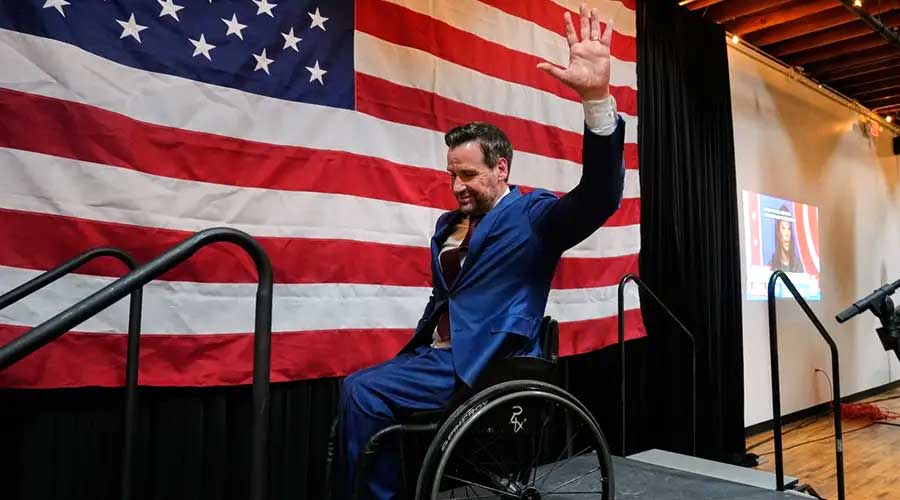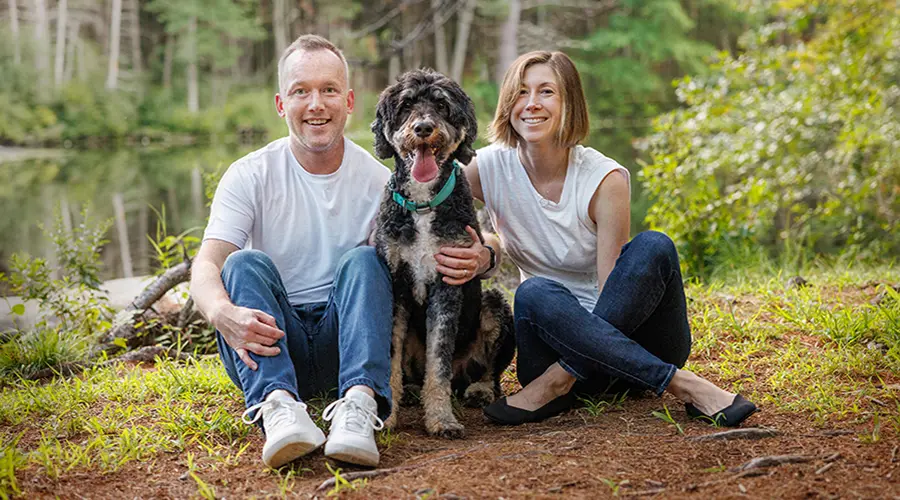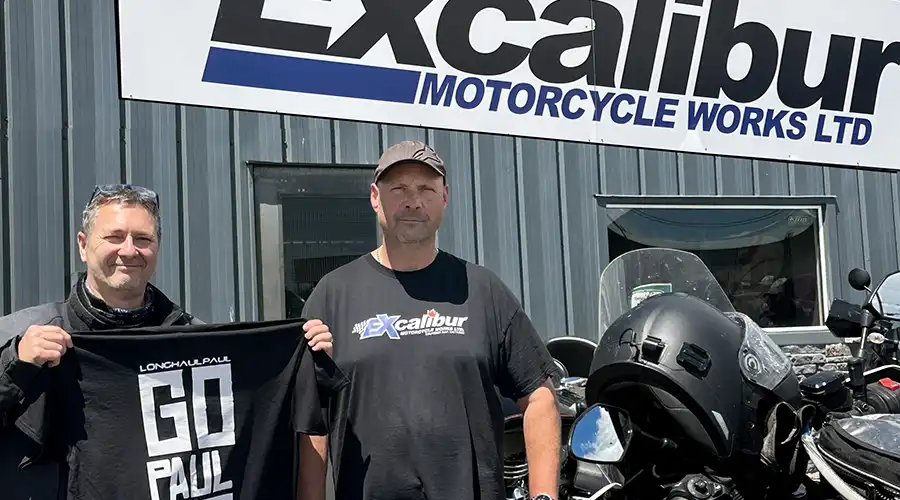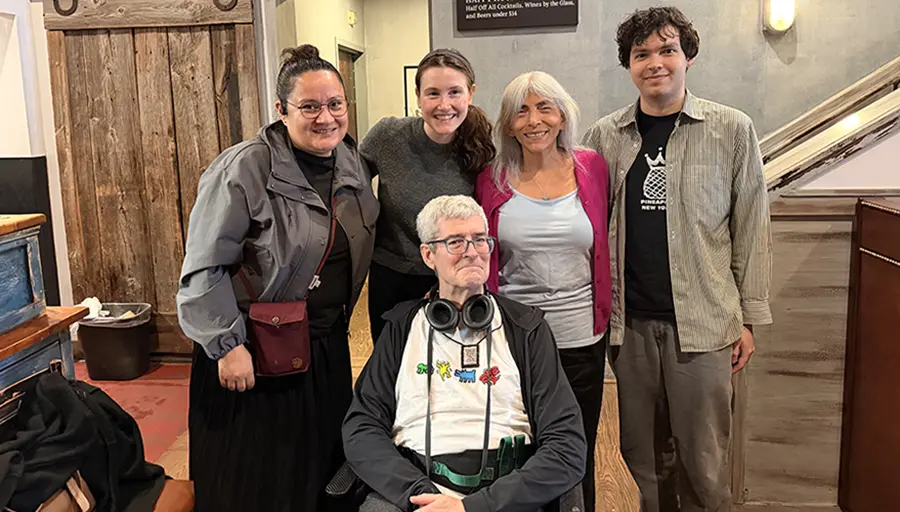















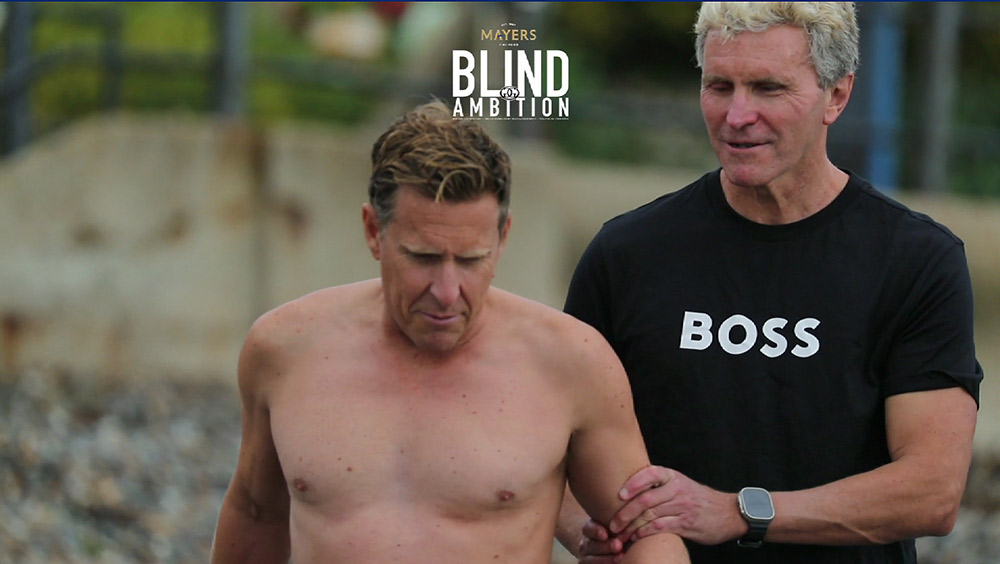
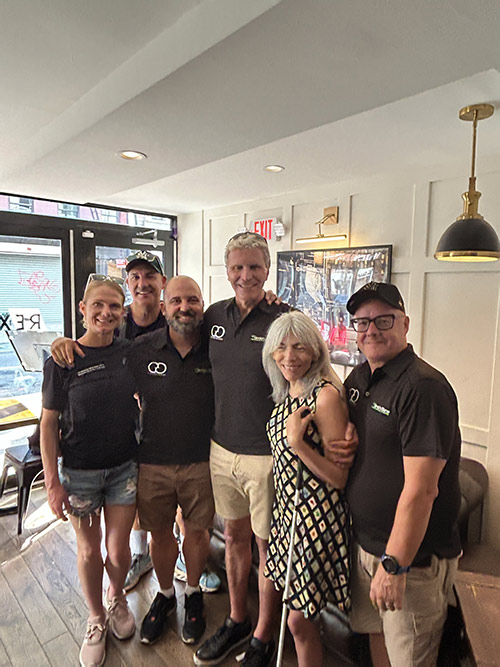
Gerrard Gosens is an internationally recognized adventurer, Paralympian, Everest climber, chocolatier, and Order of Australia Medal recipient. His latest adventure tackles open water swimming. His goal is to complete one of open water swimming’s greatest challenges: swim the 20 Bridges New York City circumnavigation and cross the English Channel, all within a single calendar month. It’s a feat never before achieved by a blind swimmer. Embodying the spirit of teamwork, Gosens navigates the journey with the steadfast support of filmmaker/project manager, Anthony “Gordo” Gordon, and seasoned swim guides—Philip Edwards, Joanna Smallacombe, Nick Barclay and Hayden Armstrong.
ABILITY Magazine’s Gina Velasquez met with the team in downtown New York City as they embarked on the first leg of their journey. Velasquez followed their progress remotely, receiving regular updates and emails from Anthony Gordon, who documented each stage of their experience for the documentary “Blind Ambition.” Gosens and his team shared their different perspectives of the journey, their teamwork in open water and the challenges they faced along the way, as they strived to push the boundaries of human potential. The team also shared their drive to encourage others with disabilities to “give it a go”, in hopes that their journey will show, with the right support, even the most daunting challenges can be met head-on.
Gina Velasquez: Is this your first time in New York City?
Gerrard Gosens: Yeah, it is. It was a long-time goal to get to New York. I’ve had the opportunities of potentially competing in the New York Marathon some years ago, but that got waylaid by some other projects that came on board. But there’s always been that fascination for me as a guide dog user of how people who are blind to low vision get around New York.
For example, when you watch a television series that is based in New York, you never hear the audio tactile lights. We always have a challenge when a dog’s walking in the snow. When does it know that a road starts and it stops from the foot pavement? When a person’s using a white cane, particularly in the snow, how they use that to identify when they’re doing shorelining with a white cane. All those things fascinate me. So here I am. And now is a chance to frame myself in the deep end and see what it’s all like.
Velasquez: What sparked the idea for doing these back-to-back open water marathon swims?
Gosens: It wasn’t something that I grew up thinking, “I’m going to do the 20 Bridges Ocean swim and I’m going to do the English Channel.” It’s always been about the opportunities for me. The 20 Bridges swim was an opportunity that became available and there was a slot. And a slot came up to swim the English Channel in July.
Back-to-back from the 20 Bridges swim over to English Channel is a big challenge in its own way, but I think I’ve got the team. We’ve done the preparation, both mentally and physically, over the past couple of years, so we’re ready to go. Looking forward to the chance to swim around Manhattan Island.
I think what is unique is that I’ve never seen Manhattan Island. I never will see Manhattan Island. I’ve never seen the Australian flag. I’ve never seen my Green and Gold tracksuit. I’ll never see the other side of the English Channel. But they’re not things I need to see. It’s that sense of belief in the journey and achieving that particular project. So, I don’t need to see the end to achieve the end.
Velasquez: Do you have any light perception?
Gosens: No, I’m totally blind. I have prosthetics, so I have no vision whatsoever. For me, it’s me not knowing what Manhattan looks like. Sure, it’s somewhat disappointing. But, as I said to my team, it’s that traveling around on the inside of Manhattan Island and getting to experience all that it has to offer through its various ingredients of people and culture. It’s like, for example, being a chocolatier, which I am. I can swim around the outside of Manhattan Island, feel the outside, but also experience the inside by walking around Manhattan Island.
Velasquez: It’s a vibe. From neighborhood to neighborhood, there’s just a different feel, different vibes. The bars are different; the smells are different. Have you ever attempted either of these swims?
Gosens: No. This will be a world’s first. It’s never been a totally blind person swim around Manhattan Island. When I swim across the English Channel, there’s never been a totally blind person actually complete the swim across the English Channel.
Products & Services

Velasquez: It’s never been attempted?
Gosens: It has been attempted but never been successful. The New York swim has never been attempted at all, ever before. The English Channel, yes, once before. And that was by me, last year. And I was three kilometers short.
Velasquez: What happened?
Gosens: Mother Nature took a turn for the worse and through everything she had at me with weather conditions, and it wasn’t safe to continue. But the weather patterns across the channel can change dramatically, very quickly.
Velasquez: You’ve also climbed Mount Everest. Now you’re doing open water swimming. How did you make these switches through all these elite sports?
Gosens: Running for me was always, I suppose, my trade. I began running at a very early age, and competed at Paralympic Games. It was obviously the goal to represent my country. Then, I went from running to triathlons. I actually got into triathlons because one of my guide runners ran me into a pothole, and I had to take a week off running for a bit. I jumped in the pool and was doing some swimming.
One of the persons who was swimming beside me said, “Oh, have you ever done a triathlon?” I said, “No, I never done a triathlon because I actually hated swimming because you go up and down, up and back.” Why would you go up and back when you can run from point A to point B? I said, “I’ll do a triathlon with you.”
And I went on and competed for Australia at some very small championships and the Commonwealth Games. Then I sort of retired at the Commonwealth Games in Australia, and a person said to me, “There’s never been a totally blind person swim the English Channel.” And I thought, “Well, let’s give it a go.”
Velasquez: You were like, I’ll do it.
Gosens: That’s what everyone says. I’m always a “yes” person. When I did Everest or “Dancing with the Stars,” it was always about, “yes.”
Velasquez: Everest though. How do you just decide I’m going to climb Everest?
Gosens: Well, that was about an opportunity. I was working at a function and a person said to me, “Would you like to either do one of two particular expeditions?” One of them was Papua New Guinea, the Kokoda Trail. It was either that or Everest Base Camp. And I thought, “Well, sure. Let’s go to Everest Base Camp.” I went to Everest Base Camp and came back with the knowledge and reconnaissance of what to do to get to the top of Everest. I put together a team, and onwards we went.
Velasquez: And then you summited? When?
Gosens: 2005. So, for me, it’s building that team around you and knowing that, in any journey, both mentally and physically, there’s going to be some crevasse along the way. And then, those smallest of challenges can be, in actual fact, the biggest. But as you say, in New York, it could be crossing the street because there’s no audio tactile lights. The smallest of things can make big changes in your life. For me, it’s about those opportunities.
Velasquez: About training, and we’ll bring your team in as well. Can you tell us what training looks like for open water swimming, both in and out of the pool?
Gosens: Yeah, in the pool, it’s multiple kilometers every day. So, I’m in a pool at 3: 00 AM in the morning, and train there for a few hours. And then, it’s off to work as in my businesses in Brisbane, Chocolate Moments. And then obviously training in the afternoon, whether that be strength or running. Weekends are the longer swims, both on Saturday and Sunday. So, that could be an open water swim on a Sunday, or it could be a 10 km swim in the pool. It’s day in, day out.
I have the background of endurance. I’ve done ultra marathons in Australia. We have Cairns to Brisbane, which is a 2000 km run or about 1200 miles. I’ve done that five times. Coming into swimming was more about the opportunity and about building a team of great supporters and swim guides. And here we are.
Once this is over, I’ll move on, because of my background of climbing, to the 2028 Los Angeles Paralympics Games. Indoor climbing is now a Paralympic sport. One of those is my classification, being totally blind. I’ll just leave swimming to the side and purely focus on climbing.
Velasquez: So, you cycle between these three types of elite sports?
Gosens: No, I think it’s about the opportunity. Again, no one ever said to me, “You will swim.” It was just about that particular opportunity. And look, you only live once. And it’s about saying “yes.” It hasn’t always been a success. There’s been plenty of failure along the way. But it’s about picking yourself up and taking that next step on, which is really the success behind all of it.
Velasquez: And when did you start the open water swimming?
Gosens: I’ve been in it for four years now. So, I swim in Great Keppel Island in Australia, which is like a 20-odd kilometer swim. And then we’ve done a few other 20-kilometer swims. And then, the preparation for English Channel last year. And I did another 20-kilometer swim earlier this year. So, the distance isn’t necessarily the worry around Manhattan Island. It’s the currents.
Velasquez: Your team was telling me that you’re not really swimming against any river currents. I thought that you might, but I understand the East River and Hudson go in opposite directions.
Gosens: Yeah, there are some points where we have to get to before a certain time. Otherwise, the tides will change. But no. Whereas the English Channel, if you imagine across the channel, there are four individual divisions. So, you almost are swimming the S shape across the English Channel. So outside right and then back to left.
Velasquez: In an S shape? And that’s because of the current?
Gosens: Yes. And if you’re not swimming fast enough, then that’s where you’ll fail.
Velasquez: Can you talk about the logistics of an open water swim. How do you manage nutrition, hydration?
Products & Services


Gosens: Every half an hour when we swap over guides, I’m not allowed to touch the boat or the kayak, they’ll toss me a bottle on a piece of rope, and I’ll just drink from that or eat from that. Then off we go. But you only take a few seconds to do it, whether it be just hydrations, whether it be a gel or other small stuff that’s easy to (eat).
Velasquez: How do you figure out navigation?
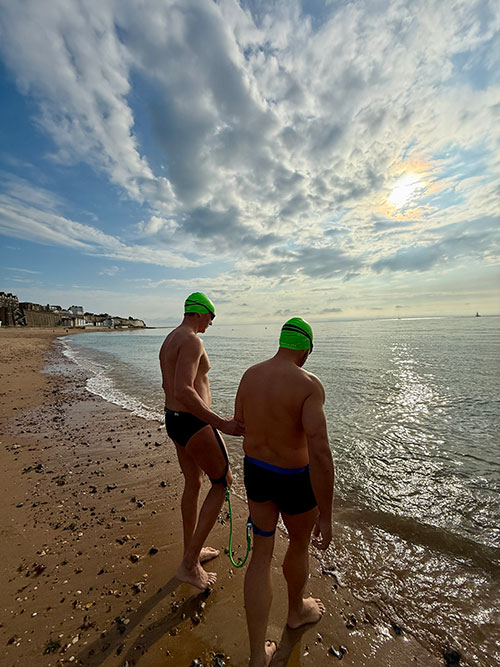
Gosens: We have a tether that goes between myself and my swim guides. It’s a short piece of elastic cord. It goes off at the actual knee. That way, obviously, you can complete your stroke. That piece of tether provides a whole communication, whether it’s slack or whether that’s tight. That will give me the direction, whether it’s any left or right. But once you get in sync with that person, and that’s where training with these guys for quite some time comes in. You’re well aware where their body is in the water as well.
Velasquez: And they take turns?
Gosens: Every half an hour, they swap over. I’ve actually chosen some guys that will be taken by the sharks before me. So, they’re actually more attractive than me. That’s why the shark will go for them first.
(laughter)
Velasquez: I didn’t want to say anything, but there’s been about seven shark sightings off the New York City beaches this summer.
Gosens: Well, I have three guides.
Velasquez: There are seven sharks though. But how do you prepare for encounters with sea creatures?
Gosens: I push these guys in the way.
Velasquez: I see. Very smart.
Gosens: We encounter plenty of jellyfish. And in Australia, there’s probably more severe jellyfish than what’s here.
Velasquez: Are you wearing a wetsuit then?
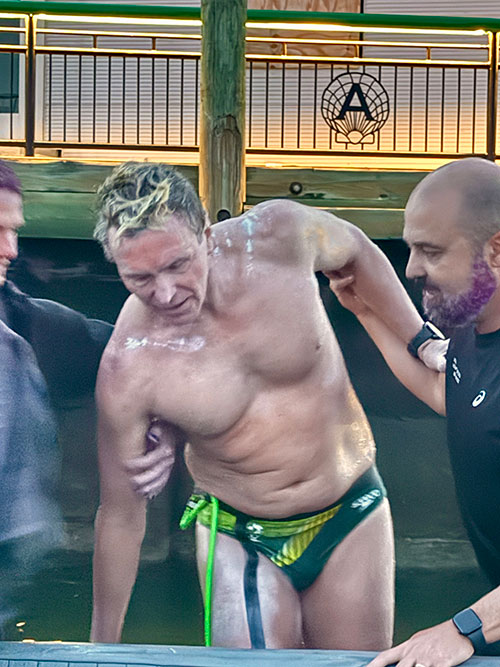
Gosens: No, there’s no wetsuit. It’s just a swim cap, togs, and goggles.
Velasquez: Isn’t the water freezing cold still around New York?
Gosens: No, it’s actually quite warmish here. It’s the English Channel, which is right now seeing about 16.7 (62 degrees Fahrenheit).
Velasquez: And you won’t wear a wetsuit in the English Channel?
Gosens: No, not for either.
Velasquez: How do you acclimate then to the cold water?
Gosens: We’ve done some cold-water training back in Australia. We’ve done it for the last little while. You start to question your sexuality by the end of it.
Velasquez: (laughter) Did I hear that right?
Gosens: Yes. It’s cold water. It’s bloody cold water.
(laughter)
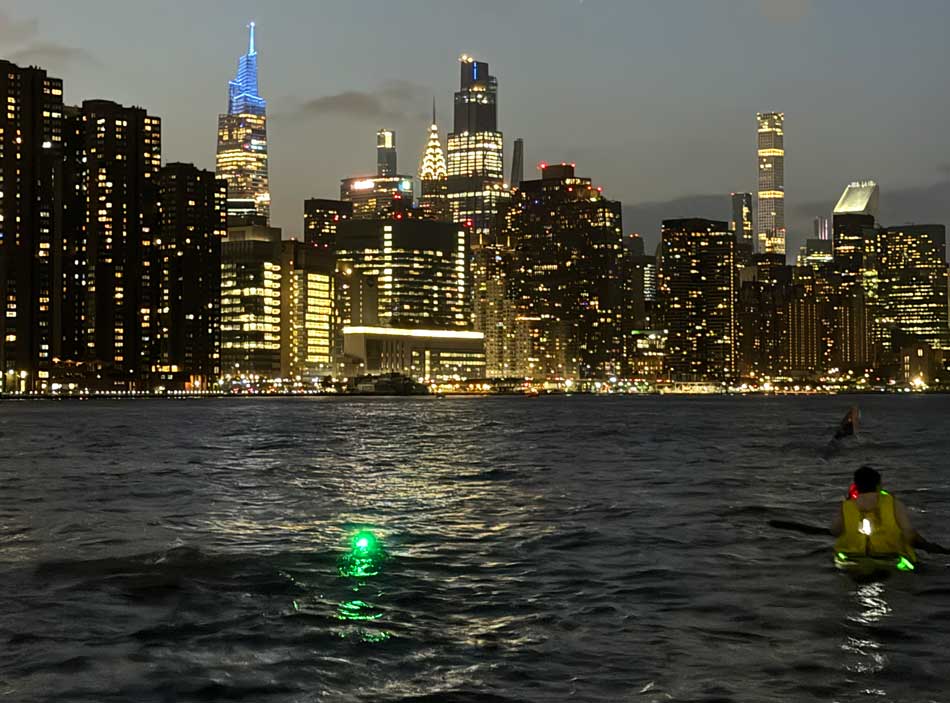
Velasquez: Is there a reason it’s a night swim in New York?
Gosens: No, it’s a choice. To me, it doesn’t matter to me whether it’s night or day. And I think it’s a great atmosphere. It’s a good chance for these guys to experience what Manhattan is like at night. And it’s obviously avoiding the sun. So that’s probably a bonus as well.
Velasquez: How long do you think the New York City 20 Bridges swim will take?
Gosens: I suppose nine or 10 hours.
Velasquez: Is that a record? Are you trying to break a timing record?
Gosens: No, there’s no record. As I don’t claim to be a swimmer. I just claim to be an adventurer who is out there to give it a go with Nick and Phil and Jo.
Velasquez: So, the record is the back-to-back 20 Bridges and English Channel swims.
Gosens: Yes. That’s a record. But as I said, there’s never been a totally blind person swim around New York. I hope that through this particular pursuit and through the swim tether, my goal is for kids, who are coming through who are blind or who have low vision, have a chance to understand that there are people like Jo, Phil, Hayden, and Nick who are swim guides. Perhaps at places like Coney Island or what have you, those swim guides can become available to take people like yourself or young kids out for a swim in the ocean and to do a One, two, three, four, five kilometers swim.
Velasquez: How long have you had this team, this particular team?
Gosens: For a few years now. They’ve all been long-standing team members, back in Australia training on a weekly basis. That’s why it isn’t me crossing the line. It’s the entire team. As it is in producing a magazine, as it is producing anything at all. It’s not the one journalist; it’s about the entire team.
Products & Services


Velasquez: Then what will you be doing in the interim between the 20 Bridges and the English Channel? Will you be training or resting?
Gosens: We’ll go and obviously train and recover. And then get over to the UK on the 18th and then do some water acclimatization in the cold water. We’ll have a few days there to get used to the water.
Velasquez: Can you speak more about your goals afterwards, the Paralympics?
Gosens: Yeah, the 2028 Los Angeles Games. That’s a journey to have the next three years to get stuck into and build my team around getting up a wall, and driving people up the wall. Look, it’d be a great chance to, I suppose, end the career in Los Angeles.
Velasquez: Did you say end your career?
Gosens: As in from a Paralympic perspective. So, the great thing about climbing is it’s not about your age. It’s about technique and ability. If I was a sprinter, I’d have no chance. Whereas a climber, it’s just about that technique off the actual wall, technique and strength. Like 2032, I’m probably a bit past it. The 2032 Games are actually in Brisbane, my country, as in my state where I live. So, looking forward to that opportunity, as in to play a part in that somehow.
Velasquez: And you’re going to be in the ’28 games?
Gosens: Yes, that’s the goal. I’m in the Australian squad right now, but the goal is to be in the 2028 Games.
Velasquez: Do you have a message you’d like for people to take away from your feat?
Gosens: I think it’s about the opportunities, about the challenges. While there are challenges in open water swimming, I think with people like my swim guides, it gives young kids coming through the chance to be in future events, like open water swimming at the Paralympic Games.
And then it’s the chance for people to just simply do sport and recreation. While we’ve come a long way with technology, I think there’s a hell of a long way to go with sport and recreation, the support of it, the recognition of it, the funding of it, and also the development of it.
As I said, it takes a team. If I go for run, I’ll have a guide runner beside me. Or if I go for a swim, it’s having those guides. Nick will tell you—He’s a good example. —The first swim they think, “Oh, I’ll be hesitant.” Then after it, it just becomes a natural thing. They even forget on there.
But swimming for me is about opportunity and climbing is also about the opportunity for young kids coming through. There’s still a long way to go with employment and sports and recreation. In Australia, for example, you’re looking at maybe 55% of people who are blind, or have low vision, who don’t have a job. But they want a job. It’s the same as for access to sport. I still see some really disheartening places where you go to a school, and the only sport and recreation is where the teacher takes them for a walk around the block. This is 2025. We should be way further than that.
Velasquez: What advice would you give to other disabled kids or people out there who want to join the sport?
Gosens: It’s about building that team, about not being scared to take the first step. The first step is always the hardest, and also jumping in at times. And as it is here, jumping in the deep end of Manhattan is taking that plunge. It’s about taking on the sport that you have a passion for and then thinking, Okay, what are the opportunities? If I can’t ride a bike on my own? Okay, let’s get a tandem bike. If I want to go for a run around the park, I will find a guide runner, ask a friend, go to a local athletics club. If I want to go for a swim, go down to see a life-saving club. There’s always an opportunity, but at times we fear the unknown.
When you fear failure, embrace it because that’s the next step on the way to success.
Anthony Gordon, Film Maker and Project Manager
Velasquez: Tell me about following Gerrard’s journey.
Anthony Gordon: I’ve known Gerrard for a number of years, and then he convinced me to tell his story. I wasn’t really interested in the story because swimming is not the most interesting sport. He mentioned that it was about the team and his guide swimmers and the tethered side of the thing. I’ve made documentaries my entire life with famous sportsmen and women, but it’s about what they do. Not many people can ever aspire to be a number one tennis player, a number one surfer, a number one cricket player. But everyone can aspire to be a supporter. The last film we made was about the team. It wasn’t about Gerrard. Therefore, we were inspiring other people to support other people.
Velasquez: What’s the name of that film?
Gordon: That was called “Changing Channels”. It was his first attempt at the channel. Then when that didn’t eventuate, he said, “Well, what should we do?” I said, “What do you want to do?” He said, “How badly do you want to hurt?” He said, “Well, let’s try and do something that no one’s done twice.” Here we are, 12 months later, sitting in New York.
Velasquez: This one is called “Blind Ambition”?
Gordon: “Blind Ambition,” yeah. It’s a bit of a cliché film, but Gerrard was actually an extra in a film years ago called “Blind Ambition,” which was an athletics film. And this is called “Blind Ambition.” It’s a little bit different because I haven’t been able to do the lead up because he asked me to manage the project for him. It’s hard to do both. I reckon the easiest part of this thing is just getting in the water and bloody swimming, to be honest.
Velasquez: But it still takes a lot of energy, charisma, drive to put this together for him so that he can focus on his swim and the team can focus on what they’re doing.
Gordon: It’s interesting because you’re creating a film for a guy that can never see it, but then he sees through his ears. How I create this has been really unique because a lot of people that can’t see have been watching the previous film; they know all about it. You spend more time on the sound than on the vision. But it’s given me another unique perspective to actually be his eyes and how he does things. It’s really interesting. It’s actually made me a better filmmaker because I’m seeing with different senses now, and that’s been the rewarding side.
Products & Services

Velasquez: Was it hard to get all the permissions? I was asking the team, and they said that you have stories, at least about the English Channel.
Gordon: When the English Channel wasn’t completed last year, there were a lot of human errors in play. The problem is the boat captains and the organization themselves just couldn’t be bothered. At the end of the day, most of the boat captains are all fishermen. The crazy thing is half of it’s an international wire transfer. The rest is cash in a paper bag.
Velasquez: Really? Paper bag?
Gordon: Yeah, it’s a fact. So, we eventually paid both with cash and a brown paper bag. And when Gerrard wasn’t successful, no one seemed to care. And we tried to get more involved. Gerrard gave them a two-page submission as to how he would better things, not just for people with an ability issuse, but with fully able-bodied people.
And in the CSA (Channel Swimming Association) minutes, they documented their response, which was that the recommendation that you’ve given us, Gerrard, we would apply if we were transporting nuclear waste across the channel. That’s just not right.
We started to explore the possibilities of “Do you need an association?” There are three associations, two large ones and a small one. There’s a monopoly of boat captains. I went all the way up to the commandant that ran the French naval base. I said, “Where’s the legality in this?”
What I found out is the only reason why the associations exist is because they’ve been mandated from a 1946 post-war immigration law that prescribed that to go across the channel. It had to be done as a specific crossing, and they had to do it for safety.
Therefore, if anyone could provide the safety documents, anyone should be able to do it, and the channel association should give it permission. I thought, let’s just do that anyway, and they wouldn’t give us permission. So, it is categorically a probable corrupt organization that is prejudiced against people with disabilities. It’s a non-ethical process. People’s dreams are being quashed because of their prejudice.
The harder you work, the luckier you get. All of a sudden, a slot opened up. We spoke to Captain Eddie Spelling, and he said, “Right, let’s do this.” He gets it. He understands.— Finally, after 22 billion emails, we found a guy that said “Let’s give it a crack.”— Then I had to say to Gerrard, “Right, now you got to back it up.” He’s got one job right now—to swim.
Velasquez: And it was easier to get New York City permits or permission.
Gordon: The guys in New York are fantastic. It’s a pity that more New Yorkers don’t understand the swim. The water quality isn’t as bad as people say. I filmed it back in 2012. I mean, you might glow in the dark for a few days after you get out. (laughs) The Harlem River is probably the worst part. East River has got the currents flowing. And same with the Hudson.
Velasquez: I would have thought the East River would be pretty bad.
Gordon: Yeah, but that gets a strong current though around Mill Rock. So, it moves. And also, we’re doing it at night. So, they’re not going to see what they’re swimming in anyway, let’s face it. And the good thing is with that level of water quality, you’re not going to have sharks.
(laughter)
Velasquez: The sharks will be glowing in the dark. You’ll see them a mile away.
Gordon: And I’m good with that. Gerrard had done a lot of swims and done his miles. He had to qualify for it. You can’t just apply and get in. For this one, you’ve got to have done the distance, you’ve got to do a certain pace. Before the English Channel, you’ve got to have done certain swims. You have to basically swim for 6 hours in 14° water, which is 57° Fahrenheit, which Gerrard did do to qualify. But look, Gerrard’s resilient. He’s probably one of the most headstrong humans I’ve met.
Velasquez: Is there a reason why it’s a night swim?
Gordon: Yeah, because he wanted it to be difficult for his guide swimmers.
(laughter)
Velasquez: Is it harder to swim at night?
Gordon: Yeah, they can’t see anything. He can’t see, so he doesn’t mind.
Velasquez: Wait, so who really made that decision?
Gordon: Gerrard.
Velasquez: I thought you did.
Products & Services


Gordon: No, I just thought it’d be cool because I filmed it in the daylight once. I don’t want to do that again. I sit in a boat for nine hours and look at Manhattan. Let me tell you, the back end of (his) arm, there’s nothing pretty, right? There might be some cool graffiti.
When he said he wanted to do a night one, I was like, “Yeah, let’s do that.” I’d much rather go around at nighttime than in daytime. I’m at my best through the night anyway. I like to see a lot more suffering. I like to see them struggle a bit.
(laughs)
Velasquez: Is it really that much harder? I mean, I thought they go by sight and follow the boat.
Gordon: Yeah, but you still got to see it. When you’re on a water level and there’s this drop in waves, you can’t see over there. Also, when they’re that elite and they’re that good swimmers, you can make it look easier. I don’t want that in the film. I want it to look hard.
Velasquez: How long is the 20 Bridges swim expected to take?
Gordon: The swim begins at 8: 00 PM. We should finish, hopefully by 5:00 AM in the morning. That’s nine hours if there’s good current. You need a good current. It’s got to wash all the bodies out to sea.
(laughs)
Velasquez: Hopefully the sharks will get to them first, so you don’t bump into them.
Gordon: I mean, Sharks really like that flavor.
(laughs)
Philip Edwards, Swim Guide
Velasquez: What is your impression of the New York City leg and the entire enterprise?
Edwards: I’m very excited about the New York City leg. I’ve been with Gerrard from the start and went to Dover with him last year on our attempt of the English Channel. But the New York leg, for me this year, was so exciting because I’ve never been to the States before. I visited through LA on my way to the UK a few years ago, but that was it. So, this is a very exciting trip for me. Actually, Gerrard and Jo have never been to New York either. So, it’s very exciting for the three of us. It’s a beautiful city, big city, busy city.
Swimming around Manhattan is a challenge not because of the currents. The currents and everything should hopefully be in our favor. But just little things like people tell you that the quality of the water isn’t fantastic. We had a webinar a few weeks ago that the swimming association put on for everybody who was coming to New York to swim. They suggested things like wearing ear plugs, and they even suggested certain antibiotics that you should bring with you in case you get sick after swimming. So, it’s a worry.
Velasquez: In the East River, I think for sure.
Edwards: We actually tried to go for a swim the other day. I don’t know where we were, but it was from Bayonne. We were basically looking across to where there’s lots of container ships and things like that. And there was a little beach there. And we thought we’ll go for a swim in here. I got to about knee deep, and I was quite a long way out, It was thick mud. I was going down about ankle deep in mud, and I didn’t like that. They’re yelling at me, “Oh, lie down!” “Do some breast stroke.” Anyway, I laid down, put my hand on the bottom, and cut my finger and thumb. And as I stood up-
Velasquez: Cut your finger on what? Dead body?
Edwards: No, it was just a sharp shell or something like that. But then A crab bit me on the heel. So, I was out of there. I was just like, we’ll find a swimming pool somewhere.
Velasquez: A crab bit you. Probably thought you were dead.
Edwards: It was literally on the back of the ankle. And yeah, I was out. It was a little clip. But no, I’m still excited about the swim. We’ve got four experienced swimmers. Hayden has been with Gerrard for a long time doing triathlons. Jo and I have been with him for about the same time, swimming on the Gold Coast in Australia. Nick’s been in and around. He didn’t come with us last year, but he’s been part of the team for a long time. He was probably close to being an Olympic swimmer in Australia in his day as a youngster. He’s probably our superstar swimmer. But being part of this team—It’s amazing.
Velasquez: You all found each other at an association?
Edwards: It was a series of coincidences. A friend of mine, Marty, who we all know, was doing some training in the pool where Gerrard swims. Anyway, Marty was swimming up and down. When he got out, he said, “Is that guy blind or something? Because he kept swimming into me.” And I said, “Actually, he is.” Marty felt so bad. So, he went over, introduced himself and said, “I’ve been swimming on the Gold Coast with some guys in this open water club. Do you want to come down sometime?” That’s how it happened.
Marty brings him down to the Coast, introduces him to the squad, And then Gerrard met different people from the team along the way. Jo and another lady that swims with us regularly, Rosie. They started bringing him down on a regular occasion from Brisbane to the Gold Coast, and it went from there.
I actually swam across the channel in ’22. When Gerrard found out about it, he said to me one day, “What do I need to do?” I said, “I could put you in touch with the right people.” And he said, “Do it.” So, I gave him all the details. And that went from there.
Velasquez: That was about four years ago?
Edwards: Yeah. So, it’s been a long journey, and we’ve had our ups and downs, but this is the “big two”, especially now because we didn’t make it last year. There’s still that little bit of maybe in the back of your mind. Can we do it? I think doing the New York swim will hopefully be the push that we get around, and then that will give us a little bit of extra confidence to push us over the line on the channel. That’s what I’m looking forward to, standing up on the beach with Gerrard in France. They say, “stand on the beach, raise your hands.” As soon as the horn on the boat sounds, that’s it, you’re finished. That’s what I did. And it’s an amazing feeling.
Velasquez: And how long Is the English Channel expected to take?
Edwards: At our pace, I think probably 14 hours plus. There’s been some swims lately across the channel that have taken up to 19 hours. I think last year when we pulled out, he’d done over 14 hours at the time.
Velasquez: That’s nonstop.
Edwards: Yeah, absolutely. Only stopping briefly to eat. It is a long time. When I swam in 2022, it took me 13 and a half hours. That’s a long day. A long day in the water.
Velasquez: How do you and Gerrard manage fatigue?
Edwards: He manages it very well. He’s one of these people who’s like a machine. He just keeps going.
Products & Services
Joanna Smallacombe, Swim Guide
Velasquez: As a swim guide, how do you help Gerrard establish pace, a swim line, navigation?
Joanna Smallacombe: It depends how far we’re swimming and whether we need to pace ourselves. But generally, we just try and keep tension on the tether. That’s communication between him and us. We judge his speed and we’ll go. We position ourselves slightly in front of him so we can guide and navigate if we need to turn around obstacles. In the ocean, we’re constantly looking out for waves. There are some quite big waves, big breaks on the Gold Coast. We have to be aware of incoming rogue waves, and the sandbanks change, so we might think we’re behind the breakers, but then there might be a sandbank further out. We’re constantly looking ahead. So, if we’re a little bit in front, then we can make sure we keep that tension on the tether and predict what’s coming up, be able to hop and move.
Velasquez: Is keeping the pace and finding the right line harder to do in the channel?
Smallacombe: It’s hard when you don’t have a point of view. Say, normally when we’re swimming on the Gold Coast, it’s sky rises and there’s things you can pick to aim for and where you always look up to site to make sure you’re on track. But in the channel, because we don’t have a point of view, we can’t see the other side. It’s just sea. That’s why we keep the boat on our right. That’s quite important to have the boat there so we can look up and keep in line with the boat.
Velasquez: You follow the boat. That makes sense.
Smallacombe: But yeah, as for pace, we go at his pace. In the channel, when you’re doing a 40 plus kilometer swim, it won’t be as quick as when you’re doing a short swim. And we, as guides, will be quite fresh each time we swim because we’re only doing a half hour to an hour at a time, and we get a rest in between. So, it’s just Gerrard maintaining that pace, and our job is to swim at that pace and keep the tension on the rope and look out for any…
Velasquez: Sharks?
Smallacombe: Then we put Gerrard in the way.
(laughter)
Velasquez: Honestly, what do you do, though?
Smallacombe: Well, luckily, we haven’t actually encountered that yet, but we take precautions. When we’re swimming in open water, we don’t swim at dawn and dusk. That’s shark feeding time. We went through a period where there were lots of baitfish, bait balls (small fish swarm) around, and that’s a good indication there could be sharks lurking around. In terms of what we would do if we saw one. The best thing is just stay calm. We have seen them. It’s a rarity, but they are there, and we do see them. But I don’t mind hearing those stories. People see them because they would have seen us a long time before. So, they’re not feeding, and they don’t generally care. It’s only if they’re hungry or curious. And if you’re splashing around, they would come and probably get a bit more curious. So that’s our tactic. You just try to stay calm.
Velasquez: Do you have a message for people who want to become guide swimmers?
Smallacombe: Being a guide swimmer is very rewarding. I was actually hesitant to start with because, for me, the ocean was my escape. It was like my meditation. It was my time where whatever is happening in the week, I get down to the ocean on the weekend and spend an hour in there and everything was okay in the world again. When someone initially mentioned being a guide, at first, I was very hesitant because I thought, “That’ll take up my time in the ocean,” because I’d only be able to get down to the Gold Coast one day a week.
But then I thought about it, and being in open water is just a whole unique experience. It’s not just about the site and what you can see. It’s about the feel of the waves and the currents and the feel of the water on your skin. But I’d love to be able to help someone else experience that who can’t by themselves. Being able to give someone the opportunity to go and swim in open water in the ocean and experience that, it’s pretty unique. And it’s very rewarding and it’s fun.
We have a fun team and go out there and have fun during our swims. I’d say anyone that’s a keen swimmer and confident in the ocean and thinks it’s something they could do, then definitely give it a go. I mean, it’s not just sight impaired people that need a guide. Even just people lacking confidence in the ocean might want someone tethered to them to swim along beside them, or whether there’s blind groups or deaf groups that you might be able to link up with. We’re definitely trying to encourage that.
Velasquez: Maybe he’ll start a movement.
Smallacombe: That’s what we’re actually trying to build up, a network of guide swimmers. I know there’s running groups that have guides available. So, something similar to that. We’d love to work and create a network of guides. It’s something on the cards that we’re working on.
Products & Services

Nick Barclay, Swim Guide
Velasquez: Can you talk about your perspective as a team member in this challenge?
Nick Barclay: We didn’t know whether he’d actually get another crack at the channel because getting channel slots is hard, particularly within a year. If you plan two or three years out, you can get them.
Originally, Phil said, “Hey, Gerrard’s going to do the 20 Bridges.” I’m married to a New Yorker, and I lived here for 10 years. So, I said, “I’m there. I don’t care when it is, I’m coming.” And then, in organizing the 20 Bridges, the English Channel started to come into focus. Gordo (Anthony Gordon) was just absolutely hell-bent on saying, “Look, if I can get the right time, he can do both back to back.” Again, full credit to Gordo. He was just a dog with a bone. He just did not let it go. He made this happen. It’s going to be epic. We’re so excited.
Velasquez: And only four people have completed the NYC 20 Bridges?
Barclay: No, many hundreds of people have completed it. I think the four you’re referring to is four people who’ve done both the 20 Bridges and English Channel within a calendar month. I think there’s between 100 and 200 swimmers who do the 20 Bridges during the summer months. But then most of them will get out of the water and go to bed for the next two weeks. Gerrard will probably have a short sleep, and then he’ll be like, I’m ready to do something else. And then, we go to England, and he’ll swim the English Channel.
Velasquez: So, the record is the back-to-back swims within a calendar month.
Barclay: Yeah. There was some research done, and I think Gordo said there’s been three or four other humans who have swum both those swims within a calendar month or within several weeks of each other. But certainly, none of them have been partially or totally blind.
Velasquez: I think it’s interesting that all the communication is based on that tension on the tether. So, there’s no speaking?
Barclay: We can. If we need to communicate more meaningfully, then he’ll stop me, I’ll stop him. But most of the time it’s through the tether. I think I’m developing more of a feel now of the communication back to me. Most of the time it was Gerrard getting communication from me to him saying, “Hey, let’s go this direction, that direction”. But as we’ve gone on, I’m starting to feel that communication back.
Just the other day, Gerrard said to me, “We don’t want to let the line go slack.” Because then he doesn’t know what’s going on. He knows we’re still connected, but it’s just making sure that that healthy tension is there. But I’m not pulling him through the water. I’m guiding him. I mean, I liken us to guide dogs. We’re not there to pull him along. We’re there to make sure that he is pointed in the right direction.
Velasquez: It’s very much the same for a guide person. Same concept. How long is the tether?
Barclay: The tether is about, keep or take, two and a half – three feet. So, we’re very close to each other, but there’s enough room for him, and both of us, to move our arms and complete our strokes comfortably. And you do get buffeted around a bit. So, he’ll run into me, I’ll run into him. And then sometimes the tether will stretch a little bit. But he can feel that the tether is being stretched because the current is pushing us apart. It’s not because I’m saying, “Hey, G, we’re going to the right or we’re going to the left.” You get to feel the right kinds of tension and what it means.
Velasquez: So, that’s what all the training and teamwork is about, to get to know those things about each other. I’m sure it’s a lot about trust as well.
Barclay: Gerrard has swum tethered with quite a few people, and he’s only going to ask the people onto his team that he feels a connection with. He’s the one who makes that decision—I want to swim with Phil or Jo or Nick, and maybe not with others. Obviously, he’s the ultimate decision maker on that.
Velasquez: Is there anything else you’d like to share about guide swimming?
Barclay: Gerrard explained the tether that we use and the method of communication. I heard Jo speaking about the level of concentration that we have to have while swimming with him because it’s actually a different swim. And it’s a new one for me, for all of us, because normally swimming is very individual.
I was a very serious competitive swimmer when I was younger. It is the ultimate individual sport, even if you’re in a relay because you’re always alone in the water. You’re not tied to somebody. But when you’re tethered to someone whose life you are responsible for, it brings a different perspective. It’s more enjoyable because you’re not swimming with your friend; you’re swimming for them and with them.
When the conditions are good and you get very much into the zone, you build up a rhythm and you lose yourself because you really don’t need to concentrate that much. But as a guide swimmer, you’ve got to keep your wits about you. There’s not much that we can run into out there, but the odd wave that comes on us, we need to be ready to pull Gerrard in the right direction or be ready for the sandbank 100 meters further up. And there’s the occasion where Gerrard will feel that tug from us, a more urgent tug saying, “Let’s get over to this side quickly because there’s something serious coming.” So, we do need to keep our wits about us. It’s very different swimming, but it’s amazing. It adds just a different dimension to the sport that I love.
Products & Services

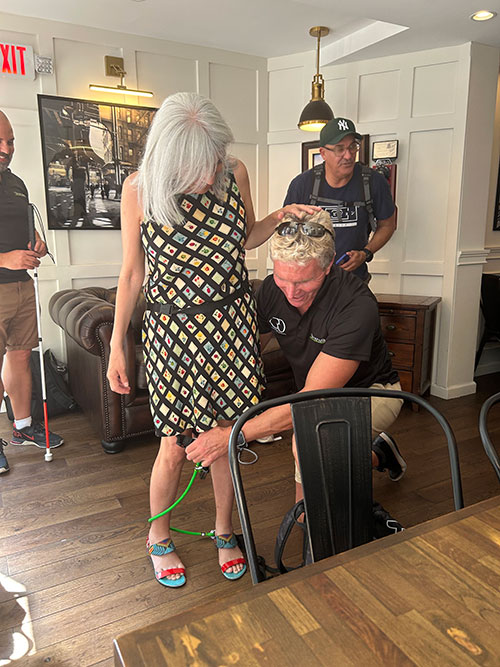
Swim Tether – Gosen’s Invention
Velasquez: Can you tell me more about your swim tether? I didn’t realize you invented it.
Gosens: There are obviously no waves (in NYC), but we have some fairly significant waves off the Gold Coast in Australia. So, when we’re going out or even coming in through the waves, we have to have something that has some strength about it. So, the actual rope or the actual tether that goes around your body is a lightweight climbing rope that is rated very high. The actual rubber or the actual elastic piece that you see between myself and my swim guide, I’ve worked with its tension over time. So, for example, if you walk into a sports store and you go to the resistance band area, there’s different sizes and different levels of resistance. And over time, I found the particular resistance band that communicates the best.
You can have some that are just too thick, no give. And you can have some that are too floppy and absolutely no communication. It’s almost like a piece of spring. So, for the actual tether, we’ve gone through different designs of different materials that went around the body. And this one doesn’t mark the person, as it doesn’t create an issue of irritation. It’s smooth, it’s like silk. Whereas we’ve used some materials that were rougher, but perhaps a fraction more lightweight. This doesn’t really absorb water, so it’s not going to stick to the body.
I started to use these when I was competing in triathlons. If you’re ever in a triathlon swim, there are quite a large number of athletes, and everyone’s fighting. It’s like a falling pool of water where everyone’s fighting to get to lead. And often at times we have people swimming between us. So, I had to find something that wasn’t going to be pulled down if a person tried to swim in between myself and my swim guide. So that’s why the tether goes around the waist, goes down the thigh and around the leg, So it’s more of protection. Secondly, when you’re running from the beach to the cycle area, you had to have something that was lightweight, easy to unzip. And that way you can either unzip and hold the person’s elbow and run very quickly to the triathlon changeover.
Velasquez: Do you intend to market it or patent it?
Gosens: I sell it in Australia. I sell it to athletes. So, the Australian Power Community and Triathlon Australia use my swim tether for Australian athletes. And I sell it to athletes who are either doing swimming, doing triathlons or, recreationally, who simply want to go out and have a swim.
I’m not there to push. It is it’s more of a service. I see it as really important for kids who are blind to low vision to have a chance to participate in swimming at whatever age, whether it be very young to people who perhaps are losing their vision.
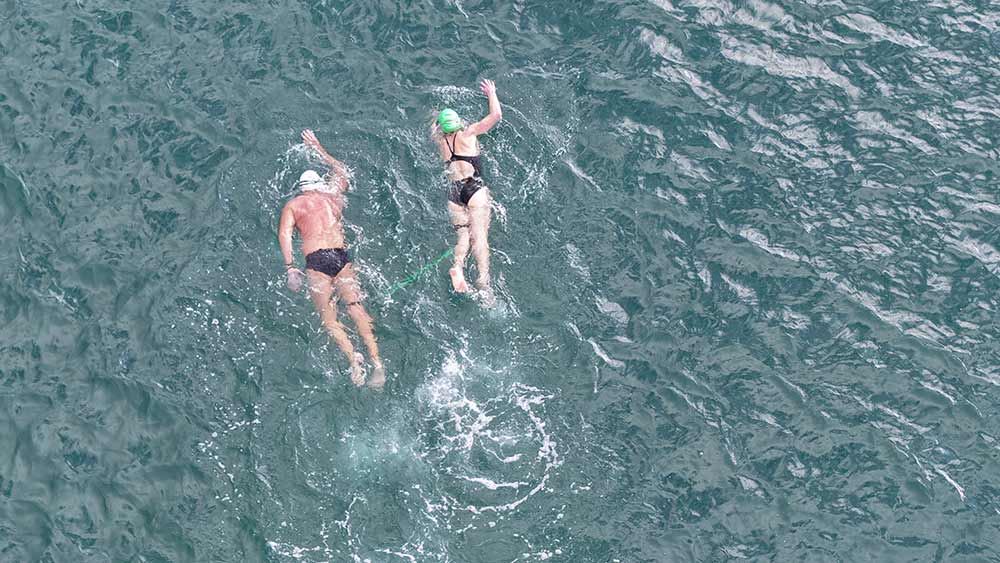
The great thing about the swim tether is it’s not just for people who are blind or have low vision. It can be used for a person who actually can’t swim. They might fear the water. Being attached to a swim guide will give them the confidence to go out through the waves and then go for a swim. So, for example, the ocean in Australia where there’s some large waves, there’s a chance for a person to be attached to another person, and they know they’re safe. So, it’s not just for people who are blind and low vision. It works with able-bodied people who just lack confidence or skill. And thirdly, it can also be used by a coach in their preparation with the athlete. They can set times and distances and be alongside the athlete as well.
Products & Services

After the NYC 20 Bridges Swim
Velasquez: Okay, well, let’s start with the swim. Congratulations.
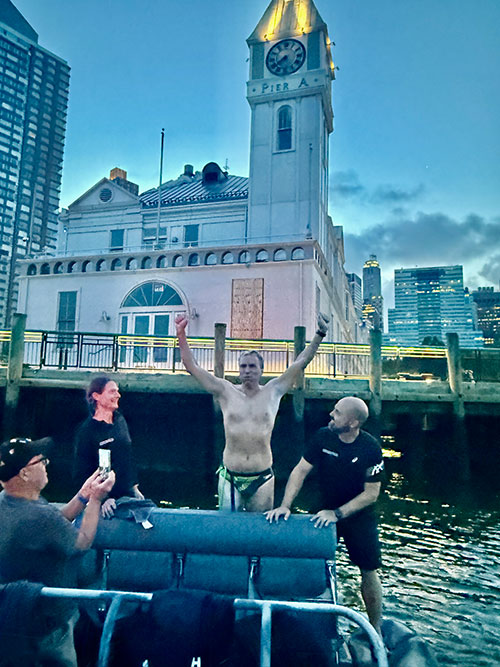
Gosens: Thank you. It was certainly an interesting swim, since it was in many different parts. The first couple of hours were a bit choppy due to weather, and also ferries. Then the next portion, a lot of it was relatively smooth, but there were also the currents going through the Harlem River where you had to fight into the river as well as the depth of the water. Sometimes we were hitting a few rocks. Once we got to the Hudson, there was a bit of a push behind us. Then there was a bit of colder water, or as we say in Australia, less than warm. Towards the finish, it was nine hours, eight minutes and 47 seconds.
Velasquez: How did it feel when you knew you were done, when you finished it?
Gosens: Well, All the way there we were counting down the hours to go. And my body was in somewhat of a flow. There were some parts where we pushed hard. I can lift my arms really well, so that’s a good sign. Body’s recovered. I’m fairly good at recovering because of my history of endurance events.
As I said to the team when we finished the race, that was a halftime event. We’re now enjoying the spoils of the halftime entertainment, and now it’s moving on to what we call in Australia the premiership quarter, where you really have to dig in. This is the quarter that really counts. Right?
Velasquez: It was exciting to get the email from Anthony that you completed the swim.
Gosens: Most definitely. The swim around Manhattan Island provides a lot of confidence because it’s a lot further than what the English Channel is. But the English Channel is a very different beast in its complexity. It’s the challenge of the tides, the currents and the water temperature is a lot colder. So, there are significant impacts on the body with those two realms. So, it’s a step down in distance, but perhaps a double step in its complexities and the challenges of the English Channel.
In excess of seven and a half thousand people have climbed Mount Everest, whereas in the English Channel, it’s probably around about 2500. And you have to appreciate that the first crossing of the English Channel was done in 1853. So, it’s 100 years longer than what Everest has been climbed upon. So, it can show us the challenges, the complexities of crossing, and not because it’s distant, because of its cold and its currents.
Velasquez: I think you guys are going to do very well.
Gosens: We have a great team. It’s an awesome team, and great teams make the dream work. So, It’s about that team pulling together. And then they’ve all played very different parts.
And look, I think for people in the US this is a great chance, now, to really lift open water swimming and to realize that while we did it in the dark, there are some great opportunities for people in the day. So, give it a crack. Maybe even have the first blind and low vision relay team, a team of four or five people, and let’s really pick it up in the US.