















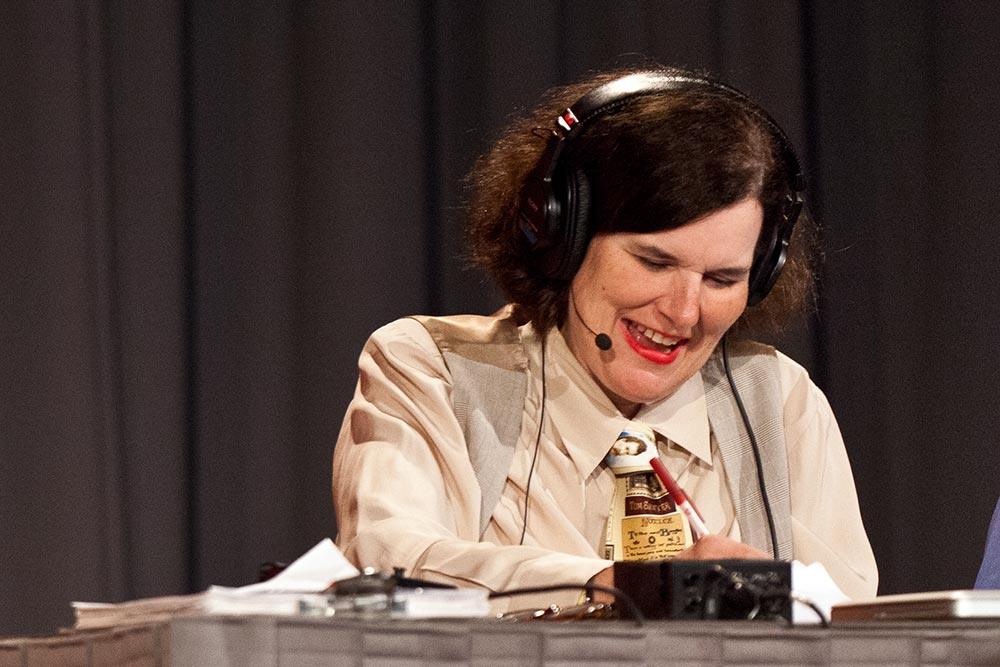
Paula Poundstone has never fit neatly into a box—and that’s precisely what makes her so compelling. With a career that bridges stand-up comedy, radio, voice acting, and activism, she’s carved out a place as one of America’s most authentic and quick-thinking comedic voices. Whether riffing on stage or bantering with fellow panelists on NPR’s Wait Wait… Don’t Tell Me!, Poundstone’s humor is rooted in curiosity, compassion, and an unmistakable edge of irreverence.
ABILITY Magazine’s Chet Cooper and Jennifer Woodall met with Poundstone in a virtual interview where she reflects on her early comedic influences, her dynamic with live audiences, and the delicate dance between improv and prepared material. She opens up about her experience voicing characters in Inside Out and the challenges of remote auditions in today’s entertainment landscape. The interview also touches on more personal ground—her journey with OCD, her admiration for Robin Williams, and even a solo protest march in Santa Monica. True to form, Poundstone balances the funny with the heartfelt, delivering an honest look at the complexities behind the comedy.
Jennifer Woodall: So, I saw your academic references on your website, and it seems that as early as kindergarten, you were cracking jokes. Was there a definitive moment in your life when you decided that you wanted to pursue comedy as a career?
Paula Poundstone: I wanted to be from the time I was very young. Probably, honestly, because of Mrs. Bump my kindergarten teacher. Also, we had a neighbor that used to say to me, “Oh, you’re a comedian.” when I was really little, and I didn’t even know what the word meant. I wasn’t familiar with stand-up when I was young. I wanted to be Carol Burnett or Lucille Ball or Lily Tomlin or Gilda Radner. Honestly, when I was real little–maybe even a young adult–I didn’t even know that Johnny Carson was reading off cards. So, I was pretty naive about what stand-up was.
Products & Services


Woodall: Great. You’re on tour now, right?
Poundstone: I’m always on tour.
Woodall: I was looking at your schedule, and it seems pretty grueling to me. You’re traveling everywhere. Can you talk about what it’s like being on tour?
Poundstone: I mean, It’s the good news and the bad news. I love my job. Standing in front of an audience, telling one’s little jokes, laughing with people is so much fun. The travel part, it’s a little not always great, but lucky to be able to do it. Since COVID hit, there’s not as many flights as there used to be, and when I’m traveling, I need to have a plan B. What would I do if the flight that I’m on is delayed or canceled? So, I need to travel at a time when if one didn’t work, I could get to another. Therefore, since COVID, I do a lot of flying overnight. For at least half a week, I’m a bit of a zombie, except for when I go on stage. It’s the weirdest thing. I feel like my teeth know how to do my job, so no matter how tired I am, I go do that. That’s really the only hard part. Outside of that, it’s really a dream job.
Woodall: You’ve been a panelist on Wait Wait…Don’t Tell Me! for over 20 years now. I know that they’re both comedy-based, but can you talk about what the difference is between being a panelist on a show and then doing a stand-up show?

Poundstone: Oh, it’s a world of difference. For one thing is that I am working with other people on Wait Wait…Don’t Tell Me! For those who aren’t familiar, it’s a weekly news quiz/comedy show made by NPR on public radio stations on the weekend. I’m not on every week, but on the weeks that I’m on, I sit on a panel of three people. There’s a host named Peter Sagal and an announcement scorekeeper named Bill Kurtis, and they have different little games that they play. Sometimes it involves somebody who calls in, and we answer questions about the week’s news. The panelists, of which I am one, we are not scripted. We answer the questions and make jokes just off the top of our heads. That part is great. It plays to perhaps a strength of mine, which is they pitch me something and I swing at it. Sometimes, by the way, I miss, and every now and then I get a piece of it. That works great for me. Of course, doing stand-up, it’s just me standing on stage, telling my little jokes, talking directly to the audience. That is one big difference, is that when I do stand-up, I can talk directly to individuals in the audience. Wait Wait…Don’t Tell Me! has a live audience, usually, but that live audience is watching us make the radio show, so you don’t talk directly to them, except for during the breaks. They’re both fun.
Chet Cooper: In your stand-up, then, if I heard you correctly, you’re doing improv with the with your crowd?
Poundstone: Yeah, I don’t call it improv. I’m having conversations. In fact, it’s very similar to when we have a conversation, or if you have a conversation with a stranger, or even with a friend you bump into on the street. There’s a certain structure to it. “How are you?” “I’m fine.” Whereas most of us probably don’t really feel fine, but that’s how you begin. Then you might talk about things that are current, that are happening right around you, or somebody may ask you to tell them something that you’ve told before. There’s a certain structure to it just because we’re human beings and we have a form of communicating. My point is, every conversation that you have, no one says, “Oh, I had an improvised conversation with my neighbor today.” Some people are like, “Oh, how do you do that?” I go, “We do it all the time.” Everybody does it.
Cooper: I think the difference is people are expecting you to come back with something that’s witty and funny. That’s the difference in just pure communications. I was involved in National Lampoon for a little while, and a lot of the writers would try to do stand-up, and they were great at writing, but they were awful at stand-up. They tried to rehearse the materials, but they couldn’t communicate with the audience. I’m sure you’re aware of what I’m talking about with a certain stand-up, how you just practice what you practice, but they’re not comfortable with that off-the-wall interchange with humans.
Poundstone: Honestly, the difference is you have to learn to do stand-up comedy. You could be the most brilliant writer in the world, but if you don’t take the time to learn to do it, which requires some bombing. If I consider myself a brilliant writer and I work for National Lampoon, and I’ve had great success there, it might be really hard to go out and eat in front of a crowd because I thought of myself as such a brilliant writer, and now it somehow appears that I’m not. But that’s not true. It’s that you haven’t learned this form of delivering what you’re writing, and that just takes time. I was going to say it’s easier to do when you’re younger, but that is not a science-based statement. I don’t know that it’s easier to do. I just feel like when I was a kid, somehow, I can get kicked around a little bit better than I can now.
Cooper: You knew Robin Williams?
Poundstone: Yes.
Cooper: I was talking to Jay Leno once, and we were talking about stand-up, and I mentioned Robin Williams, and I said something like how much he just adlibs and what he does. He said, “No, he’s just got a bigger bag of material to pull from.” Is that your view? That even people like Robin Williams that seem to be just spontaneous have rehearsed some of the humor at some point in time?
Products & Services

Poundstone: I don’t know the answer to that. I know that in some way that I do. There are times, for example, if I’m talking to an audience member, I generally do the time on where they’re from and what they do for a living. If I ask them what they do for a living and they say “I’m a nurse,” I might ask them a couple of questions about their job. Then more often than not, I would get to the point of saying, “Look, when my kids were in the hospital, the nurse always came in and thopped the machine when a beeper went off.” And then I would talk to them about that. I’ve had that conversation and made jokes about the nurse thopping the thing beeping many, many times–I guess I would call it a piece of material–and if it’s germane to the moment, that’s when I pull it out of the bag. There are some conversations that I have with audience members where everything that gets said is unique just to that night in that conversation, maybe because the circumstances that the person is telling me about themselves, I just don’t have anything about. Or also, I don’t always remember what I’ve said before, and I like it that way. My point is, I move in and out of things that are pieces of material and things that I just thought of there in the moment and will never be said again. I think Robin probably did the same thing. Honestly, I never asked him about it, but it makes sense to me that that’s probably what he did. Otherwise, he couldn’t have made his stand-up specials, because I can guarantee you that what he couldn’t do–because no one could do it–is stand on stage and think up in that moment everything they’re saying. So, my guess is it was all a lasagna. It was a little bit of this, layer of that, layer of that, and part of Robin’s brilliance–and he was brilliant–was also the energy with which he did it. I always tell people, anybody my age or older doing stand-up owes Robin Williams a debt of gratitude because he almost single-handedly reinvigorated audience interest in stand-up comedy. The way he did it was with that frenetic energy. I mean, there were obviously stand-up up comics since we came out of the caves, or maybe since before we came out of the caves, but Robin really made people excited to hear stand up again. Also, he showed up in every club. Robin could be working a 3,000-seat amphitheater in Cincinnati, and somewhere after that show, he would show up at Uncle Fannie’s Yuck House and play to 50 people. He just loved to perform. He was a bit of a stimulation junkie, and what happened, therefore, was during that really big explosion of the comedy club thing in the ’80s, people would go to comedy clubs hoping they might see Robin Williams. And guess what? A lot of times they did.
Cooper: Back to Wait Wait…Don’t Tell Me!, can you remember a question that you stumbled on, that you knew the answer, but you said something that you still today think of as, “How the heck did I answer it like that?”
Poundstone: Oh, I can’t remember specifically, but trust me, I’ve answered a lot of things wrong. In fact, there’s a guy named Linh Pham who keeps the stats on Wait Wait…Don’t Tell Me!. It’s just something he started doing on his own. He’s a fan of the show, and he makes a little entry into a journal. He’d make an entry about every episode of Wait Wait…Don’t Tell Me!. and so, he kept track of how many wins someone had. I believe I’m still in first place for most losses. It’s funny. I was doing the show a couple of weeks ago in Orlando–usually, the show is headquartered in Chicago, but about once a month, they’ll go to a different city and perform in front of the audience there–so we were in Orlando, and a scholar called in to do the Listener Limerick Challenge. Now, the guy who writes these limericks is so damn brilliant. He writes a limerick, and there’s a blank left in each. The limerick is about a current events news story. It could be a news of the weird story, or it could be a more mainstream known story, but the last line where there’s a blank, the word is going to rhyme with two other words in the limerick, because that’s how limericks are written. Therefore, there’s multiple clues. It’s pretty hard to get it wrong. The audience in the theater is listening along, and they generally know the answer by the time Bill reads the limerick because, again, it’s pretty hard to get it wrong. I can’t tell you how many times I’ve been there as a panelist, and particularly this recent time in Orlando, where the poor listener could not get the answer, and to everybody else, it seems so obvious. Everybody started to laugh like it’s funny that the guy is struggling, but the thing is, when you call in to a show or when you’re on the spot and you’re being asked in front of a lot of people–we have like 5 million listeners–people choke. That’s exactly what happens. It happens to me, too, especially in the lightning round where you’re supposed to go fast, and I’m not good at going fast. What’s funny is most of the time, I listen to the questions asked of the other panelists, and almost 100% of the time, I know all their answer, but when it’s my turn, I choke. Not always, but often. I used to just keep in my back pocket two answers. For the longest time, I would tell myself, “Okay, no matter what happens, no matter what I think, if I’m struggling, unless I have the answer, unless I know for sure, I should just say Trump or lemurs down their pants.” There’s a lot of news of the weird on, Wait Wait…Don’t Tell Me! and sometimes, honestly, I’m proud that I don’t know those answers. There’s tons of smuggling stories. Who knew? Who knew so many people smuggled? And smuggled in really weird stuff, and often down their pants, coming through the TSA. It’s funny, with all those stories, I never once have seen somebody pulled aside by the TSA. Never once. And I travel a lot. But they’ll be pulled aside because they have lemurs in their pants. Who would do that? And what lemur would agree to it?
Woodall: Maybe Wait Wait…Don’t Tell Me! is starting to get the word out so people are being more cautious and putting them in other parts of their clothing.
Poundstone: Yeah, you’re exactly right. They could be getting a heads up. Maybe they’re complicit. Maybe they’re getting a kickback from from illicit lemur sales.
Woodall: Do they ever cut bits out for time from Wait Wait…Don’t Tell Me!?
Poundstone: Oh, Yes.
Products & Services

Woodall: Do you have a favorite one that got cut?
Poundstone: Oh, even if I listened, I wouldn’t probably know what thing got cut because I just have a terrible memory. So generally speaking, once it’s out of my mouth, it’s gone. When I listen to the show, it all makes sense to me. I’m like, “Yeah, that’s how it happened,” but indeed, they do edit for time. Peter always mocks me because I talk a lot. When I do a stand-up show that’s just me, it’s about two hours, and by the way, that’s an effort to keep it under two hours. So, Peter’s always telling me that on the shows that I’m not on, the tapings are much shorter, so I’m convinced that they have a computer program that automatically cuts when it hears my voice. Because trust me, there’s lots less of me on every show that was broadcast than was during the live show.
Cooper: The poundstone filter.
Poundstone: Yeah, everyone should have one. If my kids find out about it, they’re getting that.
Woodall: If it’s recorded in front of a studio audience, then the audience is privy to extra Poundstone content.
Poundstone: They are. The studio audience is often privy to extra everybody content because there’s stuff that they just wouldn’t air on NPR. We can’t sully the name of a really important service. I think most of us try to honor that to begin with, but there are times where we’ll say stuff and we’ll look at the audience and go, “Okay, this will not be on the show,” and then we’ll say whatever it is we feel like saying. By the way, NPR is an important service because it’s a trusted news source, and even recently, it’s up on the chopping block. It’s been up on the chopping block so many times over the years, but now with Musk, it’s really up on the chopping block. So, they had a hearing about it the other day, and they have statistics–in a world that is so divided–they have really good percentages of people who say they trust both NPR and PBS. In a world where we don’t all believe the same things at all at the same time, I think that’s pretty impressive. And having a strong news source right now is so important. So good for them, and I’m also glad they let us make our little jokes. It always unnerves me when people say to me, “I listen to Wait Wait…Don’t Tell Me! to get my news.” Anytime anybody says that to me, I go, “Oh, don’t do that. Listen to Wait Wait…Don’t Tell Me! because it’s funny. If we bring up a news story, as we do, that sparks your interest just by golly, look it up!” We are not a news program per se, and especially now at this critical time, you need to be getting your news from really solid news sources.

Woodall: If they aren’t getting news from anywhere else, they’re going to think the world is just chock full of people with different things down their pants.
Poundstone: Yes, exactly. It’s just not the right format. I mean, I’ve learned a lot from doing Wait Wait…Don’t Tell Me!, but it’s usually odd little factoids and not necessarily big things. I feel strongly that it is an entertainment program and that people need to get their news, at least from a more massive news source. I mean, even when we bring up real subjects, nobody’s lying, but there’s not a deep well there when we’re talking about it. We’re just making jokes. Sometimes we’re making jokes because if you didn’t laugh, you’d cry. Other times we’re making jokes about something that’s real, like someone smuggling lemurs down their pants that isn’t really important. Again, I often take great pride in not knowing the answers to those ones.
Woodall: Throughout your career, you’ve done different voice acting gigs as well, with the most recent one being in Inside Out, and Inside Out 2 I’m curious to know how the recording process has changed since you started.
Poundstone: Oh, first Inside Out, I went to Pixar to record, and did it in a booth. My partner Bobby Moynihan and I both played little characters called Forgetters. As people will remember about Inside Out, it’s a story that features characters in a girl’s brain. Both movies are very timely, funny and they’re broadly science-based. The characters are playing emotions, but they’re also talking about things that happen within the brain, like how the memory works. They may have simplified it a little bit, but Bobby and I we are blue collar workers within this kid’s brain that do the forgetting. We decide which memories to throw away–which is ironic given how much I struggle with memory problems. When I recorded, Bobby was in a booth, I was in a booth, we had headphones on, we could hear each other–I think that’s the way it’s been done for a long time–but for Inside Out 2, I recorded not at Pixar, but at a studio here somewhere in LA, and the director was back at Pixar. He was on a screen, and we use the services of the recording studio here, which I assume is different than how they would have done it a long time ago. The thing that has really changed, and there’s good news and bad news to it, is the audition process. I do a lot of auditioning for voice stuff, and they send you what’s called the sides, which are a couple of pages of the script that they’re having you audition with, so it’s not the whole script, it’s just a couple of pages, and they send you a written description of the character. If it’s for an animated thing, if they have it, they might send you the picture of how that character is being animated, and then you record by yourself. I mean, I just do it on my silly, stupid flat phone, and there’s no one reading lines with you, so you’re not responding to anything. I find it such an awful way to do it, and then you send that in. Not only that, but even if you’re auditioning for a movie or a television show with real people, not an animated one, they still have you do it at home now. And the same thing–no one is reading lines with you. You’re just saying the lines, but my house is not a studio. I am not a camera person. I can’t create a set. I don’t have lighting in my house. It’s just so stupid. The good news is that I’m not driving around Burbank trying to find a parking space and trying to go into a casting office somewhere that I had never been before and get lost. That part I don’t mind. But how anybody makes that audition work is well beyond me. I feel like I need to have a crew come in and help me audition.
Woodall: When you don’t have the energy exchange of being able to feed off of another person, that seems like it would be really hard.
Poundstone: It is really hard. The truth is, auditioning sucks. Casting agents–and I don’t know if they all have an agreement to do it this I would assume so–casting agents are notorious for when they read with you, when they’re doing the other people’s lines that you’re interacting with, they don’t put a lot of punch behind it. It is bland, but at least it’s something. Otherwise, you’re Sybil. I mean, you’re pretending that you heard something. I don’t know, I find it weird. It’s not a way that works for me. However, again, I do enjoy not having to park.
Products & Services

Woodall: Yeah, that’s a big plus. I would like that part, too.
Poundstone: I did some news thing not too long ago promoting the show that I was doing, and I had to go somewhere in Los Angeles. I go into a parking garage, and I was trying to be prompt, a lot of traffic, all those things, but I get into this parking garage, and I was a little bit tight for time, not late, but a little bit tight for time. So, I park my car, and I make my way to the studio, and I realized when I’ve finished doing the interview and I change clothes and head back to my car that I totally forgot to make note of where I parked. It was so awful. I spent an hour walking around, and it’s the parking garage kind where there’s different angles of different floors, and you’re not quite sure what floor you’re on. I finally figured out that I could push the clicker and make the car beep, but here’s the problem, it’s very echoey in a car garage, and I couldn’t tell what direction the beep was coming from. So, it made it worse, not better. So not parking is really a happy part of my day. If I get to the end of the day and I go, “I didn’t have to park at all today,” that is a win.
Cooper: Paula, do you think you have ADHD?
Poundstone: It’s not out of the question. I mean, not that I’m familiar with. I have OCD. I do have letters. What I was told when I was diagnosed years ago was that everyone has OCD, it’s only diagnosed based on the degree to which it interrupts your life, and the point at which it was interrupting my life was pretty paralyzing sometimes. The way it works with me–and I don’t think they know nearly enough about it to begin with–but the way it works with me is a little bit like cicadas. It’ll go away for a long time, and then it just comes out again. I mean, in the case of the cicadas, I guess we know why they go underground and then come out. In the case of OCD, I don’t really know what makes it resurface and what makes it stay at bay. I just try to creep around quietly, hoping I don’t wake it.
Cooper: When it does appear, how does it manifest?
Poundstone: A couple of things. One is that I tend to find a person that I become so enamored of that I can only think of the world through what I perceive to be that person’s opinion–that’ll slow you down, let me tell you–and all I can think about is that person and wanting their approval and what they would think of what I’m doing. When I was young and didn’t know that that’s what was happening, I just thought it was a perfectly natural thing at the time. I suppose it is natural, but it’s not healthy. When I was young and I would be stuck with that, I would constantly be in contact with the person because I didn’t know. I just thought that I liked them. It really has nothing to do with liking. It has to do with OCD. It also made packing really hard for some odd reason. I did go through a little period of time where I was given some medication for it. At the time, I was still drinking, and it said on the medication bottle something like: “be cautious drinking.” I always say to people, “I was being so cautious,” but I was still drinking, and this medication and alcohol interact–there was something good about it, and it’ll take you a second to figure out why–but the medication and the alcohol interacted, and what it did was exacerbate the OCD. There was about a week where I had to either walk backwards or like a knight in chess, and if I was walking at all, I had to be close to a wall. It’s weird stuff, really weird stuff. What’s good about it is that before, the OCD was just a nagging thing that would happen to me. When this happened, it was like, “Oh, my God! That’s what it is.” Whereas before, I wasn’t really sure. Maybe it was, maybe it wasn’t. Now I’m like, “Oh, no, that’s what it is!” It really highlighted the areas in my life where it was OCD and not just personal choice. Once I understood what was OCD and what was not just personal choice, it actually was really freeing because then I can bow to this or not bow to it, but I know what it is.
Cooper: When you said packing, you meant when you take all your trips?
Poundstone: Yeah, it’s a big part of my life. Every now and then my suitcase breaks down and I have to get a new one. I’m telling you, it’s like moving to a new home. You have a system. You just develop a system. They don’t make the suitcases the way they used to make them. Now I’m like, “No, but I need a pouch there.” I have to have my old pouch system.
Cooper: So if your OCD happens again, do you take meds or you just wait it through?
Poundstone: I haven’t been in that situation in a long, long time, thank goodness. I mean, not to that degree, anyways. I don’t think I would ever take that particular medication again unless, as I said, it is like cicadas where it goes underground and then it resurfaces. I suppose if it resurfaces to a debilitating degree, I might take that medication again. I quit drinking a thousand years ago, so that’s not any longer an issue. I’m not exactly sorry for that incident, though, because I feel like it really was an eye opener in that I could understand it in a way I couldn’t have otherwise. I don’t think anybody could have explained it to me, because that’s the other thing about OCD is it’s very eclectic. I don’t think we all have the same symptoms. Some may, but when it strikes, I don’t think it’s the same for everybody.
Products & Services

Cooper: Yeah. I spoke with Howie Mandel and definitely different symptoms for him.
Poundstone: Yeah. That’s part of the reason why Inside Out, those two movies are so goddamn great because the brain is just plain weird. We know so little about it and so little about sleep. I’m sure the two things are very closely related. And I have a schedule that I’m sure will be one of the things that does me in because–what do they call it? Sleep hygiene, a regulated sleep schedule is really important to a healthy brain. I have to get to my jobs.
Cooper: There are studies that indicate different people have different sleep patterns that work for them.
Poundstone: Oh, that’s good. I hope Cory Booker doesn’t have a backlash because he was up for 24 hours. I mean, the truth is we’ve all been up for 24 hours at one time or the other, but 24 hours talking intelligently…
Cooper: …and not drinking water. Yeah. He was dehydrated on top of that.
Poundstone: Oh, wow. I didn’t even think about that. You know what’s most impressive about it? I mean, I thought it was great that he broke Strom Thurmond‘s silly ass record, but what’s most impressive about it was what he was saying. He was saying that we’re in trouble and that this isn’t normal and that we’re talking about our democracy. And as he said towards the end, that of the materials that he used to speak, it was mined from both Democrats and Republicans. So, he wasn’t saying stuff that was somehow “out there,” and good for him. It’s time for courage. Now people need to take that inspiration and get out in the streets. I marched by myself in Santa Monica with a sign that said, “Stand up to Trump” on one side, and on the other side, it said “Stop the cuts, tax the rich.” I walked for two hours during rush hour traffic, up and back to the 405 entrance–which I’m sure you’ve heard of the famous 405. It’s busy. Who knows if it does any good, but we need to at least attempt to stop what’s going on here. I have a very close family member who is disabled and cannot survive without Medicaid and Social Security. I know that we are not the only family for whom that is the case, and so it’s hair on fire time.
Cooper: Do you have any pictures of you doing that solo protest?
Poundstone: I don’t because I only have two hands.
Cooper: Yeah, I know. I was wondering, maybe somebody came up and took one.
Poundstone: No, no. I walked by a handful of pedestrians, but I left the house at about 5:15. I got home at around 7:15, so it was mostly cars. I got what I believe to have been supportive honks. I got the handful of people going to the trouble of rolling down their window to flip me off.
Cooper: I’m sorry about that. I didn’t mean it. (laughs)
Poundstone: Oh, no. Oh, was that you?
Woodall: They’re just saying you’re number one.
Poundstone: Yeah, that’s what it was. I think it’s funny. I don’t see that well, if people are flipping me off from in their car–I got bad news for you. I got no idea what you’re doing. Maybe the people who bothered rolling down their windows to do it understood that I have some visual limitations.
Products & Services


Cooper: Switching subjects a little bit, what charities do you support?
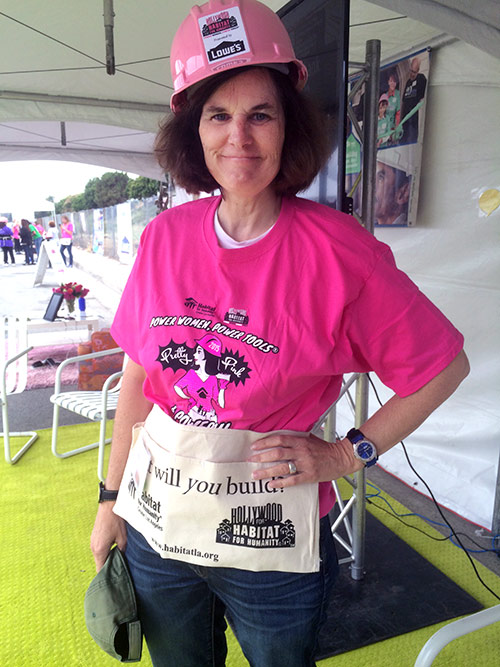
Poundstone: Lots. Right now, I think it’s important to back the ACLU. I give money to Habitat for Humanity, which I’ve also done a couple of builds with and is so damn much fun. It’s a great organization. The way they structure it for the people for whom they’re building the houses is that those people have to participate in building the house for a certain amount of hours or percentage of time or during the build. But what’s amazing, the first time I ever did it, I took my daughter with me, and she was pretty damn good at it, but they have all these volunteers, and they divide up into teams working on different parts of the build, depending on how far along the project is–this is building houses, what I’m talking about–and there’s a foreman for each of the teams. I asked this one foreman that I was working with, and I had a thousand questions in terms how to do what I was doing, and this person had all the answers. They were like, “No, you want to do it like this.” “No, it works better like this.” “Okay, and then this is going to go here.” And I said, “Well, how did you learn to do this?” and she said, “Oh, I’ve been volunteering for years.” So, people have actually learned how to build houses by volunteering for all those hours at Habitat for Humanity. It’s just great.
Cooper: Through ABILITY House we partnered with Habitat for Humanity to build housing for families that have disabilities in the family, but we access volunteers with disabilities to build the homes too. The first house we built was in Birmingham, Alabama. We had one volunteer who had no arms, so he did everything with his feet. He would come out and use his feet to help build, use the tools or hammer to help somebody else in need, which was the greatest thing about giving. You’re aware it’s to help others.
Poundstone: That’s amazing. Someone that I love that is disabled, and I have taken them a couple of times to adaptive sports things, and one of the things that I’m struck by–and I feel this when I’ve watched the Paralympics as well–is that you’re watching people who are athletes all the time. You have to be an athlete to get in and out of a wheelchair. You have to be an athlete. You’re an athlete all the time, now do athletics that are structured in a different way. The first time we went, we went to wheelchair basketball, and this person is not in a wheelchair–they have cerebral palsy, but they don’t have to be in a wheelchair. You have to sit in the wheelchair to play wheelchair basketball, but you do not have be wheelchair bound, which I never understood before. So, she’s trying to figure out the wheelchair thing, and the first time she got in the chair she was practicing shooting baskets. The majority of the other people that were playing that day were indeed wheelchair bound, perhaps not all, but most, and she was a first-timer, and the others had been there for a while. I say to her, “I tell you what, I’ll rebound for you.” I step out on the court and she shoots a couple of baskets, and at one point, the ball bounces off my fingers and jams two of my fingers. I’m hopping around in pain and I have to sit down. Then eventually, the game starts. Now she’s in this game, and there’s all these people. There were kids that had unfathomable disabilities out there with huge smiles on their faces, playing wheelchair basketball. There were adults, and the same thing, all these guys with no legs, playing wheelchair basketball. One of the guys falls entirely out of his wheelchair and has to be put back in. Do you know, I was the only injury of the day?
Cooper: Did they wheel you out in a wheelchair?
Poundstone: Oh, my God. I thought they were going to have to. It really hurts when you jam your fingers. I had a friend years ago that was a member of the first US women’s Olympic basketball team, and her fingers looked like tree roots. They went in every direction from years of jamming her fingers playing basketball. But anyways, it was just such a thing to see all these people playing.
Linh Pham’s Wait Wait…Don’t Tell Me! stat page: https://stats.wwdt.me/